Table of contents
Laminate Flooring Installation Overview
| Item | Details |
| Difficulty | Intermediate DIY |
| Estimated Time | 3–5 Hours |
| Room Types | Bedrooms, Living Rooms, Hallways |
| Not Suitable For | Bathrooms & Wet Rooms |
| Acclimatisation | 48 Hours |
| Expansion Gap | 10mm |
Tools Required:
- Tape Measure
- Spacers
- Pull Bar
- Jigsaw
- Underlay
- Tapping Block
Before You Start:
✔ Subfloor is clean
✔ Subfloor is level
✔ Flooring acclimatised for 48 hours
✔ Underlay ready
✔ Door clearances checked
This guide explains how to install laminate flooring step-by-step, including both straight plank and herringbone installation methods.
Straight plank flooring is faster and more beginner-friendly, while herringbone flooring requires more precise planning and cutting. Whether you are fitting laminate flooring in a single room or laying laminate flooring throughout your home, proper preparation and accurate installation help ensure a durable, stable and professional-looking finish.
Before You Begin Laminate Installation
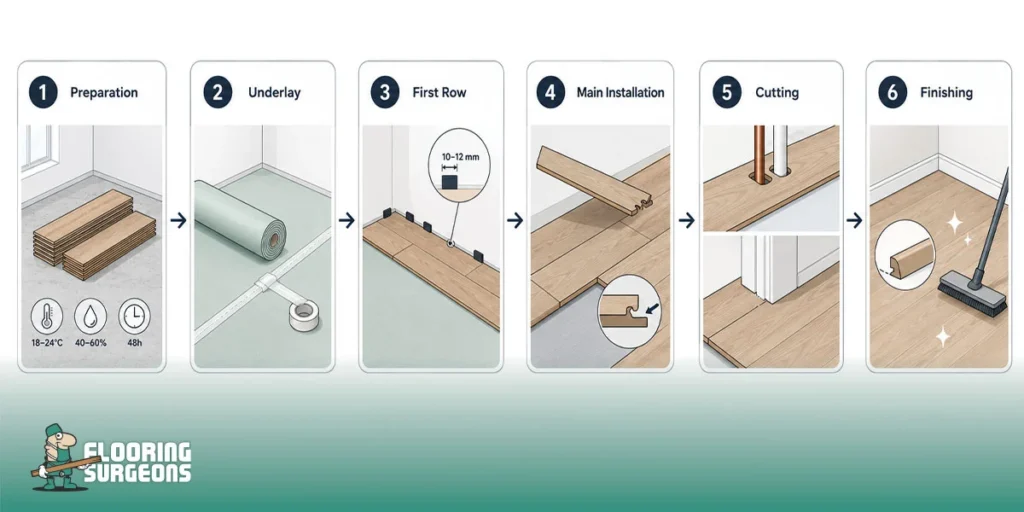
Proper preparation is essential for a successful laminate flooring installation. Before fitting begins, ensure the room conditions, flooring packs and subfloor are fully prepared.
Suitable Room Types
Laminate flooring is suitable for:
✔ Living rooms
✔ Bedrooms
✔ Hallways
✔ Dining areas
Use extra caution in kitchens and avoid bathrooms or wet rooms.
⚠ Laminate flooring is water-resistant, not waterproof.
Check Flooring Packs
Before installation:
✔ Inspect all planks for visible defects
✔ Check colour consistency between packs
✔ Ensure boards are undamaged before fitting
Do not install damaged planks.
Prepare the Subfloor
The subfloor must be:
✔ Clean
✔ Dry
✔ Level
✔ Structurally stable
Repair uneven areas using:
- Self-levelling compound
- Levelling boards
⚠ Uneven subfloors may damage locking joints and cause movement.
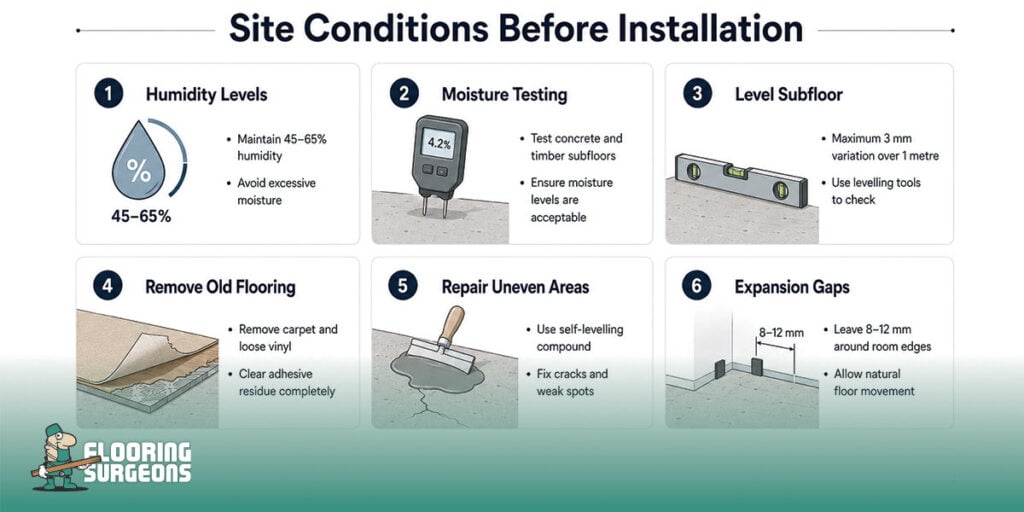
Site Conditions Checklist
Before installation:
✔ Moisture levels checked
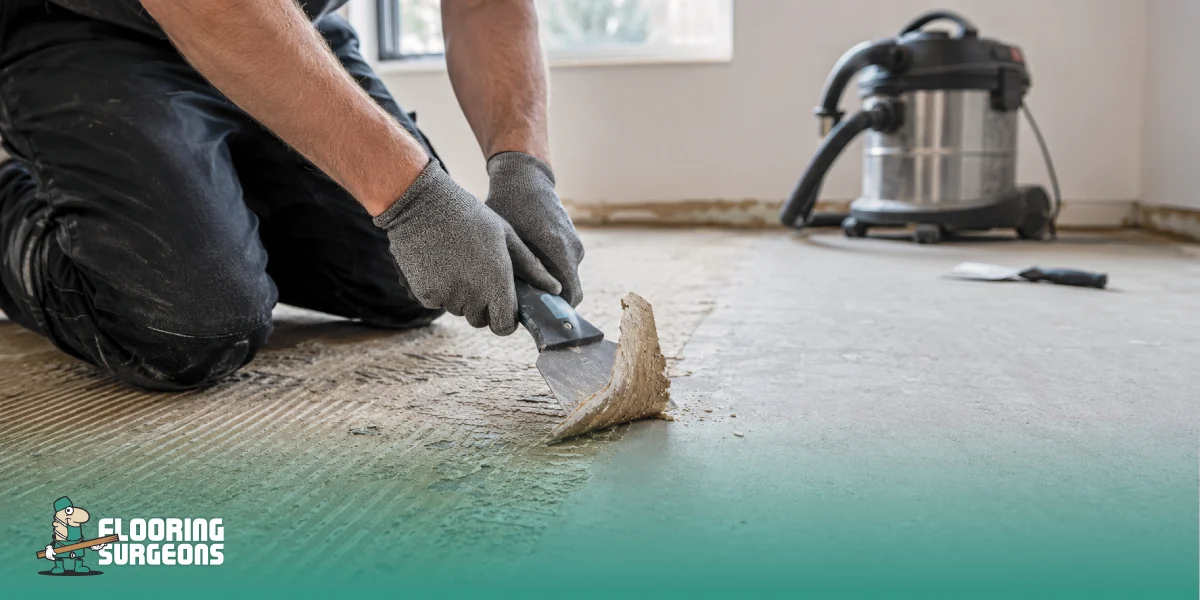
✔ Adhesive residue removed
✔ Loose boards repaired
✔ Cracks filled
✔ Expansion gaps planned
✔ Room temperature stabilised
Allow laminate flooring to acclimatise in the room for at least 48 hours before installation.
Acclimatising Laminate Flooring
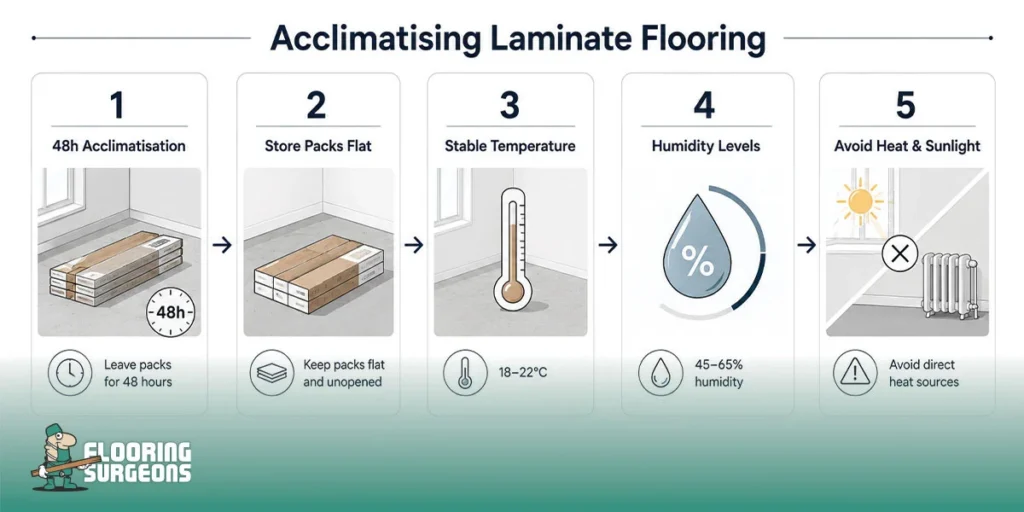
Proper acclimatisation helps prevent warping, lifting and gaps after installation.
Before installation:
✔ Leave flooring in the room for at least 48 hours
✔ Keep packs flat and unopened
✔ Maintain a stable room temperature
✔ Avoid direct sunlight and heat sources
Recommended conditions:
– Temperature: 18–22°C
– Humidity: 45–65%
– Expansion gap: 8–10 mm
⚠ Do not stack packs vertically during acclimatisation.
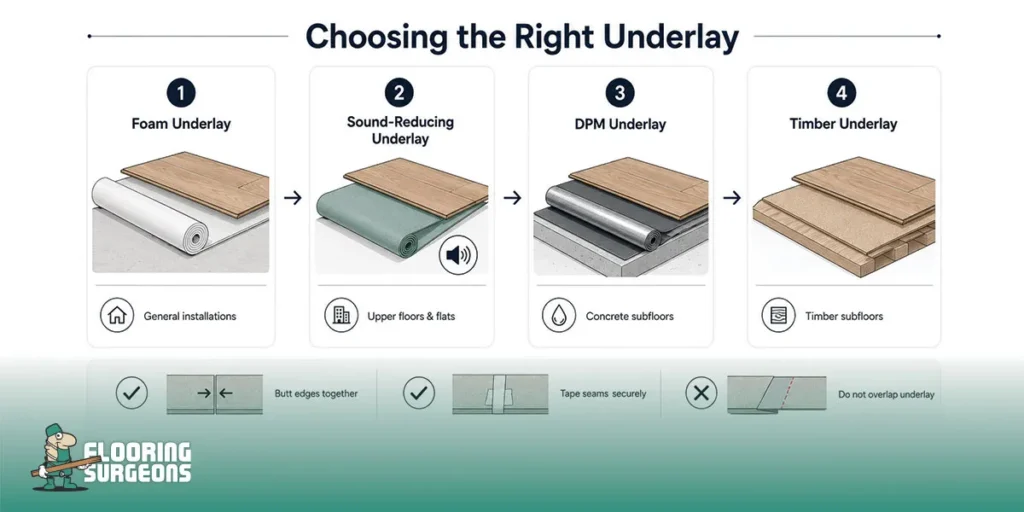
Choosing the Right Underlay for Laminate Flooring
The correct underlay improves comfort, sound insulation and floor stability.
Recommended options:
✔ Foam underlay for general installations
✔ Sound-reducing underlay for upper floors or flats
✔ DPM underlay for concrete subfloors
✔ Wood-specific underlay for timber subfloors
Before installation:
- Butt the underlay edges together.
- Do not overlap sections.
- Tape all seams securely.
Recommended underlay thickness:
- 2–3 mm for most laminate flooring
⚠ An Underlay that is too thick may weaken locking joints.
Measuring a Room for Laminate Flooring
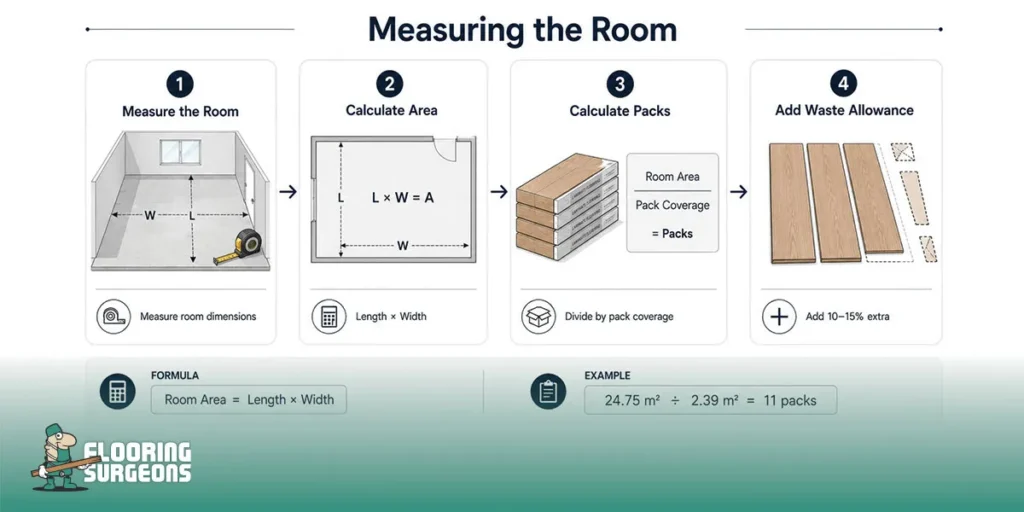
Before installation, calculate the total floor area in square metres (m²). This is one of the most important steps in How to measure a room for flooring accurately before ordering laminate flooring packs.
Calculate Flooring Packs
- Measure the room length and width.
- Multiply to calculate the total area.
- Divide the area by the pack coverage.
- Round up to the nearest full pack.
Example
- Room size: 24.75 m²
- Pack coverage: 2.39 m²
- 24.75 ÷ 2.39 = 10.3
✔ Required packs: 11
Recommended waste allowance:
- Straight plank laminate: add 10%
- Herringbone laminate: add 10–15%
⚠ Always order extra material for cuts, waste and future repairs.
Accurate measurements are essential when installing laminate flooring, as ordering the correct number of packs helps reduce waste, prevent delays and ensure a smoother installation process. Proper planning is also one of the most important first steps in learning how to lay laminate flooring successfully.
General Tools Needed for Laminate Flooring Installation
Measuring Tools
| Tool | Purpose |
|---|---|
| Tape Measure | Measure room and plank sizes |
| Straightedge Ruler | Guide straight cuts |
| Set Square | Ensure accurate angles |
| Pencil | Mark cut lines |
Cutting Tools
| Tool | Purpose |
|---|---|
| Jigsaw / Circular Saw | Cut laminate planks |
| Utility Knife | Cut underlay |
| Drill | Create pipe cut-outs |
| Undercut Jamb Saw | Trim door frames |
Installation Tools
| Tool | Purpose |
|---|---|
| Tapping Block | Join planks safely |
| Pull Bar | Tighten end joints |
| Rubber Mallet | Tap planks into place |
| Spacers | Maintain expansion gaps |
| Underlay Tape | Secure underlay seams |
Safety & Preparation
| Tool | Purpose |
|---|---|
| Knee Pads | Comfort during installation |
| Moisture Meter | Check subfloor moisture |
| Clamps | Hold planks during cutting |
Straight Plank vs Herringbone Laminate
Choose the installation pattern that best suits your room layout, experience level and preferred finish.
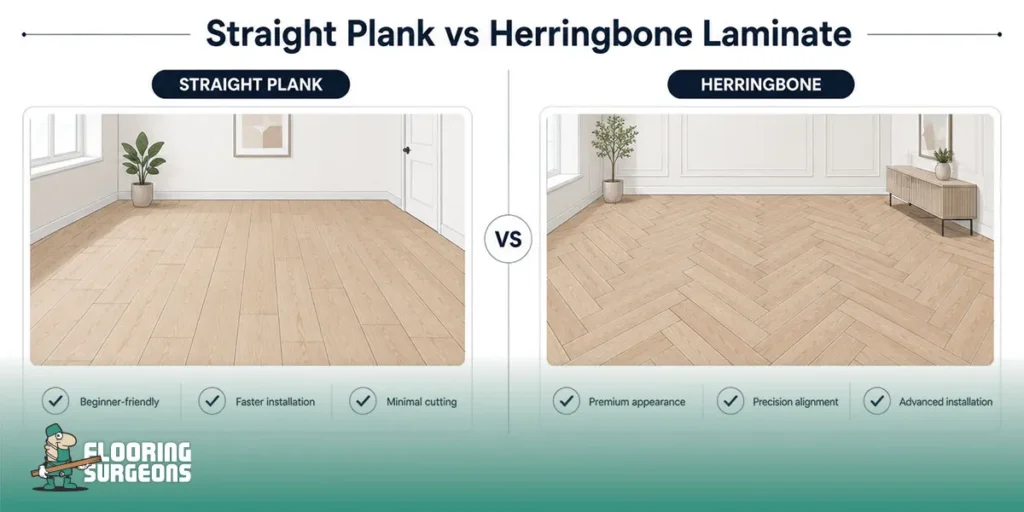
| Feature | Straight Plank | Herringbone |
|---|---|---|
| Difficulty | Beginner-friendly | Advanced |
| Layout | Parallel rows | Zigzag pattern |
| Installation Speed | Faster | Slower |
| Cutting | Minimal cuts | Angled cuts |
| Layout Planning | Simple | Precise alignment required |
| Material Waste | Lower | Higher |
| Skill Level | DIY-friendly | Experienced installers |
| Appearance | Clean & modern | Decorative & premium |
Tools for Straight Plank Installation
Straight plank laminate installation uses standard laminate flooring tools and is suitable for most DIY installations.
Recommended tools:
✔ Tape measure
✔ Spacers
✔ Tapping block and pull bar
✔ Rubber mallet
✔ Jigsaw or laminate cutter
✔ Utility knife
✔ Spirit level
⚠ Ensure all cutting tools are suitable for laminate flooring.
How to Install Straight Plank Laminate Flooring
Straight plank laminate flooring is the most common laminate installation method. It uses a staggered row pattern with planks installed parallel to one another using a click-lock system.
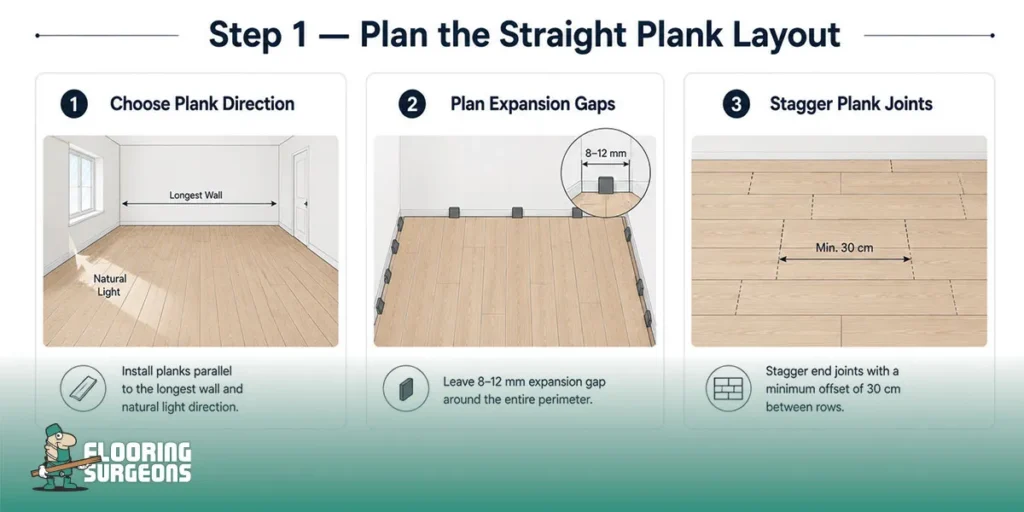
STEP 1: Plan the Straight Plank Layout
1. Choose the Plank Direction
Install planks parallel to the longest wall or main natural light source.
This helps create a cleaner and more balanced room layout.
2. Plan Expansion Gaps
Leave an 8–12 mm expansion gap around all walls, pipes and fixed objects.
Use spacers to maintain consistent gaps during installation.
3. Create a Staggered Pattern
Offset plank joints by at least 30 cm between adjacent rows.
This improves floor stability and creates a more natural appearance.
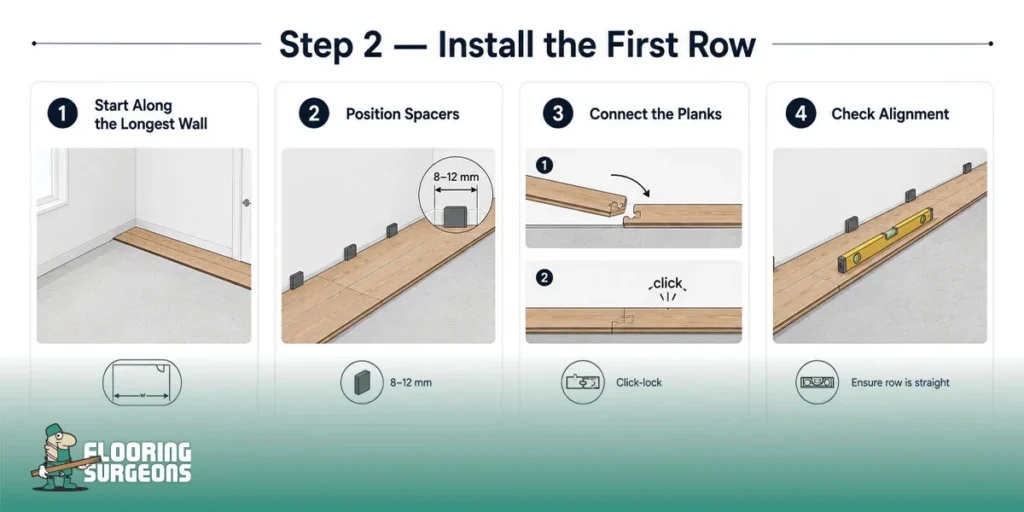
STEP 2: Install the First Row
1. Start Along the Longest Wall
Begin installation along the longest wall.
Trim the tongue edge if required to create a clean starting line.
2. Position Spacers
Place spacers between the planks and wall to maintain an 8–12 mm expansion gap.
3. Connect the Planks
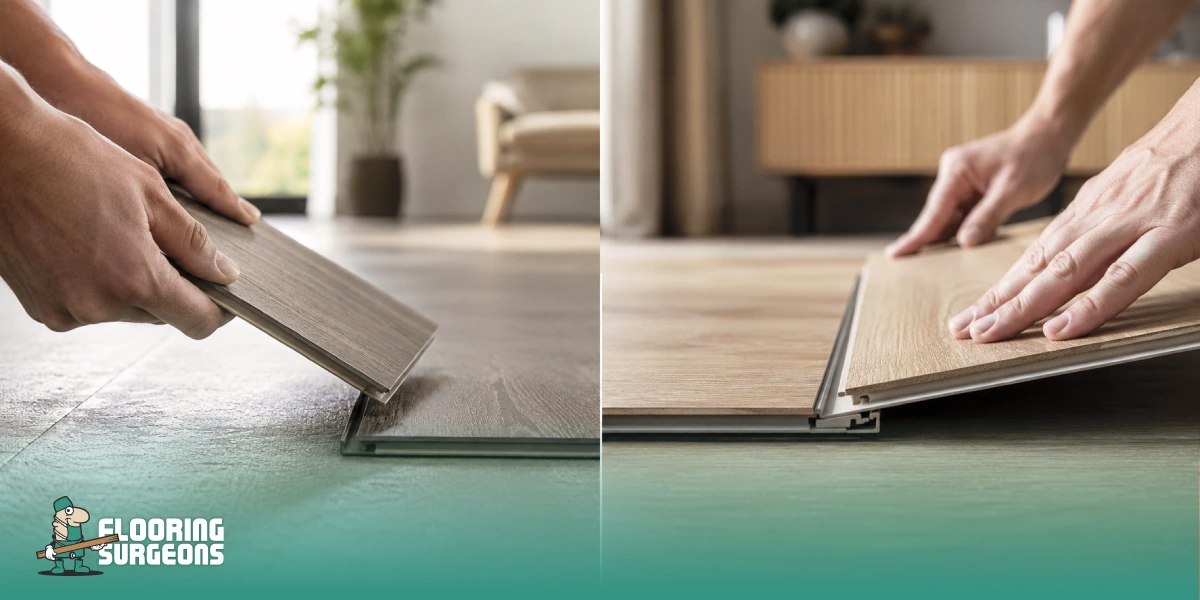
Angle and click the planks together using the locking system.
Ensure all joints are fully connected.
4. Check Alignment
Check the first row regularly using a straightedge or spirit level.
Correct alignment issues before continuing.
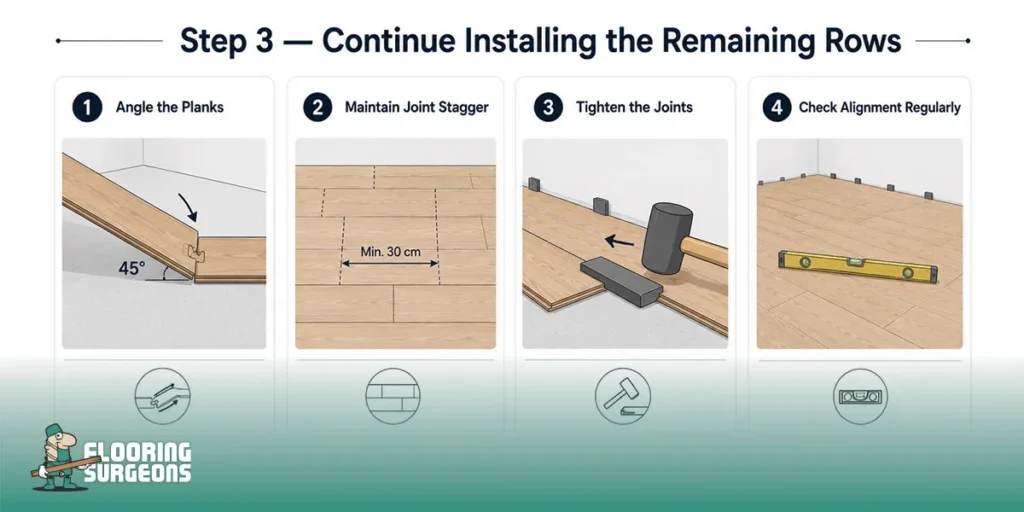
STEP 3: Continue Installing the Remaining Rows
1. Angle the Planks
Insert each plank at approximately 45° before lowering it into position.
2. Maintain Joint Stagger
Keep plank joints staggered by at least 30 cm between rows.
3. Tighten the Joints
Use a tapping block and rubber mallet to tighten joints gently.
Do not strike planks directly.
4. Check Alignment Regularly
Check row alignment regularly to prevent gaps and uneven spacing.
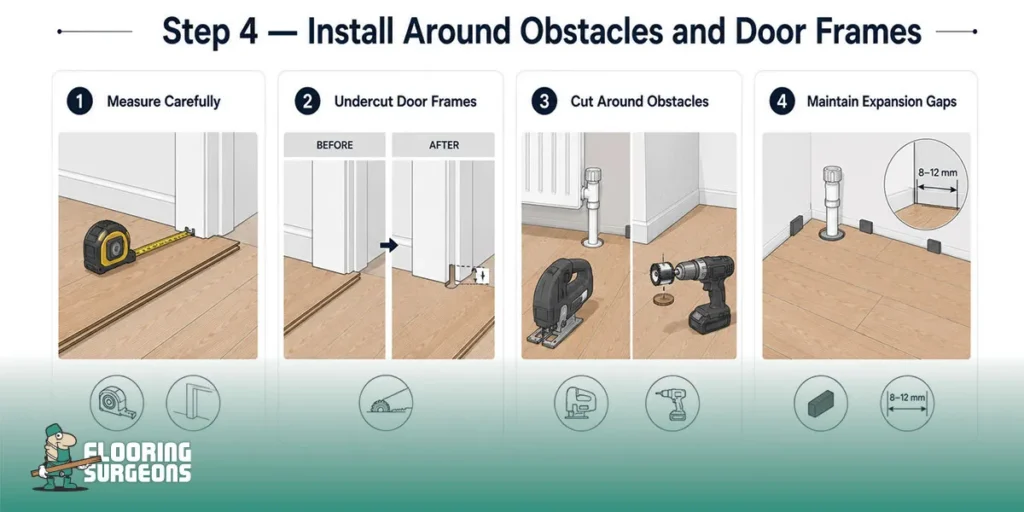
STEP 4: Install Around Obstacles and Door Frames
1. Measure Carefully
Measure accurately around pipes, corners and door frames before cutting.
2. Undercut Door Frames
Undercut door frames so laminate planks can slide underneath cleanly.
3. Cut Around Obstacles
Use a jigsaw or drill to create clean cuts around pipes and corners.
4. Maintain Expansion Gaps
Leave expansion gaps around all fixed objects and walls.
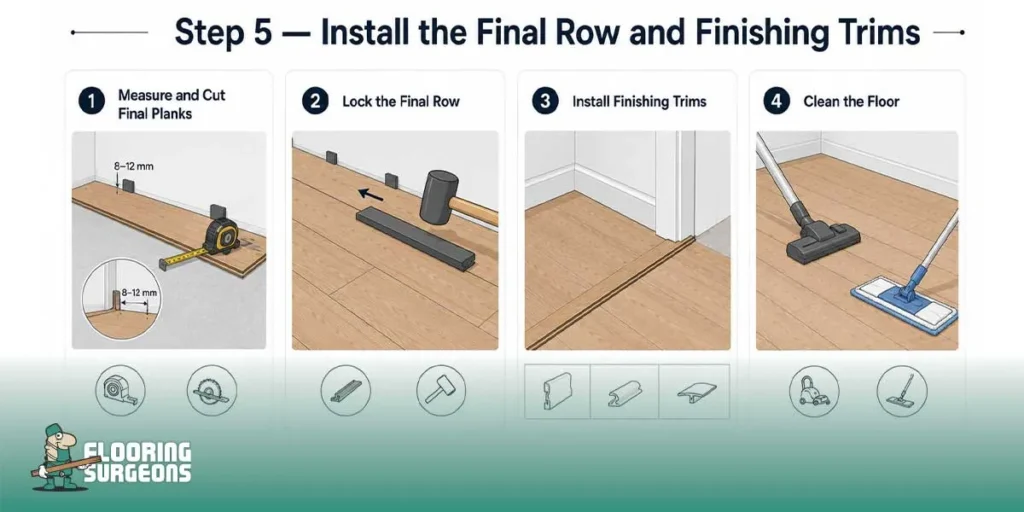
STEP 5: Install the Final Row and Finishing Trims
1. Measure and Cut Final Planks
Measure the remaining space carefully before cutting the final row.
2. Lock the Final Row
Use a pull bar to secure the final row tightly in place.
3. Install Finishing Trims
Install skirting boards or trims to cover expansion gaps.
Do not fix trims directly to the flooring.
4. Clean the Floor
Remove dust and debris using a vacuum or dry microfibre mop.
Completing the final row correctly is an important part of how to fit laminate flooring, as accurate cuts and properly installed trims help create a clean, secure and professional-looking finish. Careful laminate floor fitting also helps maintain expansion gaps and long-term floor stability.
Tools Needed for Herringbone Laminate Installation
Herringbone laminate installation requires more precise measuring and alignment than standard straight plank flooring.
Additional recommended tools:
✔ Laser level
✔ Chalk line
✔ Angle square
✔ Fine-tooth laminate saw
✔ Clamps
Standard laminate tools are also required, including spacers, tapping block, pull bar and measuring tools.
⚠ Accurate layout planning is essential to maintain a balanced herringbone pattern.
How to Install Herringbone Laminate Flooring
Herringbone laminate flooring uses a zigzag plank layout that requires accurate centre-line planning, precise alignment and careful cutting.
Compared to straight plank laminate, herringbone installation is more time-consuming and requires greater installation accuracy.
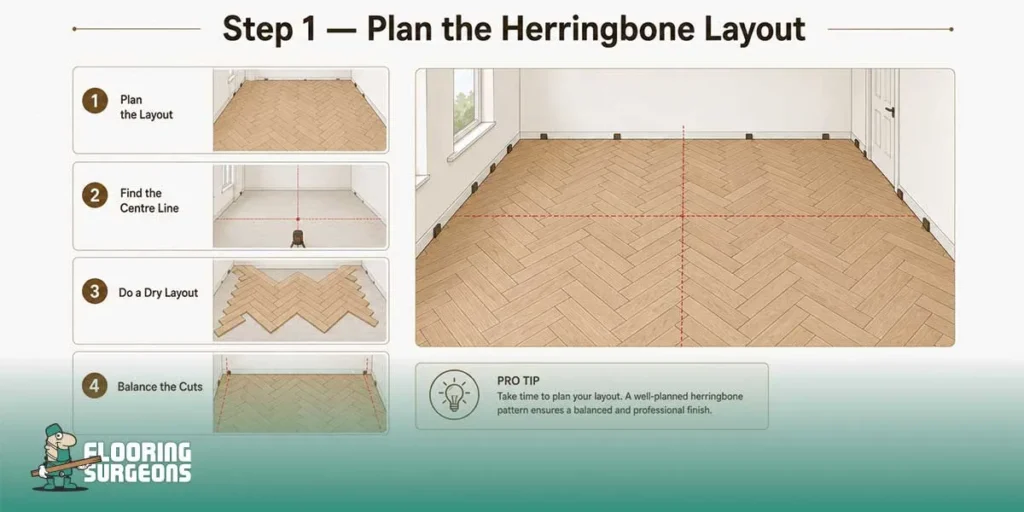
STEP 1: Plan the Herringbone Layout
1. Plan the Layout
Plan the layout before installation.
Accurate alignment is essential for a balanced herringbone pattern.
2. Find the Centre Line
Mark the room centre line using a laser level or chalk line.
Use this line as the main guide for the pattern.
3. Do a Dry Layout
Place several rows without locking them.
Check plank direction, border spacing and pattern alignment.
4. Balance the Cuts
Avoid narrow edge pieces along walls.
Adjust the layout so border cuts look even on both sides.
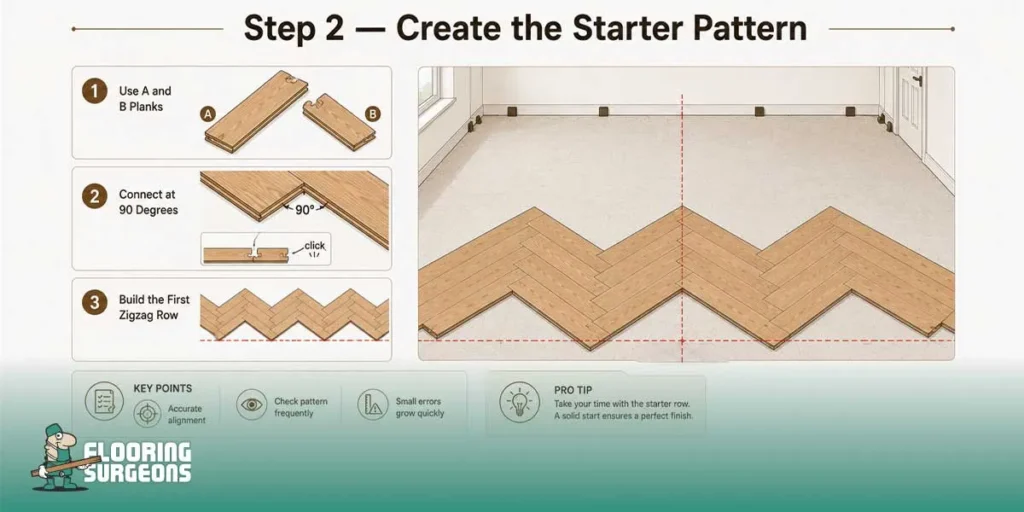
STEP 2: Create the Starter Pattern
1. Use A and B Planks
Use the correct left and right herringbone planks.
Check the manufacturer’s plank orientation before locking.
2. Connect at 90 Degrees
Connect the first planks at a 90° angle.
Keep the starter section square and aligned.
3. Build the First Zigzag Row
Build the first zigzag row slowly.
Check alignment before continuing across the room.
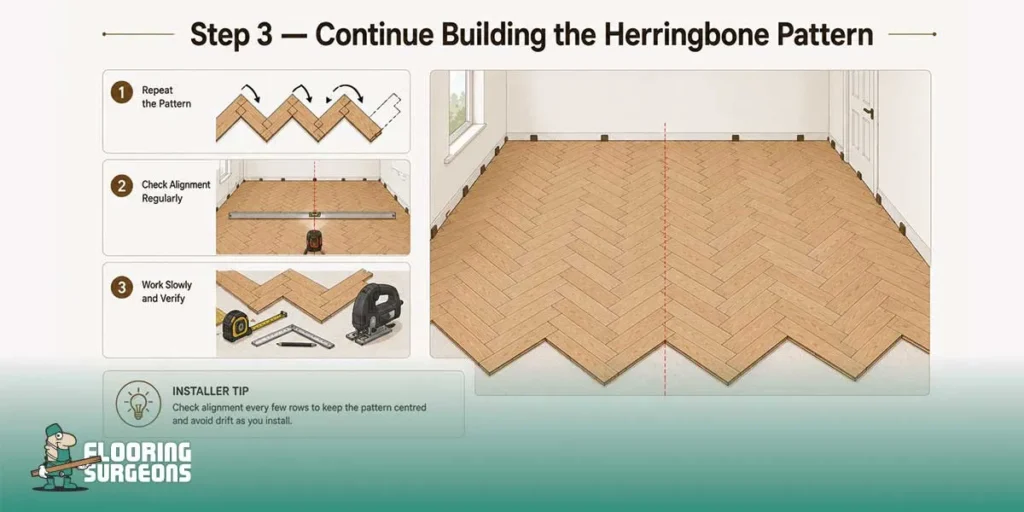
STEP 3: Continue Building the Herringbone Pattern
1. Repeat the Pattern
Continue installing planks in the same alternating zigzag pattern.
Keep joints tight without forcing the locking system.
2. Check Alignment Regularly
Check the centre line and pattern alignment every few rows.
Correct small issues before they spread across the floor.
3. Work Slowly and Verify
Herringbone installation requires more precision than straight plank flooring.
Measure and check each row before continuing.
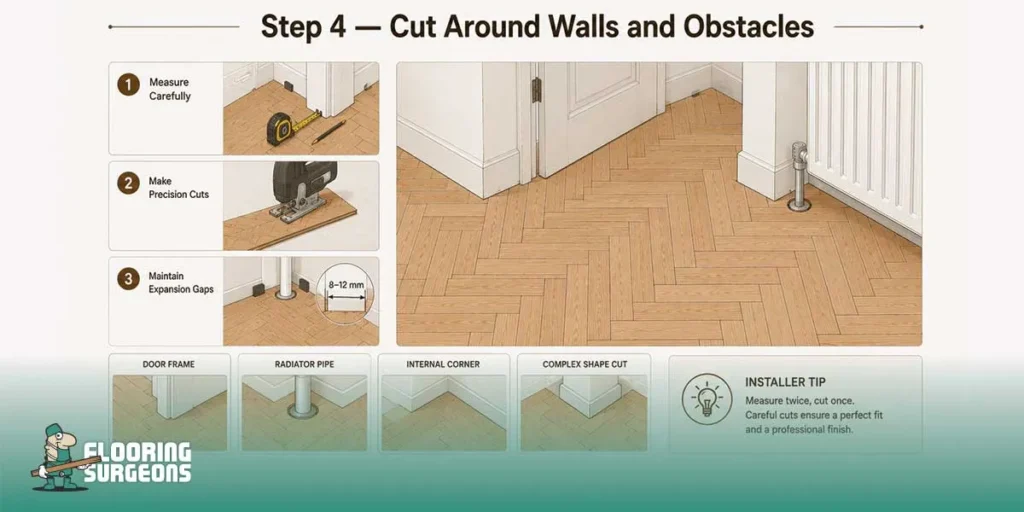
STEP 4: Cut Around Walls and Obstacles
1. Measure Carefully
Measure around walls, corners, pipes and door frames before cutting.
Mark each plank clearly before trimming.
2. Make Precision Cuts
Use a fine-tooth laminate saw or jigsaw for angled cuts.
Cut slowly to avoid damaging plank edges.
3. Maintain Expansion Gaps
Leave an 8–12 mm expansion gap around walls and fixed objects.
Do not force planks tightly against pipes, frames or corners.
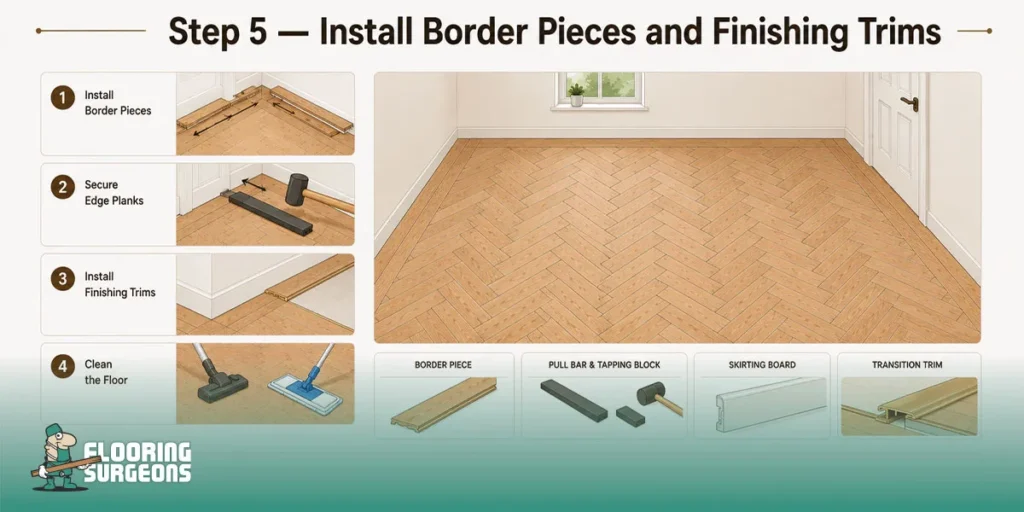
STEP 5: Install Border Pieces and Finishing Trims
1. Install Border Pieces
Fit border pieces around the room perimeter.
Measure each piece carefully for a clean, balanced finish.
2. Secure Edge Planks
Use a pull bar and tapping block to secure edge planks.
Avoid damaging the locking system or decorative pattern.
3. Install Finishing Trims
Remove spacers and cover expansion gaps with trims or skirting.
Do not fix trims directly to the laminate floor.
4. Clean the Floor
Clean the floor with a vacuum or dry microfibre mop.
Remove dust and installation debris before use.
Common Herringbone Installation Mistakes
Incorrect Centre-Line Alignment
❌ Starting from an incorrect centre line can shift the entire herringbone pattern.
Skipping a Dry Layout Test
❌ Failing to test the layout first may result in uneven border cuts and poor pattern balance.
Misaligned Zigzag Rows
❌ Small alignment errors can quickly become visible across the floor.
Incorrect A/B Plank Placement
❌ Installing planks in the wrong sequence can disrupt the locking pattern.
Inaccurate Angled Cuts
❌ Poorly angled cuts can create visible gaps and uneven borders.
Missing Expansion Gaps
❌ Tight edge cuts without expansion gaps may cause floor movement or lifting.
Tips for a Professional-Looking Finish
Use a Tapping Block
✔ Use a tapping block and rubber mallet to tighten joints without damaging plank edges.
Maintain Straight Alignment
✔ Check row alignment regularly during installation to prevent gaps and uneven spacing.
Install Finishing Trims Correctly
✔ Use transition trims and skirting boards to cover expansion gaps neatly.
⚠ Do not fix trims directly to the laminate flooring.
Laminate Flooring Installation: Dos and Don’ts
| ✔ Dos | ❌ Don’ts |
|---|---|
| Ensure the subfloor is clean, dry and level | Install laminate over uneven subfloors |
| Leave 8–12 mm expansion gaps | Fit planks tightly against walls |
| Acclimatise flooring for at least 48 hours | Skip acclimatisation before installation |
| Use the correct underlay for the subfloor type | Use underlay that is too thick |
| Check herringbone alignment regularly | Ignore centre-line alignment |
| Dry-lay herringbone planks before installation | Start installation without layout planning |
| Use tapping blocks and pull bars correctly | Force click-lock joints into place |
| Follow manufacturer installation guidelines | Ignore manufacturer instructions |
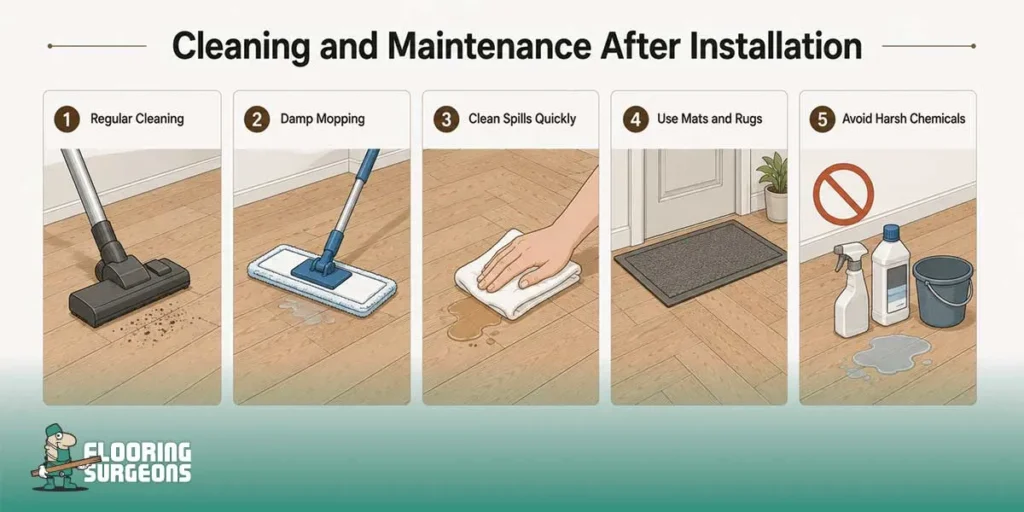
Cleaning and Maintenance After Installation
Regular Cleaning
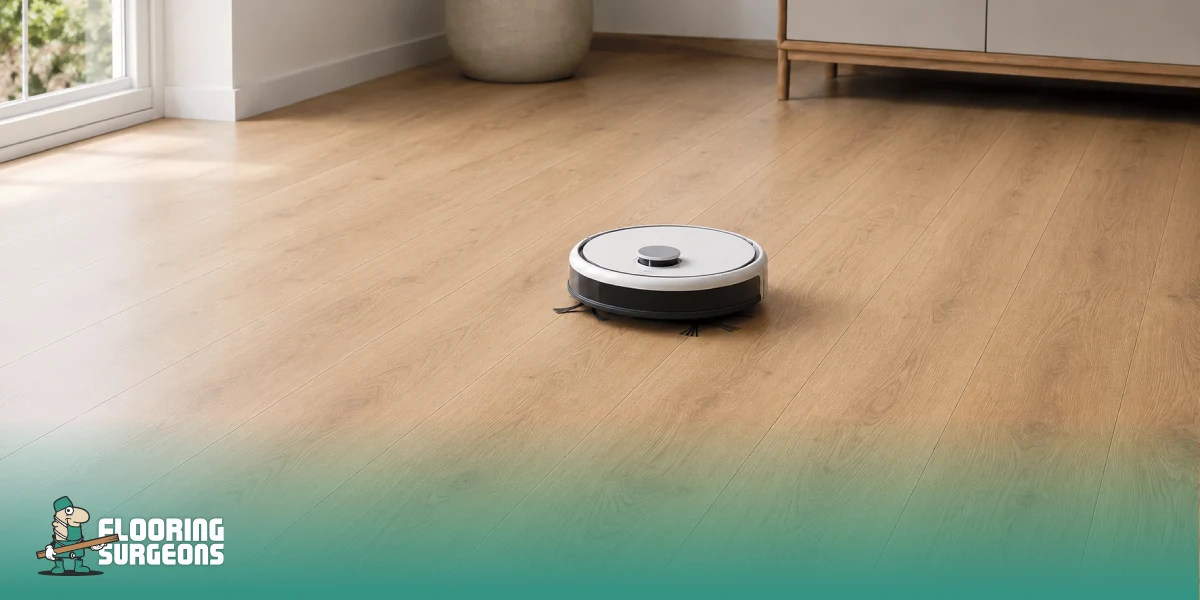
✔ Sweep or vacuum regularly using a hard-floor vacuum attachment.
Damp Mopping
✔ Clean with a lightly damp microfibre mop and laminate-safe cleaner.
Clean Spills Quickly
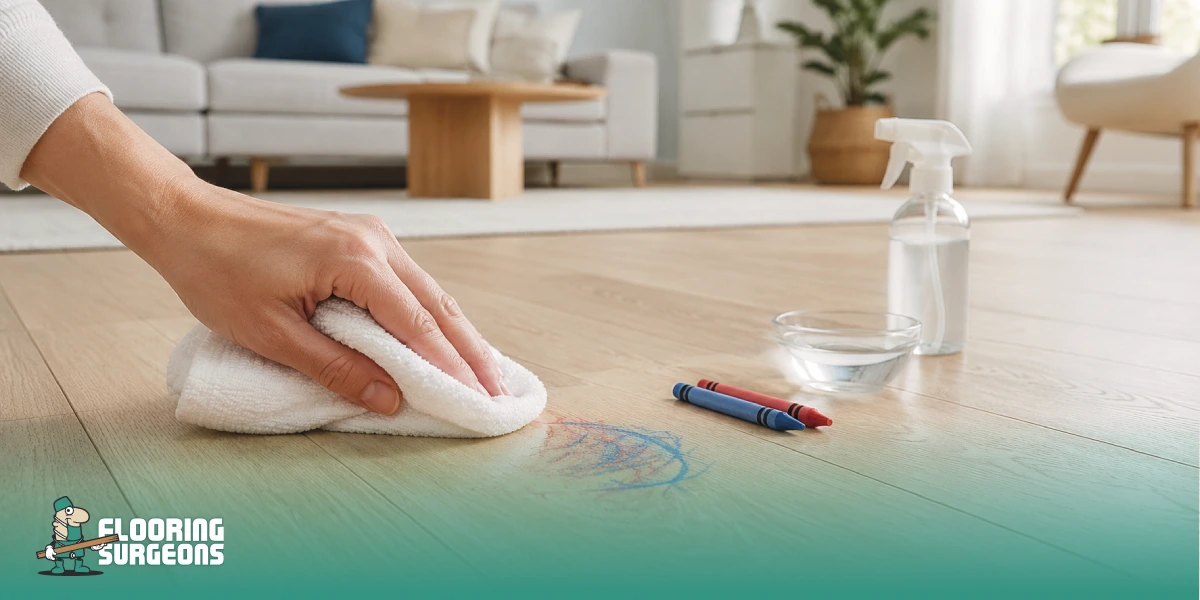
✔ Wipe spills immediately to prevent moisture damage or staining.
Use Mats and Rugs
✔ Place mats at entrances to reduce dirt and moisture.
Avoid Harsh Chemicals
✔ Do not use abrasive cleaners, wax or excessive water.
⚠ Excess moisture may damage laminate flooring over time.
Need expert help with your flooring project?
Flooring Surgeons provides professional laminate flooring installation, expert guidance and premium flooring solutions for residential and commercial spaces. Whether you need installation support, product advice or help choosing the right flooring, our team is here to help.
Contact Flooring Surgeons to discuss your project!
Conclusion
Straight plank laminate flooring offers a faster and more beginner-friendly installation process, while herringbone laminate requires more precise planning and alignment. With proper preparation, accurate measurements and correct installation techniques, both styles can deliver durable and professional-looking results.
For expert advice, premium flooring products or professional installation support, Flooring Surgeons is here to help.

Mina Asgari
I’m an SEO Specialist and Content Strategist focused on sustainable business growth. I design data-driven content strategies by deeply analyzing user intent, search behavior, and SEO best practices, ensuring every piece of content serves a clear purpose for both users and search engines.