If you’re searching “what is AC rating in laminate flooring?”, the simple answer is this: AC rating shows how durable a laminate floor is and how well it resists daily wear, scratches, scuffs, impact, and foot traffic. The scale runs from AC1 to AC6, with AC1 made for very light use and AC5 or AC6 designed for heavy commercial traffic.
But choosing the best AC rating for laminate flooring is not as simple as buying the highest number. AC4 or AC5 may sound stronger, but in some homes, it can be more expensive than necessary or less comfortable underfoot. AC rating measures surface wear resistance, not thickness, waterproofing, or total product quality.
In this guide, you’ll learn what each laminate AC rating means, how AC ratings are tested, which rating suits each room, and how to avoid common buying mistakes.
Table of contents
AC Rating Explained: What It Actually Measures
An AC rating is a durability score that indicates how well laminate flooring resists wear in real-world use. Think of it as a “toughness scale” that measures how the surface holds up to scratches, foot traffic, impact, furniture movement, and general abrasion. It doesn’t measure thickness or water resistance, only how durable the top wear layer is.
In simple terms, AC rating = how much daily wear the laminate can handle before it starts showing damage. The higher the rating, the better it performs in busy spaces. But choosing the right one depends on how you use the room, not on buying the highest number available.

How Are Laminate AC Ratings Tested? (EN 13329 Standard)
Laminate AC ratings are tested according to EN 13329, a European standard that measures a laminate flooring’s resistance to daily wear. Instead of relying on marketing claims, this test checks the floor’s surface durability through controlled stress tests.
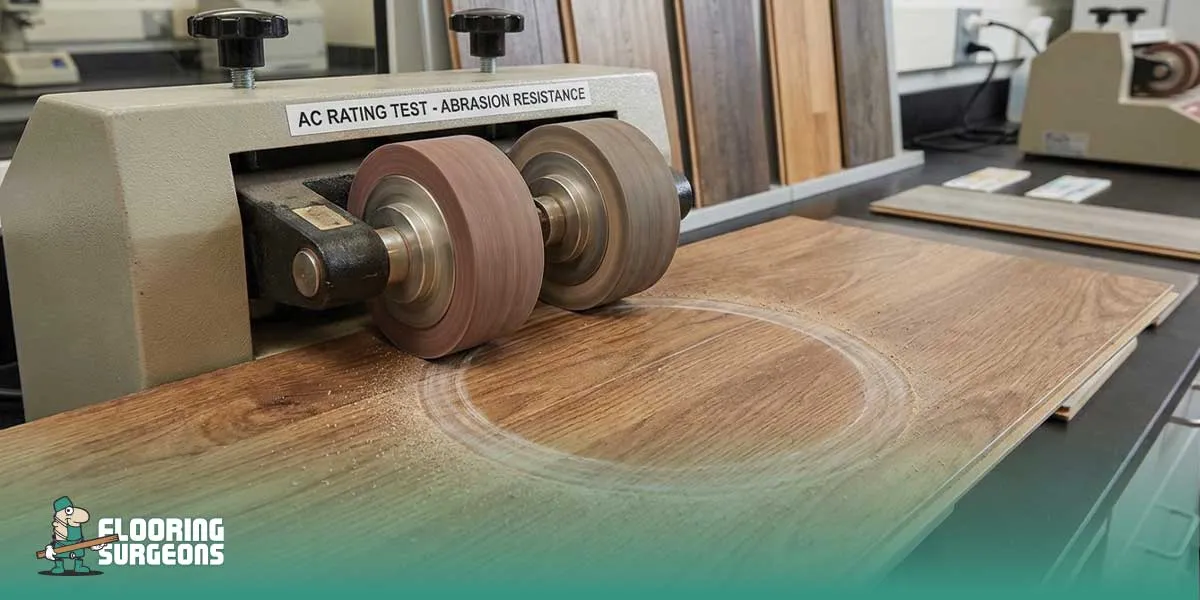
The most important part of the laminate AC rating test is abrasion resistance. In this test, a rotating abrasive wheel rubs against the surface until the first visible signs of wear appear. The more rotations the laminate can handle, the higher its AC rating. Other durability checks may include impact resistance, stain resistance, scratch resistance, swelling behaviour, and furniture movement.
In simple terms, EN 13329 tests answer one key question: how well will this laminate flooring hold up in real life? Lower resistance results usually fall into AC1–AC2, medium-duty performance falls into AC3–AC4, and heavy commercial durability falls into AC5–AC6. That’s why AC rating should be seen as a laminate durability rating, not just a product label.

Laminate AC Rating Chart (AC1–AC6 Visual Breakdown)
Choosing laminate becomes much easier when you understand what each AC level can actually handle. The AC scale (AC1–AC6) measures the floor’s resistance to abrasion, scratches, impacts, and daily wear. Higher numbers mean stronger surfaces, but choosing the right one depends on how busy your home or business is, not simply buying the highest rating. Below is the practical, real-world breakdown of what each AC rating means, who it’s for, and where it performs best.
AC1: Light Use
AC1 laminate is designed for very low-traffic areas. It withstands gentle daily use but isn’t built for busy households. Best for:
- Guest bedrooms
- Low-use storage rooms
- Occasional home offices
AC1 is rarely sold today because most modern homes need stronger flooring. It only makes sense if the budget is tight and the room sees minimal movement.
AC2: Moderate Residential Use
AC2 flooring handles regular household activity but not intense activity. It offers better abrasion and scratch resistance than AC1, but it still isn’t ideal for high-traffic homes. Best for:
- Bedrooms
- Small studies
- Low-traffic living spaces
Avoid using AC2 in hallways, kitchens, or homes with pets; it wears faster there. It’s a step up from AC1 but not a long-term durability solution.
AC3: Heavy Residential Use
AC3 is the proper residential standard. It balances durability, comfort, and cost, making it the most popular choice for modern homes. It tolerates daily foot traffic, pets, kids, and frequent cleaning. Best for:
- Living rooms
- Hallways and corridors
- Kitchens and dining rooms
- Busy family homes
AC3 can even be used in very light commercial settings (like small offices), but its strength is in active households that need reliable durability.

AC4: Light Commercial
AC4 laminate enters commercial-grade territory. It’s designed for spaces where people are constantly moving, dragging chairs, and creating abrasion. Best for:
- Offices
- Boutiques
- Cafés
- High-traffic households with pets and children
Many premium home installations now use AC4 because it offers noticeably longer life and better scratch resistance without looking overly commercial.
AC5: Heavy Commercial
AC5 is engineered for intense, all-day use. It handles heavy footfall, repeated friction, and wear that would quickly damage lower-grade ACs. Best for:
- Large retail stores
- Restaurants
- Schools
- Hotel lobbies
- Gyms and high-traffic public spaces
Some homeowners with dogs or large households also choose AC5 for maximum resilience, but it’s more flooring than most residential spaces truly require.
AC6: Extreme Use (Rare but Trending)
AC6 is the highest durability class available, and very few retailers explain it because most don’t stock it. It’s built for environments where flooring is exposed to constant abrasion, friction, and near-industrial wear. Best for:
- Airports
- Train stations
- Public buildings
- Commercial spaces with rolling carts, trolleys, or equipment
- Ultra-busy homeowners want the most rigid laminate possible.
AC6 is incredibly tough but also more expensive. The benefit is unmatched longevity and resistance; it looks newer for far longer than lower AC grades.
Laminate AC Rating Chart: Quick Comparison Table
| AC Rating | Traffic Level | Best Use | Key Advantages | Not Ideal For |
| AC1 | Very light | Guest rooms, low-use spaces | Cheapest option | Any busy area |
| AC2 | Moderate residential | Bedrooms, small offices | Decent durability | Kitchens, hallways, and pets |
| AC3 | Heavy residential | Living rooms, kitchens, hallways | Balanced durability & price | Intense commercial use |
| AC4 | Light commercial | Offices, cafés, busy homes | Strong abrasion resistance | Heavy retail |
| AC5 | Heavy commercial | Shops, hotels, schools | Handles constant traffic | Typical low-use homes |
| AC6 | Extreme commercial | Airports, public spaces | Highest durability | Overkill for most homeowners |
Which AC Rating Do You Need?
Choosing the right laminate AC rating depends entirely on how you use your space. You don’t need the highest number; you need the right number for your traffic levels, cleaning habits, and household type. Use this quick guide to choose confidently without overpaying.

Best AC Rating for Homes
AC3 is the best all-around AC rating for most homes, offering strong durability without the cost of commercial-grade laminate. AC3 handles daily traffic, occasional spills, kids running around, vacuuming, and chair movement far better than AC1–AC2. It stays visually appealing for years and works in almost every room, making it the safest, most value-driven choice for UK households.
If your home is very active or you prefer a longer lifespan with fewer visible scratches, AC4 is a worthwhile upgrade, especially for open-plan spaces where movement is constant.
Best AC Rating for Kitchens
AC3 or AC4 are the ideal choices for kitchens, depending on how busy your household is. Why:
- Kitchens get constant foot traffic.
- Chairs, stools and appliances cause abrasion.
- Frequent cleaning can wear down lower-rated laminates.
- High moisture and spills demand stronger wear layers
Choose AC3 for regular everyday use. Choose AC4 if your kitchen is the busiest part of the home, you cook often, or you want the floor to stay newer for longer. Avoid AC1–AC2 entirely; they wear out quickly in kitchen conditions.
Because kitchens deal with constant foot traffic, chair movement, spills, and frequent cleaning, it’s also worth comparing the best laminate flooring for kitchens before choosing solely based on AC rating.
Best AC Rating for Hallways & High Traffic
Hallways and entrances require AC4 because no other area of a home experiences as much repetitive friction. Why AC4 works best:
- Handles shoes, bags, pets, and constant movement
- Resists scratches from grit brought in from outside
- Maintains appearance despite long-term abrasion
If you want ultra-high performance or have a very active household, AC5 can be used, but it’s usually more than a residential hallway needs.
Best AC Rating for Rentals
For rental properties, the best AC rating is AC4; the commercial-grade durability protects your investment far better than residential options. Why AC4 is the rental sweet spot:
- Tenants aren’t always careful with flooring.
- More resistant to misuse, dragging furniture, and abrasive cleaning
- Reduces the likelihood of premature replacement
- Maintains a “clean, new” appearance for longer between tenants
In high-turnover rentals (student housing, apartments, serviced flats), some landlords even choose AC5 for maximum lifespan.

Best AC Rating for Pets & Kids
If you have pets, kids, or both, the best AC rating is AC4; it’s strong enough to resist claws, toys, spills, constant activity, and frequent cleaning. Benefits of AC4 for busy households:
- Better scratch resistance against pet claws
- Handles dropped toys, scooters, and plastic wheels.
- Survives regular mopping and vacuuming, especially when you follow the right laminate floor cleaning routine
- Less visible surface wear, even in chaotic areas
If you have large dogs, hyperactive kids, or open-plan spaces with heavy use, AC5 provides even more peace of mind, but AC4 already covers 95% of family-home needs.
AC Rating vs Laminate Thickness: What Matters More?
Many shoppers assume that a thicker laminate floor automatically lasts longer, but thickness and durability are not the same thing. Thickness mainly affects how the floor feels, its sound absorption, comfort underfoot, and how well it settles over an uneven subfloor. Durability, however, is determined almost entirely by the AC Rating. That rating reflects the strength of the wear layer and the floor’s resistance to scratches, dents, abrasion, and long-term foot traffic.
This means a 12mm laminate with an AC2 rating can wear out much faster than an 8mm laminate with an AC4 rating. The thicker board may feel more solid when you walk on it, but the thinner product with the higher AC Rating will survive years of active use without losing its surface texture or appearance. When choosing between the two, the AC Rating should always take priority; it defines how the floor will perform after three, five, or ten years, not just how it feels on day one. The ideal setup for most homes is a laminate between 8–12mm paired with AC3 or AC4 durability, while high-traffic households often benefit from AC5 even if the thickness is similar.
AC Rating Durability Factors (Wear Layer, Core, Surface Texture)
The strength of a laminate floor isn’t something you can judge by looking at thickness or colour alone. What truly determines durability is the structure beneath the surface. The wear layer, the clear protective coating on top of the printed décor, plays the most significant role. Its composition and hardness determine how well the floor resists scratching, scuffing, abrasion, and the gradual dulling that occurs in busy homes. A stronger wear layer is why higher AC Ratings consistently outperform lower ones, even when everything else looks similar.
Beneath that, the core board’s density dictates how stable the planks feel under pressure. High-density fibreboard creates a firmer, stronger product that resists dents and holds click-system joints tightly over time. Floors with weaker cores may look identical when new, but they are more prone to movement, swelling, and edge damage once daily use begins.
Texture also influences how long a floor looks “new.” A matte or registered-embossed surface hides micro-scratches far better than a smooth, glossy finish, meaning the floor maintains its visual quality for longer, even with the same AC Rating. In practice, durability is a combination of all these elements, wear layer strength, core density and surface texture, working together to deliver a laminate that lasts.
AC4 vs AC5 Laminate Flooring: Which One Should You Choose?
AC4 and AC5 both sit in the high-durability category, but they’re designed for different levels of daily demand. AC4 is the ideal balance for most households: strong enough to handle children, pets, heavy foot traffic, and everyday use, while still cost-efficient and widely available in modern styles. In a typical home, an AC4 floor maintains its appearance for many years without showing significant wear.
AC5 steps into the next tier of performance. This category is engineered for commercial environments, shops, offices, cafés, or homes with exceptional activity levels. It offers increased resistance to abrasion and long-term wear, ensuring it stays visually consistent even with hundreds or thousands of steps per day. For homeowners, AC5 is a wise choice when long-term durability is a priority, particularly in open-plan spaces or hallways that are constantly used.
The simplest way to decide is this: AC4 is more than enough for the majority of homes, but AC5 is the safer choice when you expect heavy traffic or want your flooring to look new for as long as possible. The difference isn’t in appearance or thickness; it’s in how each rating holds up over years of real-world use.

Common Mistakes Homeowners Make About AC Ratings
Most laminate flooring problems don’t come from choosing the wrong colour or thickness; they come from misunderstandings about AC Ratings. Because the terminology sounds technical, many homeowners make assumptions that lead to the incorrect product being installed in the wrong room. Below are the four misconceptions that cause the most disappointment, and understanding them helps you choose a floor that performs exactly the way you expect.
Assuming Higher AC Rating
A higher AC Rating doesn’t automatically make a floor the “best choice.” AC5 and AC6 are built for commercial environments that experience hundreds of footsteps per hour. In most homes, this level of durability simply isn’t required, and the extra hardness can even make the surface feel firmer and noisier underfoot. Many people assume AC5 is superior in every situation, but in reality, AC3 or AC4 often provides the perfect balance of comfort, quietness, and longevity for residential use. The best AC Rating is the one that matches daily traffic, not the highest number available.
Ignoring Installation Area Needs
Another common mistake is treating every room the same. Hallways, kitchens, bedrooms, and rental properties all experience different levels of wear, yet homeowners often choose a single AC Rating for the entire house. This creates mismatches, for example, installing AC2 in a busy hallway that needs AC4, or using AC5 unnecessarily in a quiet bedroom. When the AC Rating doesn’t align with the room’s traffic pattern, the floor either wears out too quickly or becomes an unnecessary expense. Understanding how each area is used is the simplest way to make the right choice.
Choosing AC Ratings Only by Price
Budget is essential, but using it as the sole deciding factor often leads to the wrong product. Low-priced laminates typically carry AC1 or AC2 ratings, which may seem attractive at checkout but struggle in anything beyond very light residential use. Homeowners who choose them purely to save money often end up replacing the floor much sooner. Conversely, some buyers overspend on AC5, thinking it guarantees a better product, when AC4 would have performed flawlessly in a home setting. The best approach is to start with needs, then compare prices within the correct AC category.
Confusing Wear Rating with Thickness
Thickness is one of the most misunderstood elements of laminate. Many homeowners assume a 12mm board is “stronger” than an 8mm board, but durability has nothing to do with thickness. A thick laminate with a low AC Rating can wear out quickly, while a thinner board with AC4 or AC5 can last for years of heavy use. Thickness affects stability, sound and comfort, but the AC Rating determines how well the surface survives scratches, abrasion, and real-world traffic. Mixing these two concepts often leads homeowners to buy the wrong product altogether.
Quick Reference Table: AC Rating Misconceptions vs Reality
| Common Belief | Reality |
| A higher AC Rating is always better | AC5/AC6 can be unnecessary for homes; AC3/AC4 often ideal |
| One AC Rating suits the whole house | Each room has different traffic needs |
| Cheaper = smarter choice | Lower AC floors wear out quickly in busy areas |
| Thicker laminate = more durable | Durability depends on AC Rating, not thickness |
Conclusion: Choosing the Right AC Rating for Laminate Flooring
The best AC rating for laminate flooring depends on how and where the floor will be used. For most homes, AC3 offers a reliable balance of durability, comfort, and value, while AC4 is the better choice for busy households, hallways, kitchens, rental properties, pets, and kids. AC5 and AC6 provide stronger commercial-grade protection, but they are usually only necessary for very high-traffic spaces.
The key is not to choose the highest AC rating available, but to match the laminate durability rating to your room’s traffic level, lifestyle, and long-term expectations. When you understand what each AC rating means, you can choose flooring that lasts longer, looks better, and gives you better value without overspending.
Conclusion: Choosing the Right AC Rating for Laminate Flooring
Choosing the right AC rating for laminate flooring is all about matching durability to the way your home is actually used. For most households, AC3 delivers an excellent balance of comfort, performance, and affordability, while AC4 is ideal for busy family homes, kitchens, hallways, pets, and high-traffic areas. Higher ratings like AC5 and AC6 offer commercial-level durability, but they are often unnecessary for standard residential spaces.
At Flooring Surgeons, we always recommend choosing laminate flooring based on real household needs rather than simply selecting the highest rating available. The right balance of durability, comfort, and performance will always deliver the best long-term results.

Haniye Ayanmanesh
As an expert writer for Flooring Surgeons, I combine technical SEO knowledge with a practical understanding of flooring, producing content that helps users make confident decisions while supporting long-term organic growth.