

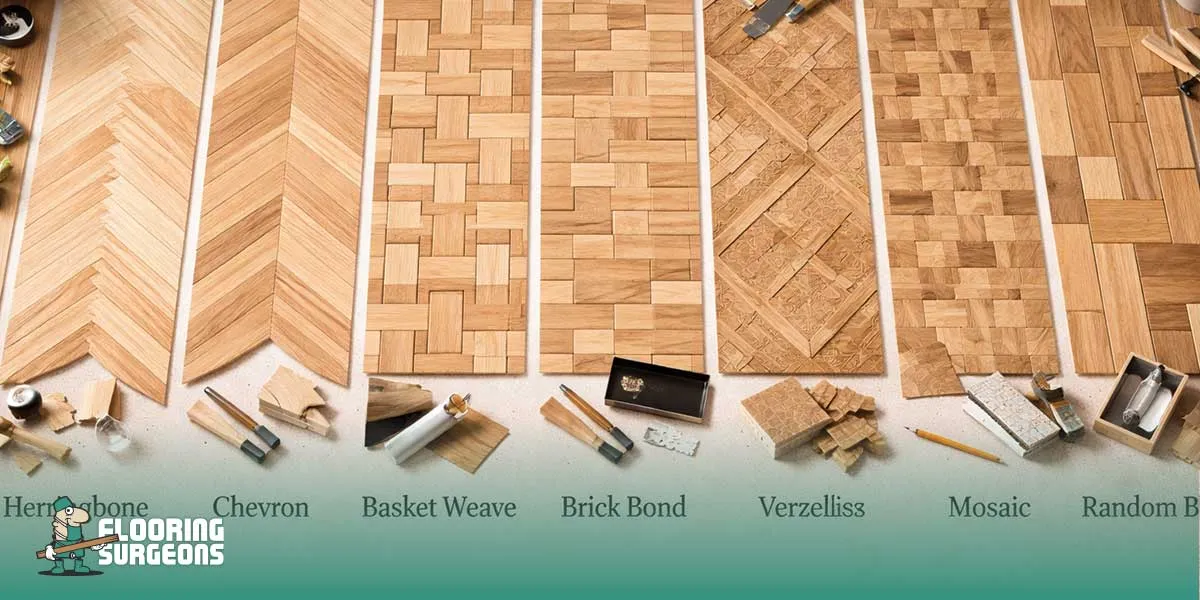
Parquet flooring patterns are defined by the geometric arrangement of wooden blocks to create structured, decorative floor designs that add both character and durability to a space. Unlike standard straight plank flooring, parquet layouts introduce movement, symmetry, and architectural detail — making them a long-standing favourite in UK homes, from Victorian properties to modern new builds.
The seven most popular parquet flooring patterns in the UK today are:
- Herringbone
- Chevron
- Basket Weave
- Brick Bond (Stretcher Bond)
- Versailles
- Mosaic
- Random Block
At first glance, choosing between these different parquet patterns may seem purely aesthetic. However, each layout affects far more than appearance. Pattern choice influences installation complexity, material waste, cost per square metre, subfloor preparation requirements, and even how spacious or bright a room feels. Some designs suit period homes with original character, while others complement contemporary interiors with clean architectural lines.
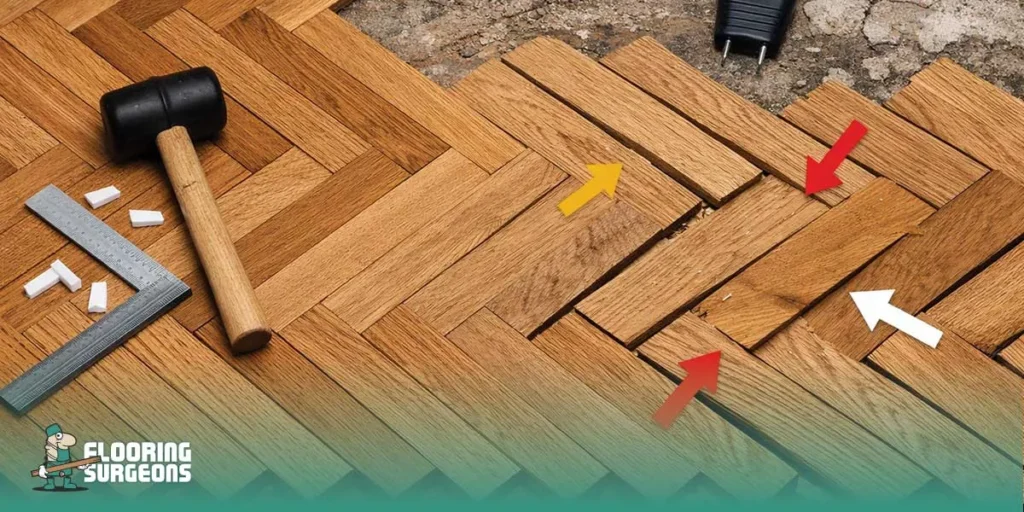
In this complete UK guide, we break down each parquet flooring pattern in detail. You’ll learn how each one looks, where it works best, how complex it is to install, and what to consider before selecting it for your property. Whether you’re planning a new parquet installation or restoring an existing wood block floor, understanding these patterns properly will help you make a confident, long-term decision.
Let’s start with the most recognised and widely installed layout: herringbone parquet flooring.
Table of contents
What Is Parquet Flooring?
Parquet flooring is a type of wood flooring made from small timber blocks arranged in repeating geometric patterns rather than long, straight planks. The defining feature of parquet is its layout — the way each piece of wood is positioned to create structured, decorative designs such as herringbone, chevron, or basket weave. This geometric wood flooring approach is what gives parquet its distinctive architectural character.
In the UK, the most common types of parquet flooring are solid wood parquet and engineered parquet flooring. Solid wood parquet is made from single hardwood blocks, typically oak, offering durability and the ability to be sanded and refinished multiple times. Engineered parquet flooring combines a real hardwood surface with a stable multi-layer base, making it more resistant to moisture movement and suitable for modern homes, including those with underfloor heating.
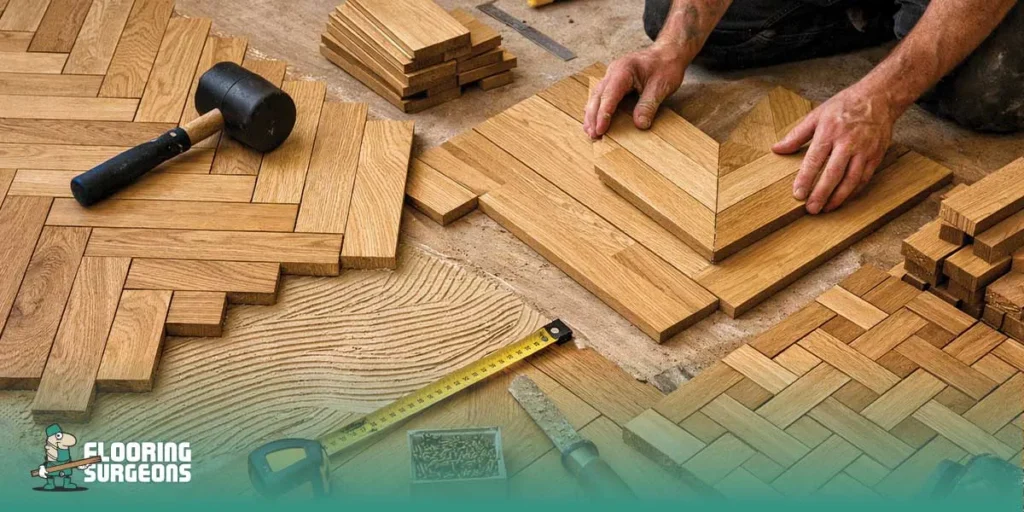
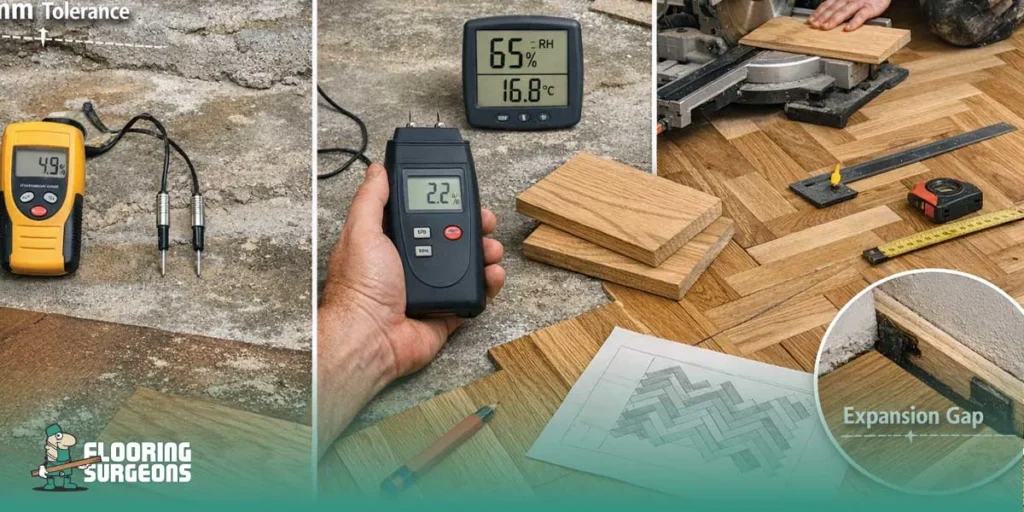
Unlike standard plank floors, wood block flooring relies heavily on installation precision. Each individual block must be aligned accurately to maintain the pattern’s symmetry. Proper subfloor preparation — including levelling, moisture testing, and expansion planning — is essential, as even minor irregularities can affect both the visual alignment and long-term stability of the floor.
1. Herringbone Parquet Flooring
Herringbone parquet flooring is one of the most recognised parquet floor designs in the UK — and for good reason. The pattern is formed by laying rectangular wood blocks at right angles in a staggered zigzag layout. Unlike chevron, the ends of the blocks are not cut diagonally, which gives herringbone its distinctive “broken V” rhythm. It feels structured, elegant, and timeless without being overly decorative.
Design Impact
Visually, a herringbone wood floor adds movement to a space. In narrow rooms or hallways, it can subtly elongate the layout by guiding the eye forward. In open-plan living areas, it introduces architectural texture without dominating the room. Because the pattern has been widely used in both period and contemporary properties, it adapts well to different interior styles — from Victorian terraces to modern renovations.
But beyond appearance, herringbone is often chosen because it strikes a balance between character and practicality. It offers the visual interest of parquet without the extreme installation complexity of more intricate layouts like Versailles.
If you want character without extreme fitting complexity, herringbone is often the safest starting point.
• Best suited for: Period homes, hallways, reception rooms, and renovation projects where architectural character is important
• Works well in: Both older properties and new builds, especially when using engineered parquet flooring
Tip: If herringbone is the look you’re aiming for, exploring herringbone flooring options can help you compare tones, thicknesses, and finishes before committing to a layout.
• Installation difficulty: Moderately high — requires accurate setting out and consistent block alignment
• Material waste: Typically 5–10%, depending on room dimensions and layout
• Underfloor heating: Suitable when engineered construction and proper subfloor preparation are used
Installation Reality
Although herringbone is considered a “classic” parquet installation pattern in the UK, achieving a clean finish depends heavily on preparation. Because every block interlocks visually with the next, even minor subfloor unevenness or misalignment can disrupt the flow of the pattern. Correct moisture testing, expansion allowances, and precise starting points are essential to prevent lifting, gaps, or long-term movement.
2. Chevron Parquet Flooring
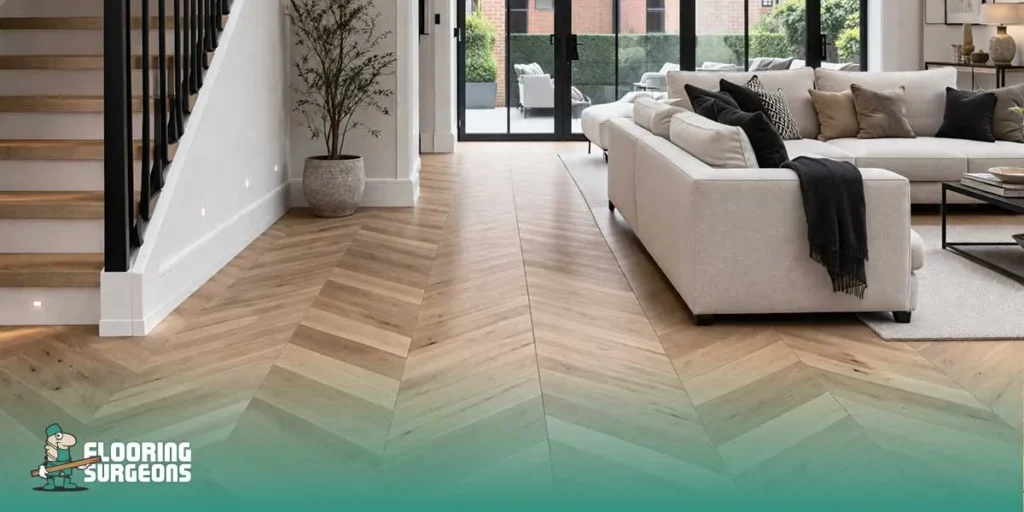
Chevron wood flooring is often chosen for its clean, continuous “V” formation that creates a sharp, symmetrical visual flow. Unlike herringbone, where blocks meet at 90 degrees, chevron parquet is cut at an angle — typically 45 degrees — so each plank joins seamlessly to form a straight diagonal line across the floor. The result is more uniform and contemporary in appearance.
Why the structure matters
In UK interiors, chevron parquet is frequently specified in modern renovations, high-end apartments, and open-plan layouts where architectural precision matters. The pattern naturally draws the eye forward, which can make spaces feel wider and more directional. Because the lines are uninterrupted, chevron tends to feel slightly more formal and refined compared to the softer rhythm of herringbone.
Many homeowners comparing chevron vs herringbone focus purely on appearance, but the structural difference in how the boards are cut significantly affects installation and cost.
| Feature | Herringbone | Chevron |
| Angle Cut | 90° | 45° |
| Installation Difficulty | High | Very High |
| Material Waste | Medium | Higher |
If you’re still weighing chevron vs herringbone, the real difference is less about style and more about cutting precision, waste, and fitting tolerance.
Chevron rewards precision — and exposes mistakes.
The angled cut required for chevron parquet UK installations increases the need for manufacturing precision and on-site accuracy. Unlike herringbone, where rectangular blocks allow minor alignment flexibility, chevron boards must meet perfectly to maintain the continuous “V” effect. Even small measurement errors can disrupt the symmetry of the entire room.
Because of this, chevron is generally less forgiving during installation. Subfloor levelling, moisture control, and exact setting out are critical before fitting begins.
3. Basket Weave Parquet
Basket weave parquet is a classic example of traditional parquet flooring, formed by arranging small rectangular wood blocks in square units that alternate direction to create a woven appearance. The pattern delivers structured symmetry and understated decorative detail, making it particularly suitable for heritage interiors and formal rooms.
Architectural Compatibility
In the UK, basket weave is most often found in period properties where architectural character is already present. It complements fireplaces, decorative cornicing, and original joinery without overwhelming the space.
This pattern works best when the architecture already carries visual weight.
However, because the layout is made up of smaller grouped blocks, it requires careful alignment during installation and even more attention during restoration. Replacing damaged sections demands accurate grain matching and precise block positioning to preserve the woven effect.
• Best suited for: Period homes, reception rooms, heritage renovations
• Works well in: Victorian and Edwardian properties with original detailing
• Installation difficulty: Moderate to high
• Material waste: Moderate
• Underfloor heating: Suitable with engineered parquet and proper moisture control
4. Brick Bond (Stretcher Bond)
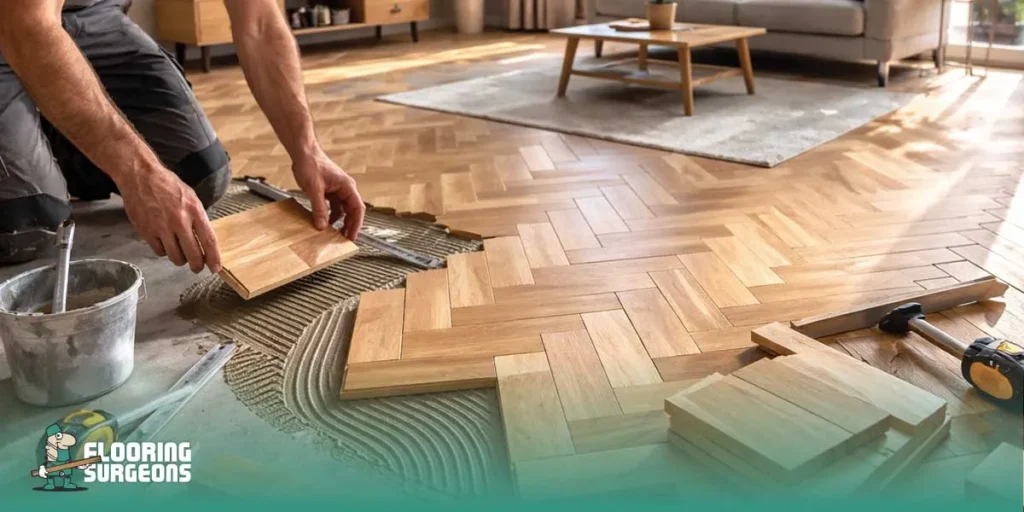
Brick bond parquet, also known as staggered wood flooring, follows a straight plank alignment with each row offset from the next. While simpler than geometric layouts like herringbone or chevron, it retains the warmth and texture of wood block flooring without the same level of cutting complexity.
Less geometric. More practical.
This pattern is particularly attractive for homeowners who want parquet flooring but prefer a more understated look. Because blocks are not angled, installation tends to be more straightforward and cost-effective. The reduced complexity also lowers material waste and makes it a practical option for modern flats, new builds, and large areas where efficiency is important.
• Best suited for: Modern homes, flats, cost-conscious renovations
• Works well in: Open-plan living areas and new builds
•Installation difficulty: Moderate
• Material waste: Low to medium
• Underfloor heating: Suitable when installed over a properly prepared subfloor
5. Versailles Pattern
The Versailles parquet pattern is one of the most intricate parquet floor designs, traditionally formed in large square panels with interwoven diagonal elements. Often associated with luxury parquet flooring in the UK, it creates a framed, architectural floor that acts as a design centrepiece.
Structural Demands
Because of its panel-based structure, installation is significantly more complex than standard block layouts. Precision subfloor levelling is critical before fitting begins, as inconsistencies become highly visible across panel joints.
Flatness isn’t optional here — it’s structural.
Moisture control and expansion allowances must also be carefully calculated, particularly due to the larger format of each panel.
• Best suited for: Large reception rooms, luxury renovations, heritage properties
• Works well in: High-ceilinged spaces with strong architectural features
• Installation difficulty: Very great
• Material waste: High
•Underfloor heating: Possible with engineered panels and strict moisture management.
6. Mosaic Parquet
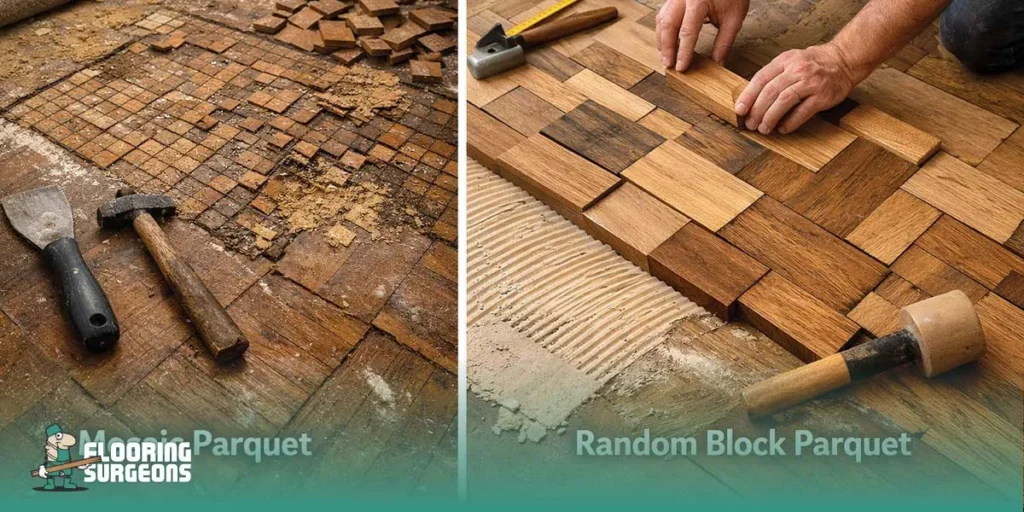
Mosaic parquet flooring is composed of small wood blocks typically pre-mounted onto mesh-backed parquet tiles. This layout became widely used in mid-century UK homes and remains common in older properties undergoing refurbishment.
Often discovered, not newly installed.
While mosaic parquet offers efficient installation compared to hand-laid patterns, ageing adhesive and subfloor movement can affect long-term stability. In many cases, these floors are restored rather than replaced.
• Best suited for: Renovations, mid-century homes, refurbishment projects
• Works well in: Living rooms, bedrooms, hallways
• Installation difficulty: Moderate
• Material waste: Low
• Underfloor heating: Suitable when substrate conditions are stable
7. Random Block Parquet
Random block parquet, often referred to as a custom parquet layout, uses varying block sizes arranged in a controlled but less repetitive format. Unlike symmetrical geometric patterns, this design introduces subtle variation while maintaining overall structural order.
Crafted — not improvised.
It is frequently selected for contemporary parquet flooring projects where individuality and craftsmanship are prioritised. Because block dimensions may vary, installation requires detailed planning, precise site measurement, and consistent spacing.
• Best suited for: Design-led renovations, bespoke interiors
• Works well in: Contemporary homes and open-plan layouts
•Installation difficulty: High due to layout planning
• Material waste: Variable depending on design complexity
• Underfloor heating: Suitable for engineered construction
How to Choose the Right Parquet Pattern for Your Property
Selecting between parquet flooring patterns should never be based on appearance alone. The right layout depends on spatial proportions, natural light behaviour, and the architectural character of the property itself. When these factors are considered together, parquet becomes more than a decorative choice — it becomes a structural design decision.
Based on Room Size
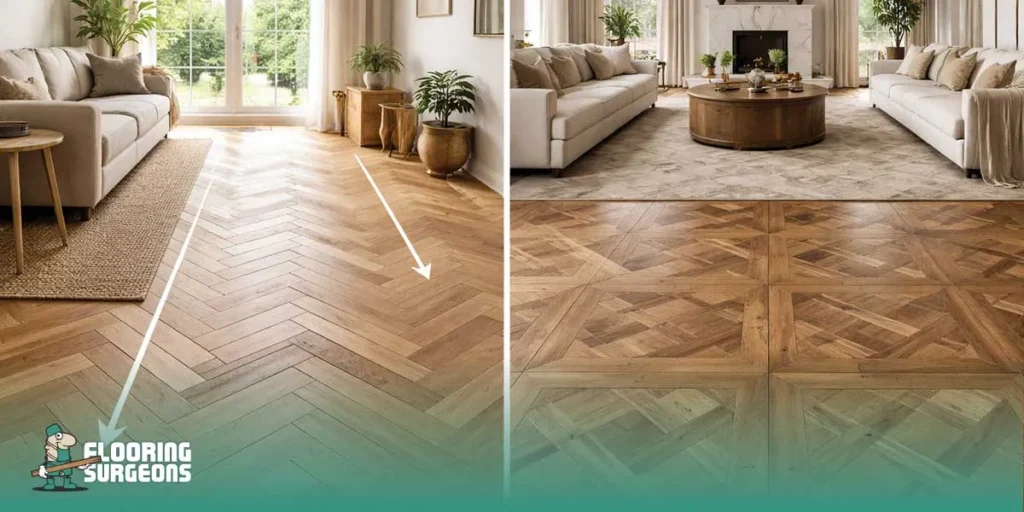
Room dimensions determine how a pattern behaves visually. In smaller spaces, choosing the right parquet pattern for small rooms can make a noticeable difference in visual expansion. Patterns such as herringbone, when laid parallel to the longest wall or main light source, can subtly guide the eye and create a sense of length. This principle is often used as flooring to make a room look bigger without altering the physical dimensions.
Small room → prioritise direction and flow
Large room → introduce structure and scale
Conversely, large and expansive rooms can accommodate more intricate layouts such as Versailles or wider-format block designs. In these settings, a detailed pattern prevents the floor from appearing empty or flat. Proportion is key — overly complex patterns in tight spaces may feel visually compressed, while overly simple layouts in large rooms can lack architectural depth.
Quick Tip: If the room feels restricted, focus on directional movement before decorative complexity.
Based on Natural Light
Natural light plays a critical role in how parquet flooring performs visually throughout the day. Grain direction and block orientation determine how light reflects across the surface. When boards run toward a window, light travels along the grain, softening shadows and creating a more seamless appearance. When laid perpendicular, the texture becomes more pronounced.
Boards toward the light source → softer reflection
Boards across the light source → stronger texture contrast
The finish selection also affects the outcome.
| Finish Type | Visual Effect |
| Matte | Diffused, subtle light reflection |
| Lacquered | Higher sheen, enhanced pattern visibility |
In darker rooms, reflective finishes can help amplify available light, whereas in bright south-facing spaces, excessive sheen may exaggerate minor surface movement over time.
Based on Property Type in the UK
The architectural context of a home significantly influences which parquet layout feels appropriate. Victorian home flooring often benefits from traditional patterns such as herringbone or basket weave, which align with original detailing and historical character. In these properties, scale and authenticity tend to matter more than bold experimentation.
Victorian / Period Homes
→ Traditional layouts
→ Subfloor assessment often required
New Build Flooring UK
→ Greater flexibility in pattern choice
→ Typically more stable concrete substrates
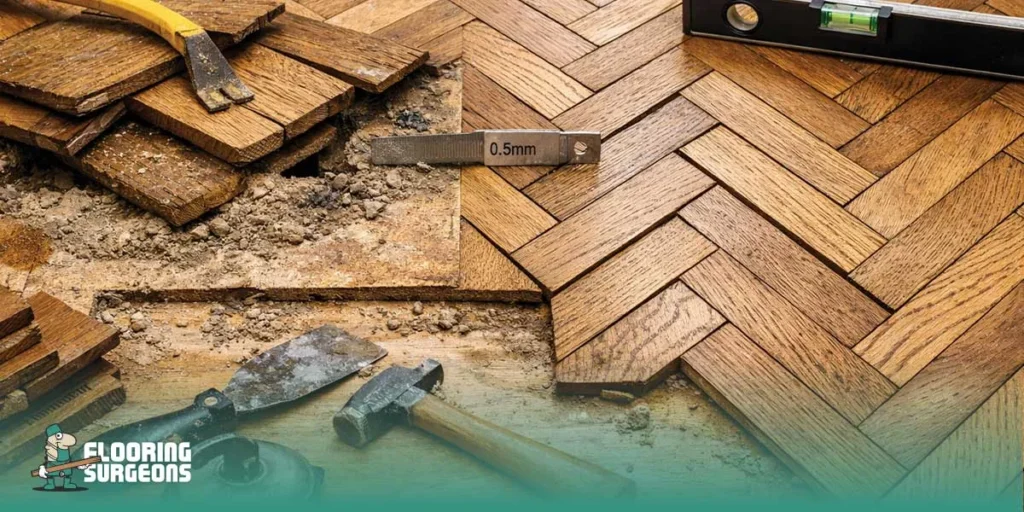
Period property parquet should also account for existing subfloor conditions. Older homes may require levelling or stabilisation before installation, particularly where original timber substrates are present. Matching the pattern to both the style and structural reality of the building is essential.
Ignoring subfloor condition is the most common cause of long-term parquet movement in older properties.
Parquet Flooring Costs in the UK (2026)
Understanding parquet flooring cost in UK projects requires separating material cost from installation complexity. The total price is influenced not only by timber type but also by layout precision, waste percentage, and preparation requirements. Average pricing across the UK typically falls within the following ranges:
| Pattern | Supply £/m² | Installation £/m² | Complexity |
| Herringbone | £45–£75 | £35–£55 | High |
| Chevron | £55–£85 | £45–£65 | Very High |
| Basket Weave | £40–£70 | £35–£50 | Moderate–High |
| Brick Bond | £35–£60 | £25–£40 | Moderate |
| Versailles | £90–£150 | £60–£90 | Very High |
| Mosaic | £30–£55 | £25–£40 | Moderate |
| Random Block | £50–£90 | £45–£65 | High |
Cost pattern insight:
The more precise the geometry, the higher the installation cost per m².
Parquet installation cost per m2 increases when cutting angles, panel alignment, or complex setting out are required. For example, the herringbone fitting cost is typically lower than the chevron due to rectangular block flexibility, while Versailles carries a premium due to panel coordination and subfloor sensitivity.
Supply cost is only part of the equation. Installation labour often represents 40–60% of the final project value in geometric patterns.
When budgeting, always account for:
Material cost
Installation labour
Subfloor preparation
Waste allowance
Ignoring preparation work can distort the real project cost.
Can Parquet Flooring Be Repaired or Restored?
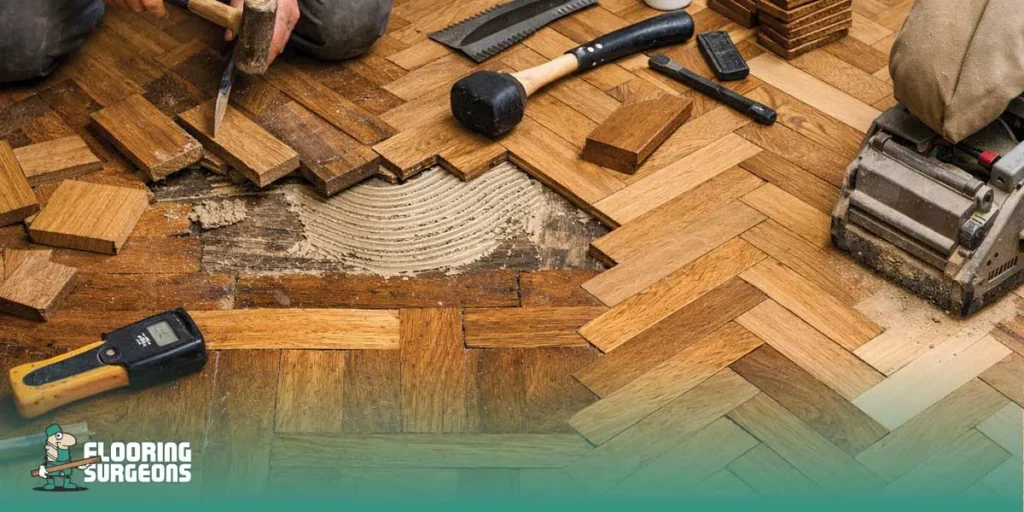
Parquet repair UK services are often possible even when floors appear severely worn. Because parquet is made from individual wood blocks rather than large planks, targeted restoration techniques can preserve much of the original layout.
Not every damaged floor needs replacement.
In many UK homes, it’s possible to restore original parquet instead of replacing it—especially when the blocks are structurally sound and the layout can be re-bonded, levelled, and refinished. In many cases, parquet floor restoration focuses on correcting structural or surface issues rather than removing the entire installation.
Can Parquet Floors Be Sanded and Refinished?
Yes — in most cases, solid wood parquet and many engineered parquet floors can be sanded and refinished multiple times. Surface wear, scratches, and dull finishes are cosmetic issues rather than structural failures. Sanding removes the top layer of damage and allows for fresh sealing or lacquering without affecting the pattern layout.
This is one of the most effective parquet floor restoration techniques for extending lifespan.
How Is Pattern Misalignment Corrected?
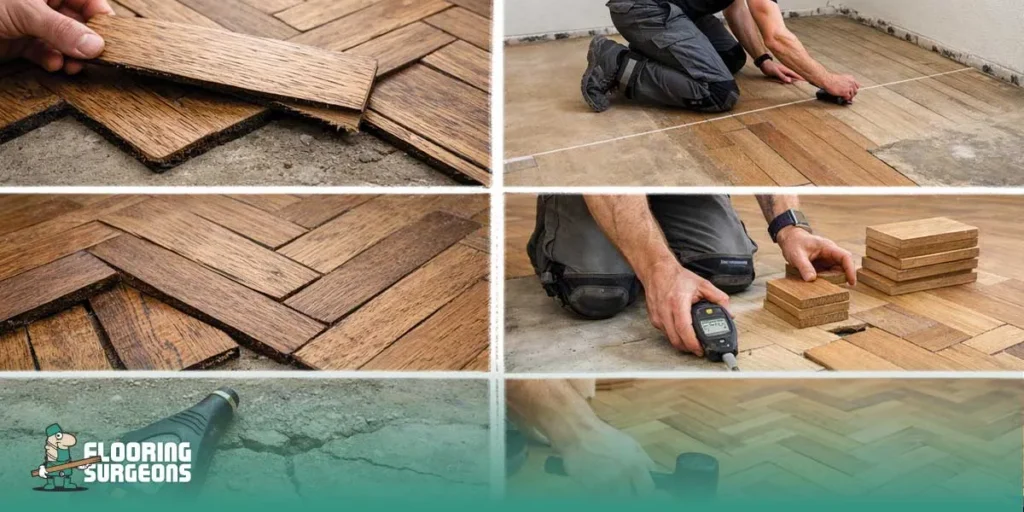
In cases where installation drift or movement has disrupted symmetry, partial lifting and pattern realignment may be required. Because parquet relies on geometric precision, even small deviations can become noticeable across larger rooms. Correction involves resetting reference lines, re-aligning affected sections, and ensuring expansion allowances remain functional.
Replacement is rarely the first solution.
“In many cases, original parquet floors can be restored rather than replaced — preserving both character and property value.”
If you want a parquet floor that stays crisp, flat, and visually consistent for years, treat it like a technical installation—not a weekend project. That’s the point where many homeowners decide it isn’t DIY. Flooring Surgeons helps bridge that gap by approaching parquet as precision work first, and design second.

Haniye Ayanmanesh
As an expert writer for Flooring Surgeons, I combine technical SEO knowledge with a practical understanding of flooring, producing content that helps users make confident decisions while supporting long-term organic growth.