

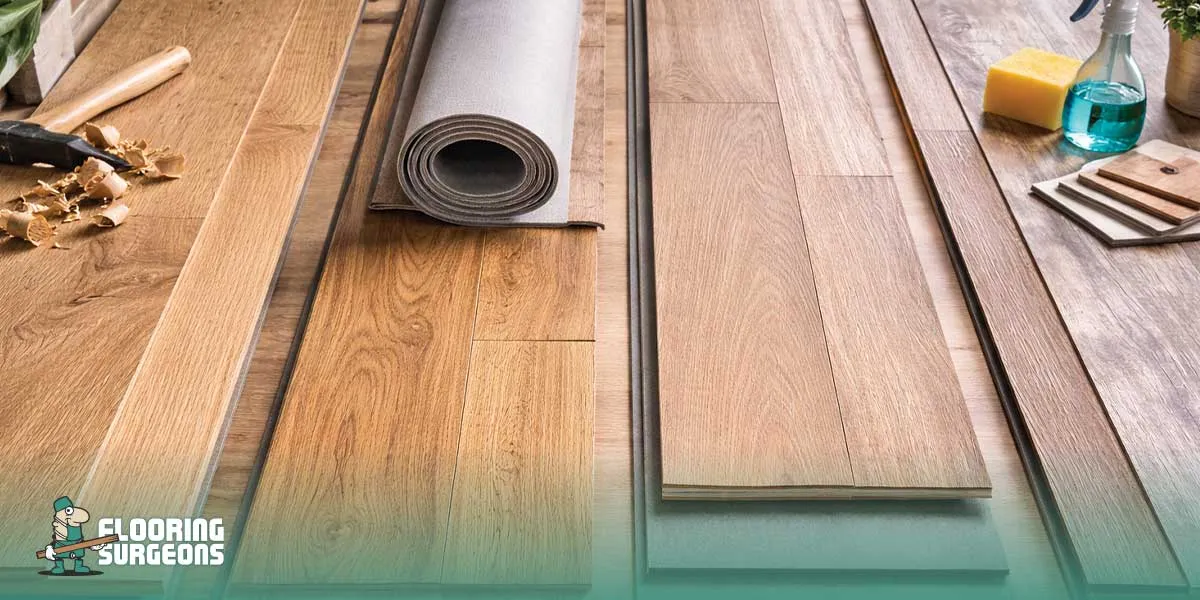
If you want a clear answer straight away, here it is. The main types of wooden flooring are solid wood flooring, engineered wood flooring, laminate flooring, and wood-effect luxury vinyl. Each one looks similar at first glance, but they behave very differently in real homes in terms of durability, stability, maintenance, and cost.
Most confusion around wooden flooring comes from assuming that “wood flooring” is a single product. It is not. Solid wood is made from one piece of timber and offers authenticity, but requires the right conditions. Engineered wood uses a real wood top layer with a layered core, making it more stable and practical for most modern homes. Laminate flooring only imitates wood visually, while wood-effect LVT prioritises durability and moisture resistance over natural material.
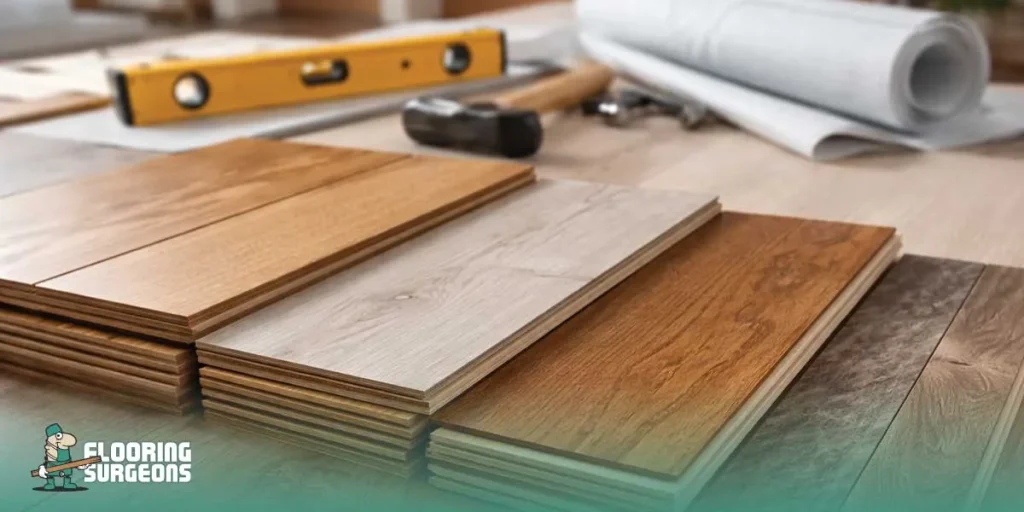
Choosing the wrong type can lead to issues such as movement, warping, high maintenance, or unnecessary expense. Choosing the right type depends less on appearance and more on how the floor will be used, how stable the environment is, and how much maintenance you are realistically willing to accept.
This guide explains the different types of wooden flooring in simple terms. You will see how each type is made, where it works best, where it causes problems, and how to decide which option suits your home, lifestyle, and budget before committing to a purchase.
Table of contents
Which Type of Wooden Flooring Is Right for Your Home?
Choosing the right type of wooden flooring is less about style and more about how each room is actually used. Light levels, moisture exposure, foot traffic, and long-term expectations matter far more than appearance alone. Below, each common space is matched with the flooring types that perform best in real homes, not showroom conditions.
Best wooden flooring for living rooms
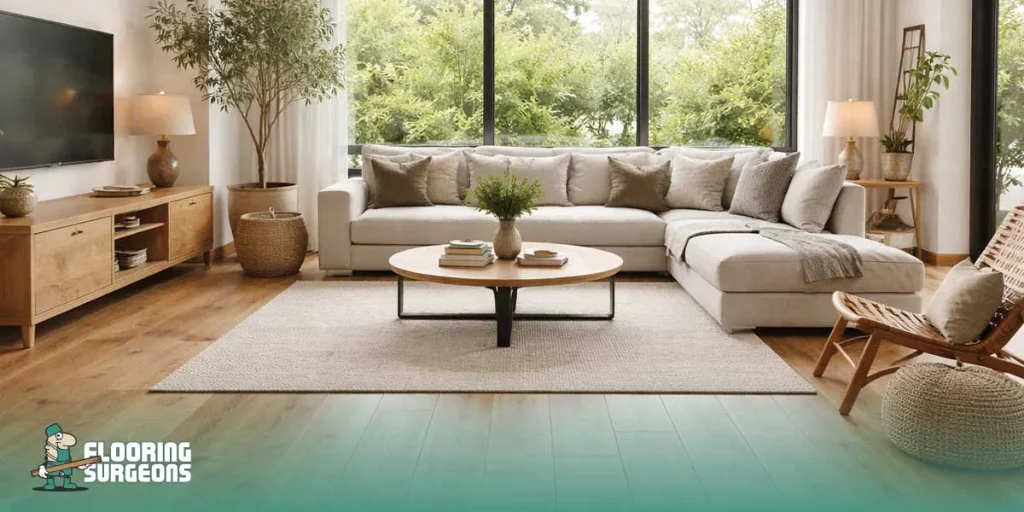
Living rooms usually have moderate foot traffic and stable conditions, which gives more flexibility in flooring choice. The priority here is visual warmth, long-term comfort, and consistency with connected spaces.
Best overall choice:
- Engineered wood flooring
Engineered wood offers the look and feel of real timber while remaining dimensionally stable across seasonal temperature changes. It works well in open-plan living areas and allows for wider planks that reduce visual fragmentation.
Also suitable:
- Solid wood flooring (only where humidity and subfloor conditions are well controlled)
- High-quality laminate flooring for budget-focused projects
Common mistake to avoid:
Choosing solid wood purely for authenticity without considering movement and long-term maintenance. In many UK living rooms, engineered wood performs better over time.
Best wooden flooring for kitchens
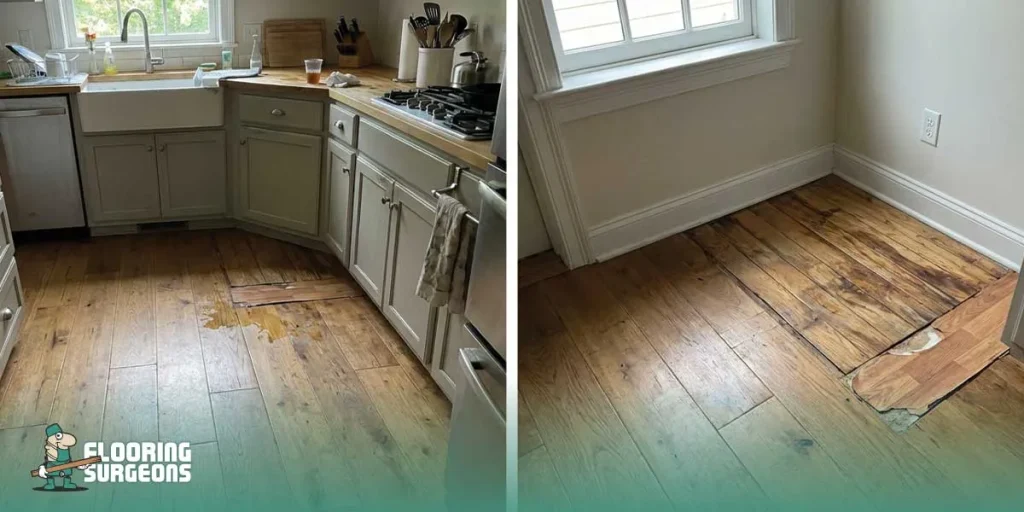
Kitchens introduce moisture, temperature changes, and heavier wear. This is where many wooden flooring mistakes happen.
Best practical choice:
- Engineered wood flooring with a durable finish
Engineered wood can work in kitchens when properly specified and installed, offering a balance between natural appearance and stability.
Also suitable:
- Wood-effect LVT for households prioritising moisture resistance and easy maintenance
Generally not recommended:
- Solid wood flooring, due to its higher sensitivity to moisture
- Low-quality laminate in spill-prone areas
Key decision factor:
If water resistance and low maintenance matter more than natural material, wood-effect alternatives are often the safer long-term choice.
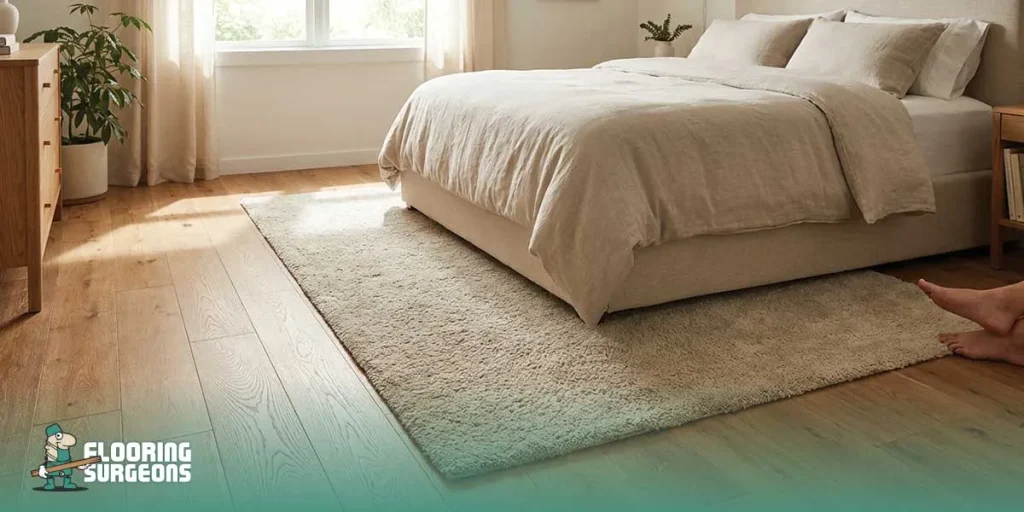
Best wooden flooring for bedrooms
Bedrooms have lighter foot traffic and more controlled conditions, which makes comfort and appearance the main priorities.
Best overall choice:
- Engineered wood flooring
Engineered wood provides warmth underfoot and visual consistency without the maintenance demands of solid wood.
Also suitable:
- Solid wood flooring where environmental conditions are stable
- Laminate flooring is a cost-effective option with minimal wear concerns.
Common mistake to avoid:
Overpaying for heavy-duty flooring performance that is not required in low-traffic spaces.
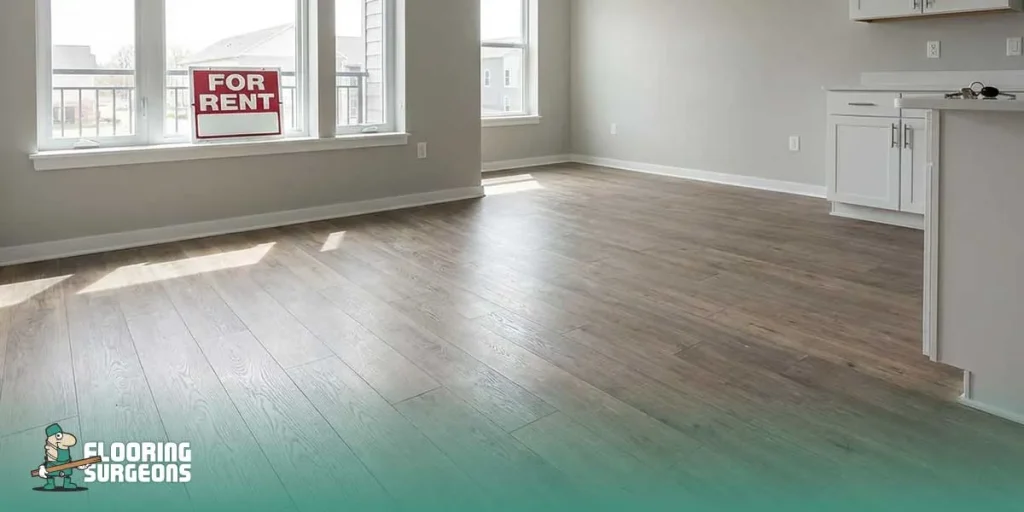
Best wooden flooring for buy-to-let properties
Buy-to-let properties require durability, ease of maintenance, and broad tenant appeal. Flooring decisions here should minimise future costs rather than maximise visual impact.
Best all-round choice:
- Engineered wood flooring
Engineered wood balances durability with a premium appearance, helping maintain property value while reducing long-term issues.
Also suitable:
- High-quality laminate flooring for tighter budgets
- Wood-effect LVT for high-turnover or moisture-prone properties
Key mistake to avoid:
Choosing flooring based on personal taste rather than resilience and replacement cost. Neutral, stable flooring consistently outperforms trend-led options in rental properties.
Quick Decision Table: Choosing the Right Wooden Flooring
| Area / Condition | Best Choice | Why It Works | Use With Caution | Generally Avoid |
| Living rooms | Engineered wood | Stable, visually warm, suits open-plan layouts | Solid wood (only in controlled conditions) | Cheap laminate |
| Kitchens | Engineered wood (durable finish) | Better stability around moisture | Wood-effect LVT | Solid wood |
| Bedrooms | Engineered wood | Comfort, low wear, long lifespan | Laminate (budget-led) | Over-specified heavy-duty floors |
| Buy-to-let | Engineered wood | Balance of durability and resale appeal | Laminate, wood-effect LVT | Trend-led or fragile finishes |
| Underfloor heating | Engineered wood | Designed for dimensional stability | Certain laminates | Solid wood |
| Uneven or older subfloors | Engineered wood | Tolerates movement better | Laminate (with prep) | Solid wood |
| Moisture-prone homes | Wood-effect LVT | Water resistance, low maintenance | Engineered wood (careful spec) | Solid wood |
If you want one option that works in most situations, engineered wood flooring is the safest and most versatile choice for UK homes.
Common Wooden Flooring Mistakes Homeowners Make
This is where many flooring decisions go wrong. Not because the materials are bad, but because the context is ignored.
- Choosing solid wood without understanding the solid vs engineered wood differences
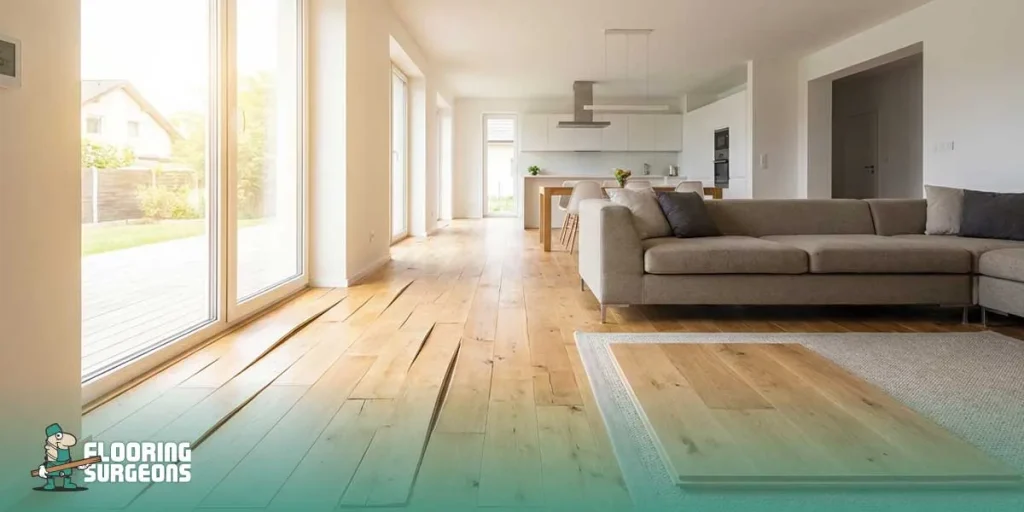
Solid wood flooring is often seen as the “premium” option, but in many modern homes, it is the wrong choice. Solid boards expand and contract significantly with changes in temperature and humidity. In properties with underfloor heating, open-plan layouts, or seasonal moisture variation, this movement can cause gaps, cupping, or warping.
Why does this happen?
Homeowners prioritise authenticity without considering environmental stability.
Smarter alternative:
Engineered wood flooring which delivers the look of real wood with far greater dimensional stability.
- Ignoring subfloor and moisture conditions
The subfloor and moisture levels have a bigger impact on performance than the flooring material itself. Installing any wooden floor over an uneven, damp, or poorly prepared subfloor increases the risk of movement, noise, and long-term damage, which is why engineered wood installation basics matter.
Why does this happen?
Focus is placed on surface appearance instead of structural conditions.
Smarter approach:
Assess moisture levels, subfloor flatness, and insulation before selecting the flooring type. In higher-risk environments, engineered wood on concrete floors or wood-effect alternatives are often more reliable.
- Overpaying for unnecessary materials
Not every room needs the most expensive or hardest-wearing wooden flooring. Bedrooms, for example, experience minimal wear, yet homeowners often overspecify materials designed for heavy commercial use.
Why does this happen?
Marketing language suggests “better” always means “more expensive”.
Smarter approach:
Match the flooring type to actual room usage. Spending strategically across the home delivers better long-term value than upgrading every space unnecessarily.
Solid vs Engineered vs Laminate: Key Differences at a Glance
| Feature / Question | Solid Wood Flooring | Engineered Wood Flooring | Laminate Flooring |
| Is it real wood? | Yes, solid timber throughout | Yes, real wood top layer | No, wood-effect surface |
| Stability in UK homes | Low | High | High |
| Reaction to moisture & humidity | High movement risk | Controlled and stable | Minimal movement |
| Suitable for underfloor heating | No | Yes (when specified correctly) | Sometimes |
| Subfloor tolerance | Low | Medium to high | Medium |
| Typical lifespan | Very long (if conditions are perfect) | Long and predictable | Medium |
| Maintenance level | High | Moderate | Low |
| Can it be sanded/refinished? | Multiple times | Limited (depends on wear layer) | No |
| Installation flexibility | Limited | Flexible | Flexible |
| Cost vs performance value | Low for most homes | Best balance | Budget-focused |
| Common regret factor | Movement, warping, gaps | Very few, when correctly chosen | Feels artificial over time |
| Best suited for | Traditional, stable environments | Most modern UK homes | Rentals, tight budgets |
How to read this table (important)
This comparison is not about which flooring is “better” in theory. It is about which one performs reliably in real homes.
- Solid wood flooring only performs well when environmental conditions are tightly controlled. In most UK homes, seasonal humidity changes, underfloor heating, or open-plan layouts make this difficult to achieve.
- Engineered wood flooring offers the most consistent balance between appearance, stability, and long-term performance. This is why it is the safest recommendation for the majority of homeowners.
- Laminate flooring prioritises practicality and cost over authenticity. It can work well in specific situations, but it does not behave like real wood over time.
Decision shortcuts (for users who want a fast answer)
- If you want real wood with minimal risk, choose engineered wood flooring.
- If your home has underfloor heating or variable humidity, avoid solid wood.
- If budget and durability matter more than material authenticity, laminate can be acceptable.
- If you are choosing flooring for long-term living rather than short-term appearance, stability matters more than tradition.
Which Type of Wooden Flooring Lasts the Longest?
When people ask which type of wooden flooring lasts the longest, they often mean which floor will look good and perform well without constant problems or expensive intervention. Longevity is not just about how long a material can exist, but how reliably it performs in real living conditions.
Real lifespan of solid, engineered, and laminate flooring in homes
In theory, solid wood flooring has the longest potential lifespan because it can be sanded and refinished multiple times. However, this only applies in environments where temperature and humidity remain stable over decades. In many modern UK homes, those conditions are difficult to maintain consistently.
Engineered wood flooring thickness plays a major role in delivering a more predictable lifespan. While it cannot always be refinished as many times as solid wood, its layered construction makes it far more stable. In practice, this stability often results in fewer issues, less visible wear, and a longer period of trouble-free use.
Laminate flooring has a more limited lifespan. It cannot be refinished, and once the surface layer is worn or damaged, replacement is the only option. That said, in low-impact environments, it can still perform acceptably for many years. The longest-lasting floor in real homes is usually the one that remains stable, not the one that can theoretically be repaired the most.
Maintenance requirements that affect the longevity of wooden flooring
Maintenance expectations are often underestimated at the point of purchase. Solid wood flooring requires careful humidity control, regular maintenance, and a higher tolerance for natural movement. Without this, even a high-quality solid floor can deteriorate faster than expected.
Engineered wood flooring requires moderate maintenance. When finished properly, it is easier to live with, more forgiving of environmental changes, and less likely to develop issues that require intervention.
Laminate flooring requires minimal maintenance, but it offers no repair flexibility. Damage is final rather than gradual. A floor that needs constant attention does not feel long-lasting, even if the material itself is durable.
Long-term flooring costs compared to the upfront price
Upfront cost rarely reflects long-term value. Solid wood flooring has a high initial cost and can incur additional expenses related to maintenance, sanding, and environmental control. These costs are often overlooked when comparing options.
Engineered wood flooring typically offers the best cost-to-performance balance. Its upfront cost is lower than that of solid wood, while long-term maintenance and failure risk are significantly reduced.
Laminate flooring has the lowest upfront cost, but replacement cycles can make it more expensive over time in high-traffic or long-term homes. The most cost-effective floor over time is usually the one that avoids problems, not the one with the lowest price tag.
Final Thoughts: Choosing Wooden Flooring Without Regret
Wooden flooring decisions should be guided by how a home is lived in, not by labels or assumptions. Solid wood, engineered wood, and laminate flooring each have their place, but they perform very differently once installed.
For most modern UK homes, engineered wood flooring offers the most reliable combination of appearance, stability, lifespan, and long-term value. Solid wood can be an excellent choice in the right conditions, but it is rarely the most practical option. Laminate flooring can work well where budget or durability takes priority, but it should be chosen with clear expectations. The biggest mistakes happen when flooring is selected based on tradition, trends, or showroom appeal rather than real-world performance. When stability, environment, and usage are prioritised, wooden flooring becomes a long-term asset rather than a recurring problem.
If there is one principle to take away from this guide, it is this: the best wooden flooring is not the one that sounds most premium, but the one that performs consistently in your home over time. That is the difference between choosing flooring that looks good and choosing flooring you will not regret. At Flooring Surgeons, we see the same pattern repeatedly. Poor products do not cause most flooring regrets, but choosing the wrong type of wooden flooring for the way a home is actually used can.

Haniye Ayanmanesh
As an expert writer for Flooring Surgeons, I combine technical SEO knowledge with a practical understanding of flooring, producing content that helps users make confident decisions while supporting long-term organic growth.