

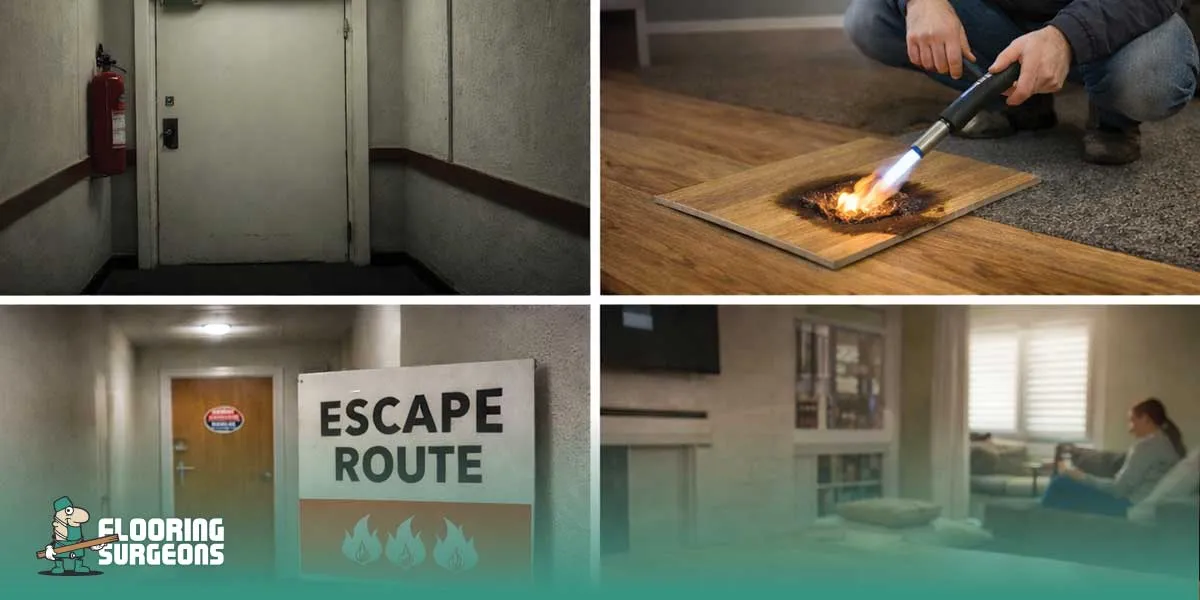
Fire safety ratings in flooring matter in the UK, but not in the way many homeowners assume. In simple terms, fire ratings are about how a floor reacts to fire, not whether it is “fireproof,” and they become most important in specific situations such as flats, escape routes, and shared or high-risk areas. For many standard houses, they are not something that dictates every flooring choice, but they are still a factor that should be understood rather than ignored.
The confusion usually comes from mixed messages. Some sources make fire ratings sound like a strict legal requirement for all homes, while others barely mention them at all. The reality sits in between. Fire safety ratings exist to limit how quickly fire can spread and how much smoke is produced, buying valuable time for escape. Whether that is critical for your home depends on layout, property type, and where the flooring is installed. A hallway or staircase in a flat is very different from a bedroom floor in a detached house.
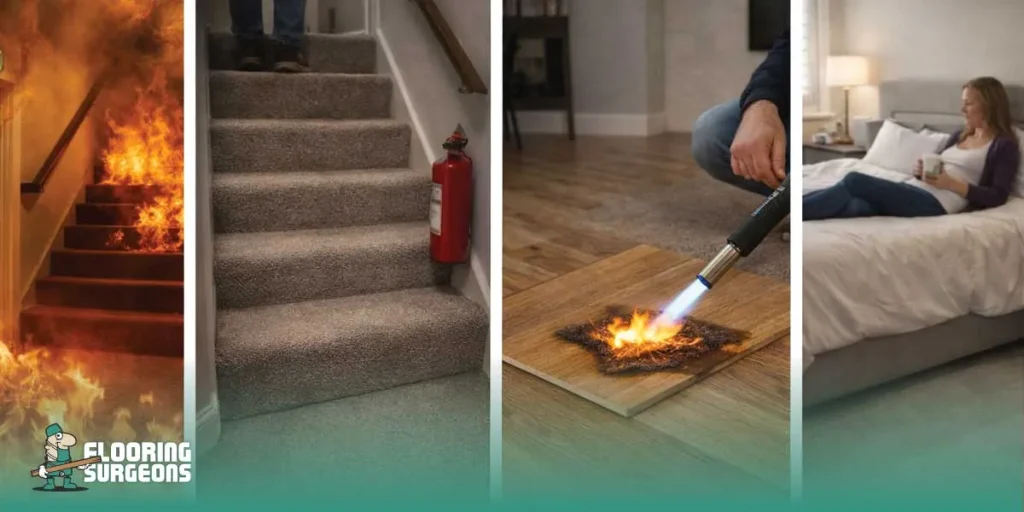
This article explains, in plain language, what fire safety ratings in flooring actually mean for UK homeowners, when they genuinely matter, and when they are less critical. You will learn how different flooring types behave in a fire, how installation and finishes affect performance, and how to make sensible choices without overcomplicating the process. If you only wanted a direct answer, fire safety ratings matter most where flooring can affect escape and fire spread. If you want to feel confident that your flooring choices are both safe and appropriate for your home, the rest of the article will guide you through that step by step.
Table of contents
Do Fire Safety Ratings Really Matter for Flooring in UK Homes?
Short answer: yes, but not in every situation. Fire safety ratings for flooring matter most when the floor can influence how quickly a fire spreads or how safely people can escape. They are not a universal constraint on all flooring choices, but they become critical in certain types of properties and locations within a home.
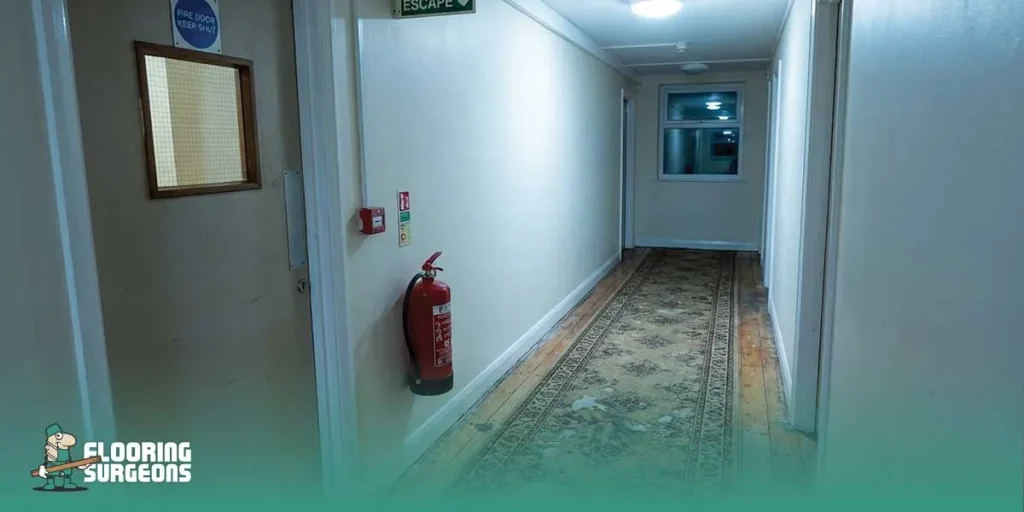
Fire ratings matter more in:
- Flats and apartments, where fire can spread between dwellings and escape routes are shared
- Escape routes, such as hallways, corridors, and staircases, where smoke and flame spread, directly affect evacuation time.
- Multi-occupancy buildings, including HMOs and buildings with communal areas, where legal standards are stricter
They are less critical (but still relevant) in:
- Single-family houses, especially in rooms away from escape routes
- Areas where flooring does not materially affect how a fire develops or how occupants leave the building
- Homes with straightforward layouts and multiple escape options, where risk is lower
That said, “less critical” does not mean irrelevant. Even in houses, flooring choice can influence smoke production, flame spread, and overall fire behaviour, particularly in circulation areas. If you only wanted a direct answer, fire safety ratings matter most when flooring can affect fire spread or escape time.
What Fire Safety Ratings in Flooring Actually Mean?
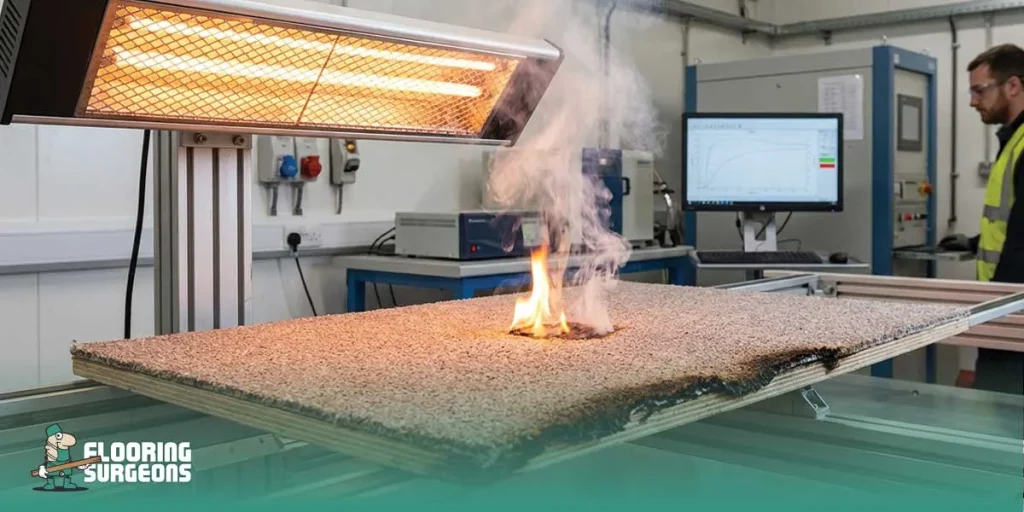
Fire safety ratings in flooring are often misunderstood because they sound more reassuring than they really are. A fire rating does not mean a floor is fireproof, and it does not mean it will stop a fire. What it measures is how the flooring reacts when exposed to fire, particularly how quickly it ignites, how much flame it spreads, and how much smoke it produces.
What does a fire rating actually measure?
Flooring fire ratings assess reaction to fire, not resistance. In practical terms, this means:
- How easily the flooring ignites
- How fast flames spread across its surface
- How much heat and smoke it contributes once burning
This matters because most injuries and fatalities in domestic fires are caused by smoke and rapid fire spread, not structural collapse. Flooring that slows flame spread or limits smoke buys time, which is critical for escape.
Fire resistance vs reaction to fire
These two terms are often confused, but they describe very different things.
- Fire resistance refers to how long a structural element (like a wall, floor structure, or door) can withstand fire without failing. This is about containment and load-bearing performance.
- Reaction to fire describes how a surface material behaves when fire reaches it. Flooring falls into this category. It does not block fire; it either helps fire spread or limits how aggressively it develops.
Most domestic flooring is rated only for reaction to fire, not resistance.
The Euroclass system, in plain English
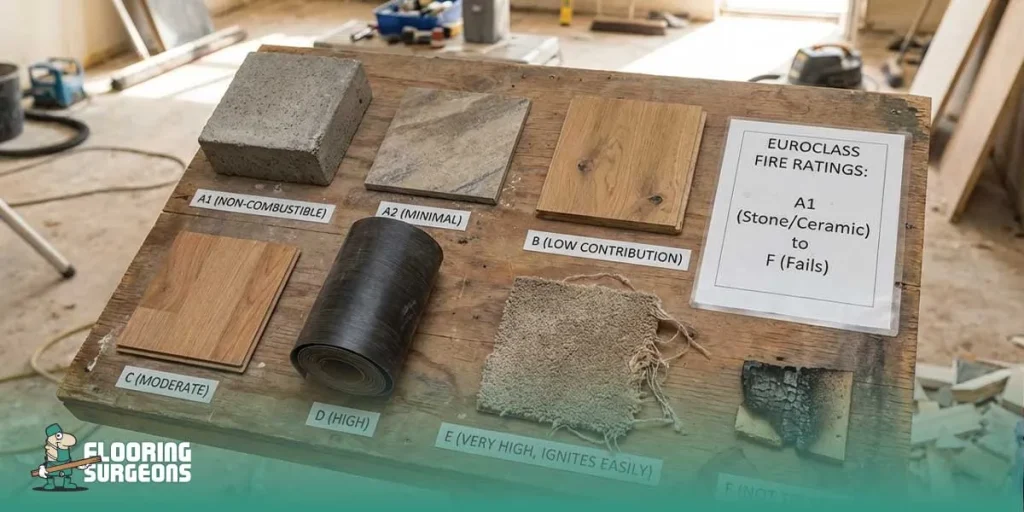
In the UK, flooring fire ratings are usually expressed using the Euroclass system, which runs from A1 to F.
- A1: Will not contribute to fire at all (typically stone or ceramic)
- A2: Minimal contribution to fire
- B: Low contribution to fire
- C: Moderate contribution
- D: High contribution
- E: Very high contribution, ignites easily
- F: Not tested or fails to meet minimum standards
Most residential flooring products sit somewhere between B and E, depending on material, construction, and finish. Importantly, even a higher rating like B does not mean the floor will not burn. It means it burns more slowly, spreads flame less aggressively, or produces less smoke compared to lower-rated options.
Why does a higher rating not mean non-combustible?
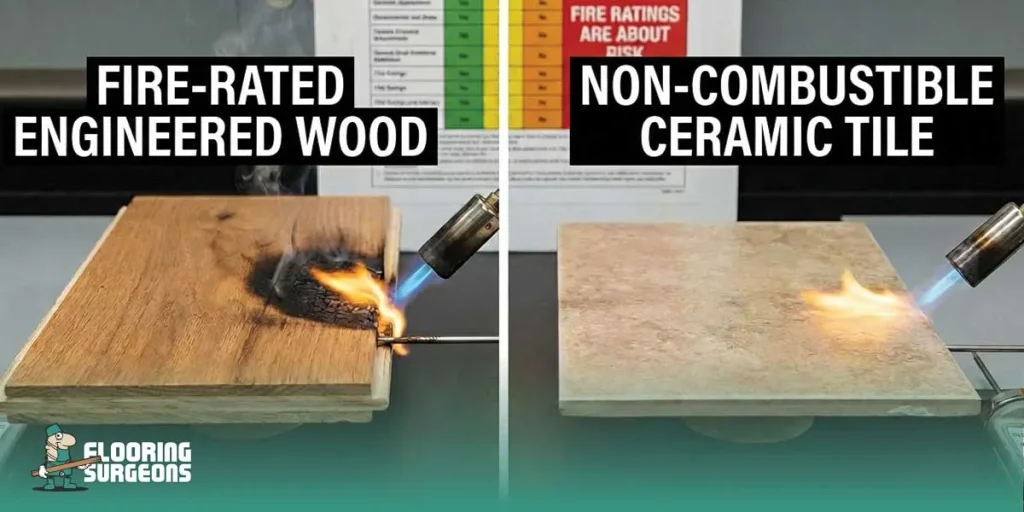
This is where expectations often go wrong. Many products with decent fire ratings are still combustible. For example, some engineered wood or treated vinyl floors achieve respectable Euroclass ratings through coatings or construction methods, but the core material can still burn. A higher rating simply indicates better behaviour under fire conditions, not immunity from fire. The role of flooring in fire safety is not to stop a fire, but to avoid accelerating it in areas where escape time matters. Understanding this distinction helps homeowners make realistic, informed choices. Fire ratings are about risk reduction, not absolute protection.
Fire Safety Regulations for Flooring in UK Homes
Fire safety rules for flooring in the UK often cause confusion because legal requirements and best practice are not the same thing. In many cases, homeowners are not legally forced to choose a specific fire-rated floor, but that does not mean fire performance is irrelevant or optional. This becomes even more relevant in rental and shared buildings, where flooring choices are closely linked to safety and compliance, particularly in the context of flooring requirements for buy-to-let properties in the UK.
Legal requirements vs best practice
In simple terms:
- Legal requirements apply only in specific situations and building types. These are the minimum standards that must be met.
- Best practice and safety guidance go further. They focus on reducing risk, improving escape time, and avoiding materials that could make a fire spread faster, even when the law does not strictly demand it.
Many fire-related flooring issues arise not because a rule was broken, but because a legal minimum was followed where a safer option was more appropriate.
Where fire safety regulations usually apply?
Fire performance of flooring becomes a regulatory issue mainly in buildings where fire spread affects multiple people or shared escape routes.
- Flats and apartments
Flooring in flats is more tightly controlled, especially in buildings with shared stairwells or corridors. Because residents rely on common escape routes, surface materials that accelerate fire or smoke spread are treated more seriously. - Escape routes
Areas that form part of an escape route, such as hallways, staircases, and landings, often face stricter expectations. Flooring here can directly affect how quickly fire and smoke travel during an emergency. - Communal areas
Shared spaces in apartment blocks or mixed-use buildings usually fall under higher scrutiny. Flooring in these areas is expected to limit fire growth rather than contribute to it.
In contrast, single-family houses generally have fewer explicit legal restrictions on flooring choice, particularly away from staircases or exits.
Why do homeowners still need awareness?
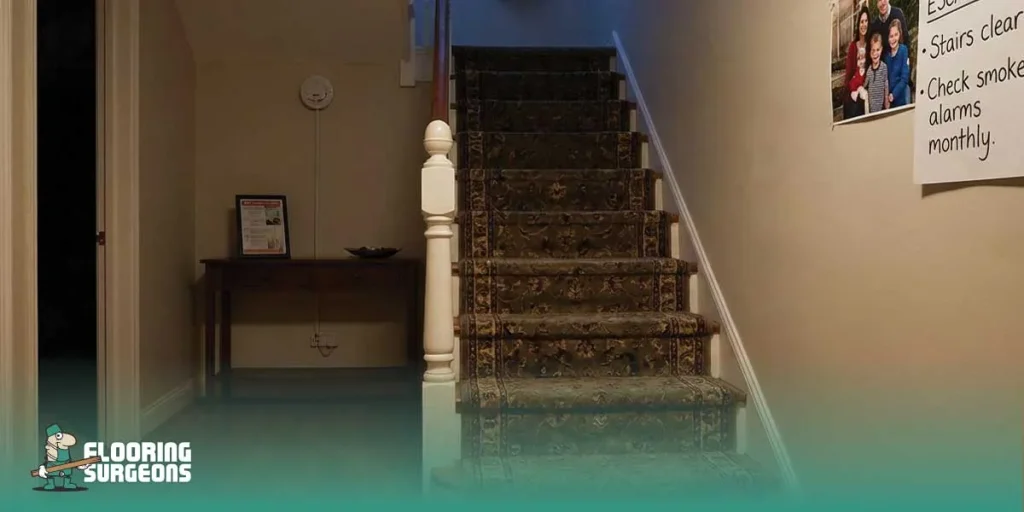
Even when there is no strict legal requirement, flooring still plays a role in fire behaviour. A floor that ignites easily, produces heavy smoke, or spreads flame rapidly can reduce escape time, especially at night or in homes with open-plan layouts. Homeowners often assume fire safety is handled entirely by alarms and doors. In reality, surface materials influence how quickly conditions become dangerous. Choosing flooring with better fire performance in key areas, such as stairs or hallways, can meaningfully reduce risk, even if the law does not explicitly require it.
The key takeaway is this:
Regulations define the minimum. Awareness and good judgment determine whether a home is merely compliant or genuinely safer.
How Different Flooring Types Perform in a Fire?
The table below gives a clear, practical comparison of common flooring types, focusing on what actually matters in a fire. It avoids technical overload and highlights real-world risk, not marketing claims. This variability is especially noticeable with layered products such as engineered wood flooring systems, where adhesives and construction methods play a major role in fire behaviour.
| Flooring type | Typical fire rating behaviour | Key risk factor | Notes for UK homes |
| Solid wood | Combustible, predictable burn rate | Contributes fuel once ignited | Burns steadily rather than melting; risk increases in escape routes and stairs |
| Engineered wood | Combustible with variable performance | Adhesives and layered construction | Some products perform worse than solid wood due to glue layers and faster flame spread |
| Laminate | Lower fire performance than real wood | Rapid flame spread and smoke | Core materials and resins can increase smoke and heat release |
| LVT / vinyl | Generally poor fire reaction | Toxic smoke and melting | Can soften, deform, and produce dense smoke early in a fire |
| Carpet | Performance varies by fibre and backing | Smoke production | Wool performs better than synthetic; the underlay can significantly affect behaviour |
| Stone/tile | Non-combustible (high rating) | Minimal | Does not contribute to fire spread; safest option near escape routes |
How to read this table properly
- Fire rating behaviour reflects how the material reacts once exposed to fire, not whether it is “fireproof”.
- Key risk factor highlights why a material may be problematic, not just whether it burns.
- Notes for UK homes focus on where the material choice matters most, such as stairs, hallways, and flats.
No flooring is risk-free, but some materials clearly worsen fire conditions faster than others. In UK homes, the most significant concerns are smoke, flame spread, and escape time, not whether a floor technically ignites. This is why non-combustible surfaces perform best in critical areas, while combustible floors require more careful placement and awareness. This comparison should help you judge materials realistically, without assuming that “natural” automatically means safer or that modern products are always compliant by default.
How Installation and Finishes Affect Fire Safety Ratings?
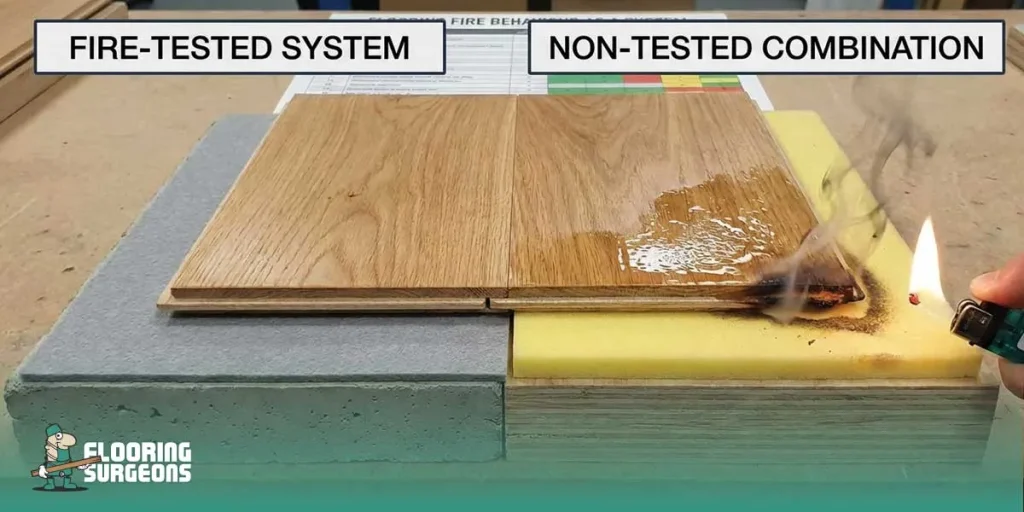
Fire safety performance is not determined by the flooring material alone. The same product can perform very differently once installed, depending on what sits beneath it and what is applied on top. Fire behaviour is best understood as a system, not a single component. Because fire performance depends on the full system, advice from experts at Flooring Surgeons can help ensure materials, underlay, and finishes work together safely.
- Subfloor and adhesives
The type of subfloor and adhesive can significantly affect fire behaviour. Some adhesives ignite or soften early, increasing flame spread and smoke production. A non-combustible floor covering installed over a combustible adhesive system may perform worse than expected in real conditions. - Underlay choice
Underlay often has a bigger impact than homeowners realise. Foam and rubber underlays can accelerate fire spread and produce dense smoke, even if the visible floor covering has a reasonable fire rating. Fire-tested flooring systems usually assume a specific underlay type. - Surface finishes and coatings
Oils, lacquers, and sealants can alter how quickly a floor ignites and how flames travel across the surface. Certain finishes increase the surface spread of flame, while others slow it down. Fire ratings are typically tested with specific finishes, not all possible coatings. - Installation method
Floating, glued, or mechanically fixed installations behave differently in a fire. Floating systems may shift or expose edges sooner, while poorly fixed floors can fail faster under heat. Installation quality directly influences fire performance. - System compatibility
Fire ratings are issued for tested combinations, not for individual layers in isolation. Changing one component, such as the underlay or finish, can invalidate assumptions about performance even if the flooring itself remains unchanged.
The key point
Fire safety ratings reflect how a flooring system behaves as a whole, not just the surface material you can see. This is why two homes using the same flooring product can experience very different fire outcomes depending on installation choices.
How to Choose Flooring with Fire Safety in Mind?
Choosing flooring with fire safety in mind does not mean defaulting to the highest rating available. It means understanding where risk actually exists and making informed, proportionate decisions based on how the space is used.
- Where the flooring will be installed
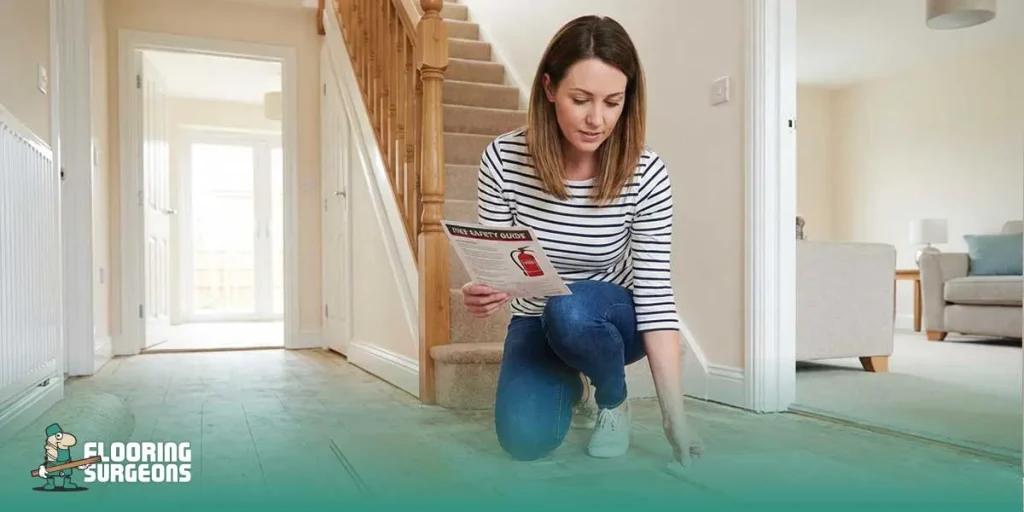
Flooring in escape routes, communal areas, hallways, and stairwells carries greater fire safety importance than flooring in low-risk rooms. The closer the floor is to an exit path, the more its fire behaviour matters. - Who uses the space
Homes with multiple occupants, short-term lets, or vulnerable users require a higher level of consideration than single-occupant households. Fire safety ratings become more relevant as responsibility and exposure increase. - Escape routes and layout
Open-plan layouts, shared corridors, and staircases can allow fire and smoke to travel more quickly. Flooring in these areas should be chosen with reaction-to-fire performance in mind, not just appearance. - Material and installation combination
Always consider the full flooring system. Material, adhesive, underlay, and finish work together to determine real fire performance. A safer material can underperform if installed with the wrong components. - Balancing safety with appearance
Many visually appealing floors also meet sensible fire performance expectations when specified correctly. Fire safety does not require compromising design, but it does require awareness.
Fire safety ratings should inform your flooring decision, not dominate it. When you understand where fire performance genuinely matters and how installation affects outcomes, you can choose flooring that is both appropriate for your home and aligned with sensible safety expectations.
Key Takeaways for UK Homeowners
- Fire safety ratings matter contextually.
Fire ratings are most important where flooring can affect escape time or fire spread, such as flats, communal areas, and key circulation routes. They are less critical in some private spaces, but never irrelevant. - Material alone does not define fire performance.
Flooring fire behaviour depends on the entire system, including subfloor, adhesive, underlay, and finish. The same material can perform very differently depending on how it is installed. - Awareness is more valuable than panic.
Fire safety does not require extreme choices or constant fear. Understanding where risk exists and how ratings work allows for calm, proportionate decisions. - Informed choices lead to safer homes.
When homeowners consider layout, usage, and installation alongside material selection, flooring becomes part of a broader safety strategy rather than a standalone concern.
Fire safety ratings are not about eliminating all risk. They are about making informed, sensible choices that support both everyday living and long-term safety in UK homes.

Haniye Ayanmanesh
As an expert writer for Flooring Surgeons, I combine technical SEO knowledge with a practical understanding of flooring, producing content that helps users make confident decisions while supporting long-term organic growth.