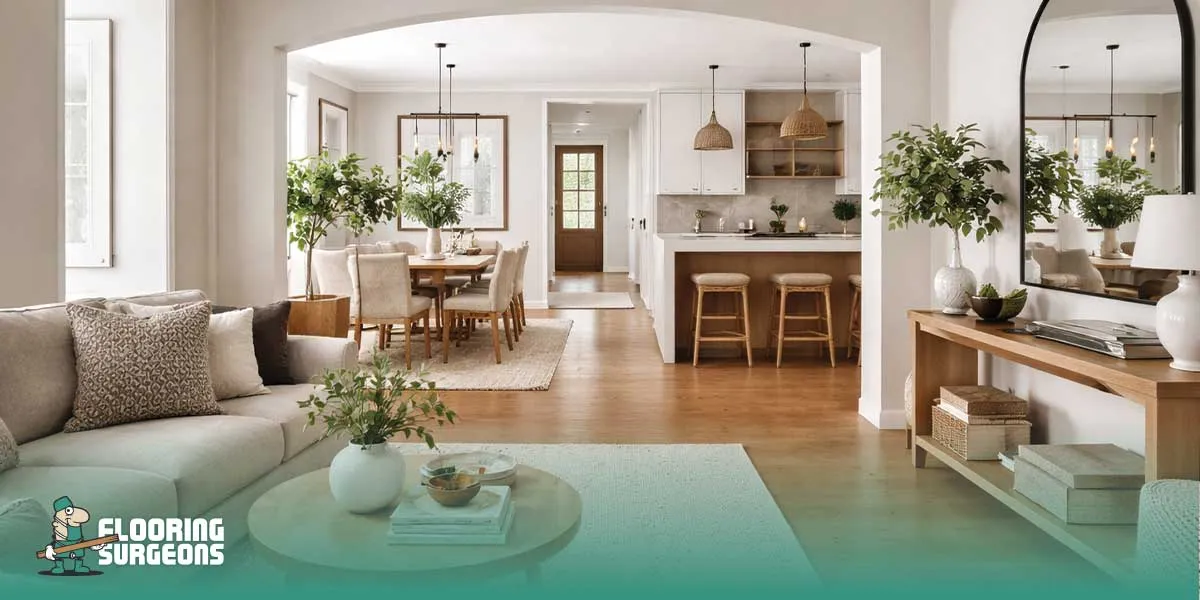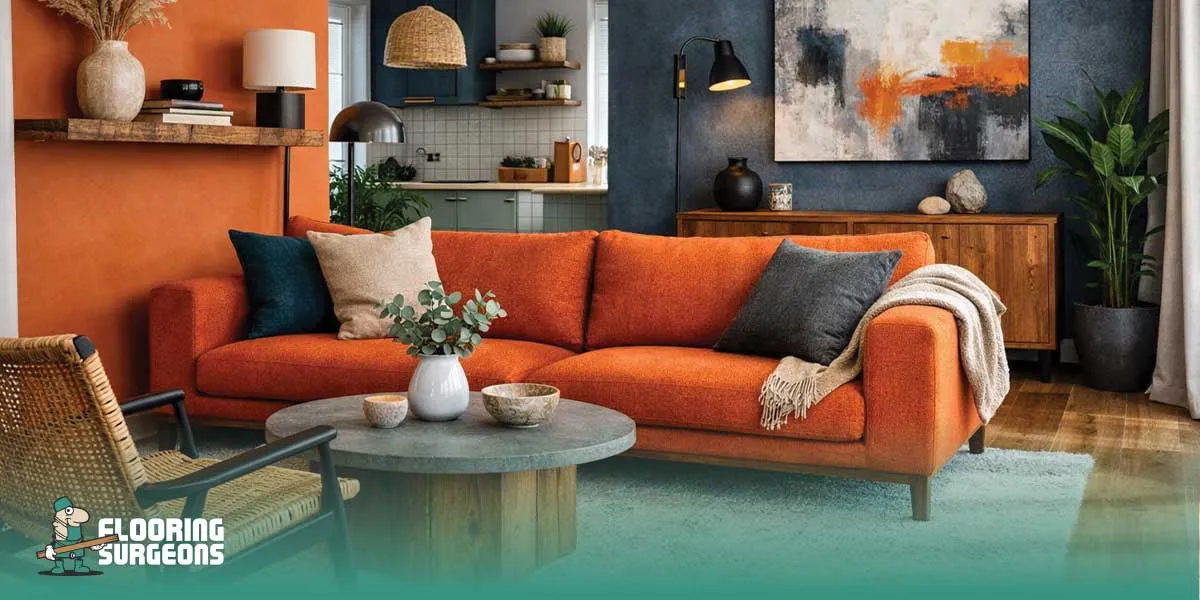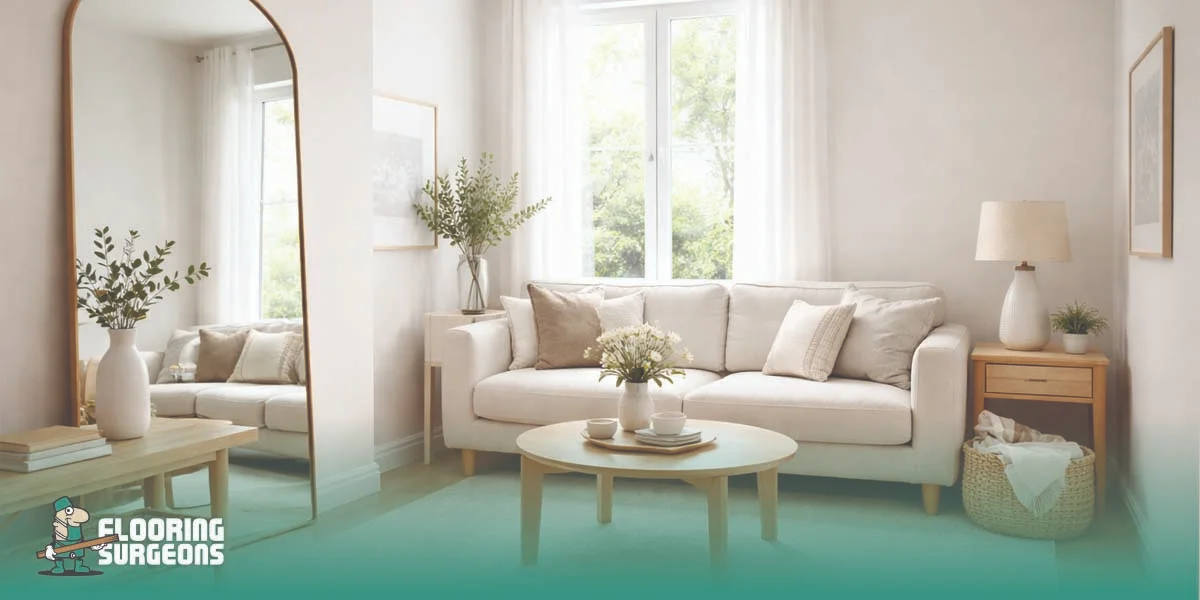


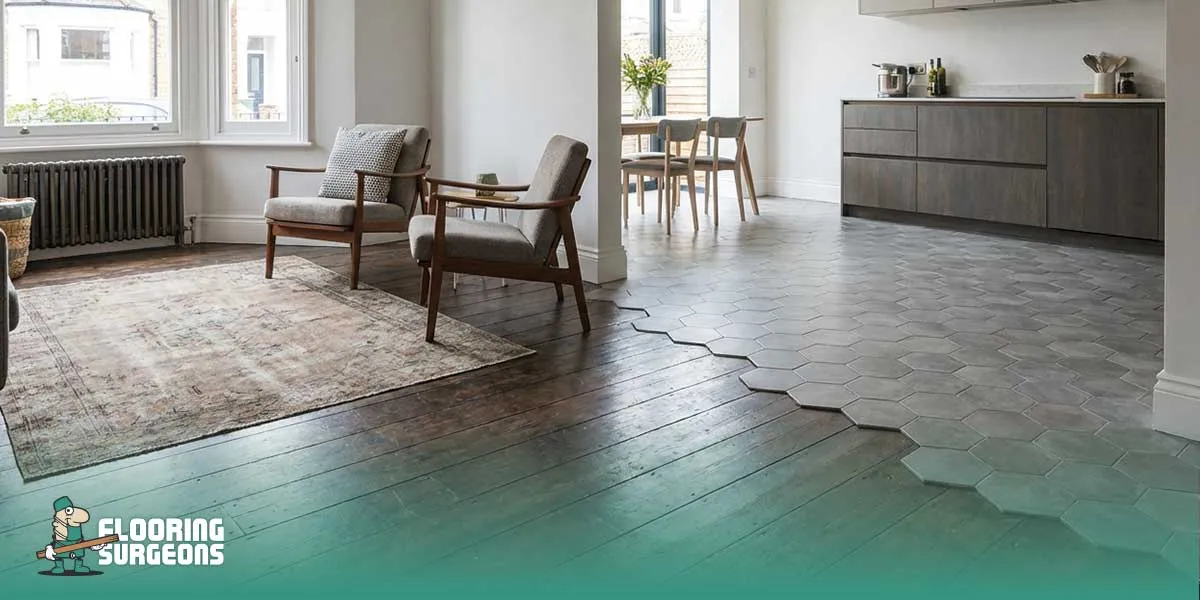
A flooring-only transitional space is an area where the boundary between two zones is defined entirely through the floor design, without using walls, partitions, level changes or architectural barriers. Instead, the transition is created by changing the flooring material, pattern, colour, texture or installation direction. In simple terms, the floor itself becomes the tool that tells you: “This space ends here, and another one begins.” This approach allows spaces to be clearly understood while remaining visually connected — a key requirement in contemporary interior design.
Why flooring-based transitions are essential in modern interiors
Modern homes increasingly rely on open-plan layouts, where kitchens, living areas, dining spaces and entry zones flow into one another. While this improves light, flexibility and spatial openness, it also creates a new design challenge: how to define different functions without breaking the flow.
Flooring-only transitions solve this problem by:
- Defining zones without enclosing them
- Maintaining visual continuity across the interior
- Improving spatial legibility and wayfinding
- Supporting both aesthetic cohesion and practical performance
Rather than acting as a background finish, the floor becomes an active spatial organiser.
A well-designed flooring transition:
- Separates spaces without isolating them
- Enhances movement and visual flow
- Works in both compact homes and large open interiors
- Turns flooring into a strategic design element, not just a surface
The sections that follow explore types of flooring transitions, material choices, design techniques and common mistakes, showing how transitional spaces can be designed using flooring alone — intelligently, elegantly and without unnecessary complexity.

Table of contents
Benefits of Designing Transitions with Flooring Alone
Visual zoning without walls
This approach has become increasingly common in open-plan interiors, particularly when using flooring to define zones without walls while maintaining visual continuity. Using flooring alone to define transitions allows spaces to be clearly zoned without physical separation. By changing material, pattern or direction underfoot, the eye naturally recognises where one area ends and another begins — even though the space remains open.
This approach is especially effective because it:
- Preserves openness and natural light
- Avoids visual clutter from partitions or screens
- Creates intuitive spatial boundaries users understand instantly
In short, flooring-based zoning defines space without adding mass to it.
Enhancing flow in open-plan designs
One of the biggest strengths of flooring-only transitions is their ability to maintain continuity. Unlike walls or steps, a well-planned floor transition guides movement smoothly from one zone to the next.
In open-plan interiors, this means:
- Movement feels natural rather than interrupted
- Spaces remain connected, not fragmented
- The layout reads as intentional, not improvised
The result is an interior that flows logically, where each area feels distinct yet part of a coherent whole.
Practical advantages: durability, safety and performance
Beyond aesthetics, flooring-only transitions also offer clear functional benefits.
When designed correctly, they can:
- Reduce wear by placing durable materials in high-traffic zones
- Improve safety by avoiding thresholds and level changes
- Allow materials to be selected based on moisture, heat or usage needs
- Simplify cleaning and long-term maintenance
By letting the floor respond directly to how a space is used, transitions become both practical and purposeful, not just decorative.
Why this approach works
Designing transitions with flooring alone strikes a rare balance:
- Clear spatial definition
- Uninterrupted flow
- Long-term practicality
This is why it has become a preferred strategy in contemporary interiors — particularly where flexibility, openness and performance all matter.

Key Concepts in Flooring Transitions
- Transition refers to a deliberate change in flooring used to connect two spaces while maintaining continuity. It is primarily a design decision, not a physical barrier, and can be achieved through material change, pattern shift, colour contrast or directional layout.
- Threshold is a functional break point, traditionally used at doorways. It often involves a strip or edge detail and exists to manage structural movement, level changes or material expansion rather than spatial design.
- Border is a decorative or framing element within flooring. It does not separate spaces functionally but highlights edges, zones or focal areas, often used to visually anchor a layout.
- Transitions influence how large or small a space feels. Seamless or subtle transitions make interiors appear larger and more open, while strong contrasts create clear spatial definition but can visually shorten or narrow areas.
- Direction and pattern matter as much as material. Changing plank orientation or introducing a patterned zone can guide movement, suggest hierarchy and subtly control how the eye travels through a space.
- Colour and tone affect perception. Lighter, continuous flooring enhances brightness and openness, while darker or contrasting transitions emphasise separation and function.
- Well-placed transitions improve spatial legibility. Users instinctively understand where activities change — for example, from circulation to living — without needing signage, furniture or walls.
- Poorly planned transitions can fragment space. Overuse, misalignment or unnecessary breaks interrupt flow and make interiors feel disjointed rather than intentional.
Types of Flooring Transitions
| Transition Type | How it works | Best used when | Visual effect | Key considerations |
| Seamless transitions (flush, same material) | A continuous floor surface with no visible break, often using the same material throughout | You want maximum openness and minimal visual interruption | Makes spaces feel larger, calmer and more unified | Requires precise installation, level subfloors and careful planning for expansion joints |
| Contrast transitions (colour or texture change) | The flooring material stays the same, but colour, finish or texture changes to mark zones | Spaces need definition without changing materials | Clearly defines zones while maintaining material consistency | Over-contrast can visually fragment space if not balanced carefully |
| Material mix transitions (e.g. wood–tile, stone–wood) | Two different flooring materials meet at a planned transition line | Different functional needs (moisture, heat, durability) exist | Strong functional and visual separation between areas | Height differences, expansion gaps and edge detailing must be resolved correctly |
| Directional transitions | Flooring direction changes rather than material or colour | You want subtle zoning without strong contrast | Guides movement and influences spatial perception | Poor alignment can feel accidental rather than intentional |
| Pattern-based transitions | A patterned zone (herringbone, geometric, inset area) marks the transition | The transition itself should become a design feature | Creates a focal point and visual interest | Patterns must relate to surrounding flooring to avoid visual noise |
| Soft-edge transitions (curved or irregular lines) | The boundary between materials is curved or organic | You want a contemporary, less rigid layout | Feels fluid, dynamic and modern | More complex to install and requires skilled workmanship |
Best Flooring Materials for Transitional Spaces
- Wood and hardwood
Wood works best when continuity and warmth are priorities. Direction changes, plank width variation or subtle tone shifts can create transitions without breaking visual flow. Hardwood is ideal for dry zones with consistent traffic patterns. Engineered wood performs particularly well in transitional layouts, making engineered wood flooring transitions a practical choice for spaces requiring warmth and stability. - Tile to wood and tile to stone
These combinations are driven by function. Tile manages moisture and heat well, while wood or stone brings comfort and visual softness. Successful transitions rely on clean junctions, controlled height differences and deliberate transition lines rather than improvised joins. - Modern materials (LVT, polished concrete, terrazzo)
These materials excel in transitional spaces because of their durability and flexibility. LVT allows seamless visual transitions with varied finishes, polished concrete offers uninterrupted flow across zones, and terrazzo works well as a unifying surface or statement transition area. Materials such as luxury vinyl flooring for transitional spaces are particularly effective due to their durability, flexibility and ability to maintain visual continuity across zones.
Creative Flooring Transition Design Techniques for Modern Interiors
- Geometric and pattern-based transitions
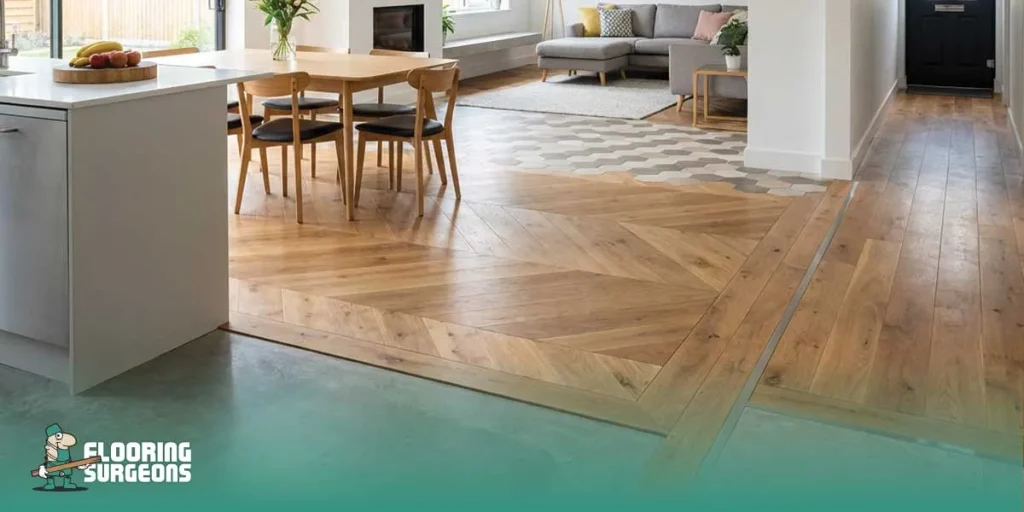
Patterns such as herringbone, chevron or hexagon tiles define zones through geometry rather than material change, adding visual interest without overcomplication. - Inlays and decorative borders
Metal strips, stone lines or slim contrasting borders create precise, intentional transitions. They are especially effective in high-end interiors where detail matters. - Curved and non-linear transitions (emerging trend)
Soft, flowing transition lines replace rigid straight edges, creating a more organic spatial experience. This approach works particularly well in contemporary and fluid layouts. - Flooring “rugs” as focal transitions
A defined flooring area acts like a rug embedded into the floor, anchoring furniture or marking functional zones while remaining fully integrated into the surface.
Flooring Colour and Texture Strategies for Defining Transitional Spaces
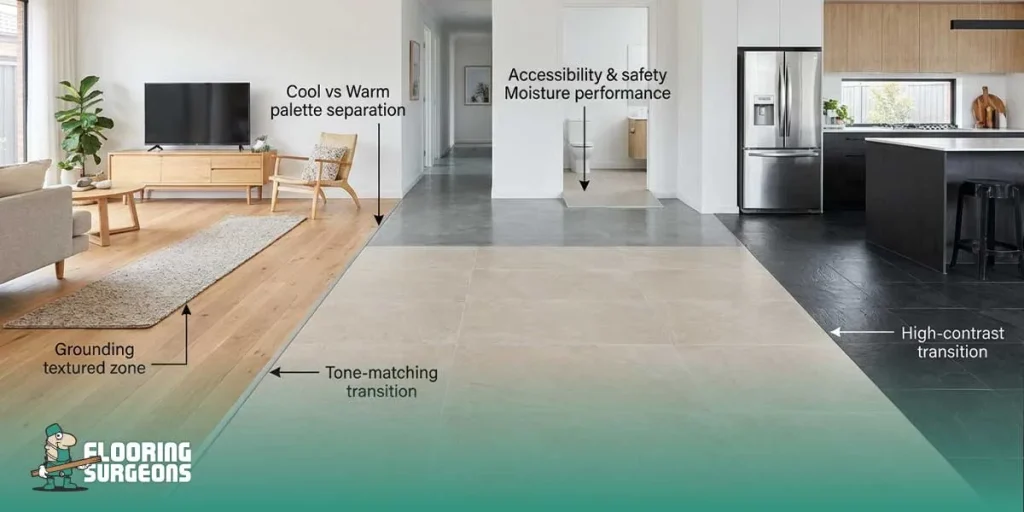
- Tone-matching transitions
Using similar shades across materials maintains continuity and reduces visual breaks, ideal for compact or minimalist spaces. - High-contrast transitions
Strong colour or texture contrasts clearly define zones but must be used selectively to avoid fragmenting the space. - Warm vs cool palettes
Warm tones create comfort and cohesion, while cool tones emphasise clarity and separation. Mixing them deliberately helps signal functional change. - Using flooring to alter spatial perception
Linear layouts can visually widen narrow spaces, while darker or textured zones can ground large open areas and make them feel more controlled.
Functional Flooring Transition Considerations for Safety and Performance
- Managing uneven subfloors
Transitions can be used strategically to absorb or disguise minor level differences without introducing steps. - Accessibility and safety
Flush transitions reduce trip hazards and improve accessibility, particularly important in circulation zones. - Moisture and traffic performance
Transitions allow materials to respond directly to use conditions, placing resistance and durability where they are most needed.
How to Plan Flooring Transitions in Open-Plan and Connected Spaces
- Identify primary and secondary functions within the open space
- Decide where behaviour changes, not just where rooms would traditionally divide
- Choose transition points that align with natural movement paths
- Keep transition lines purposeful and limited in number
- Ensure each transition has a clear reason: functional, visual or both
Well-planned transitions feel inevitable rather than decorative.
Flooring Transition Installation Tips and Common Design Mistakes
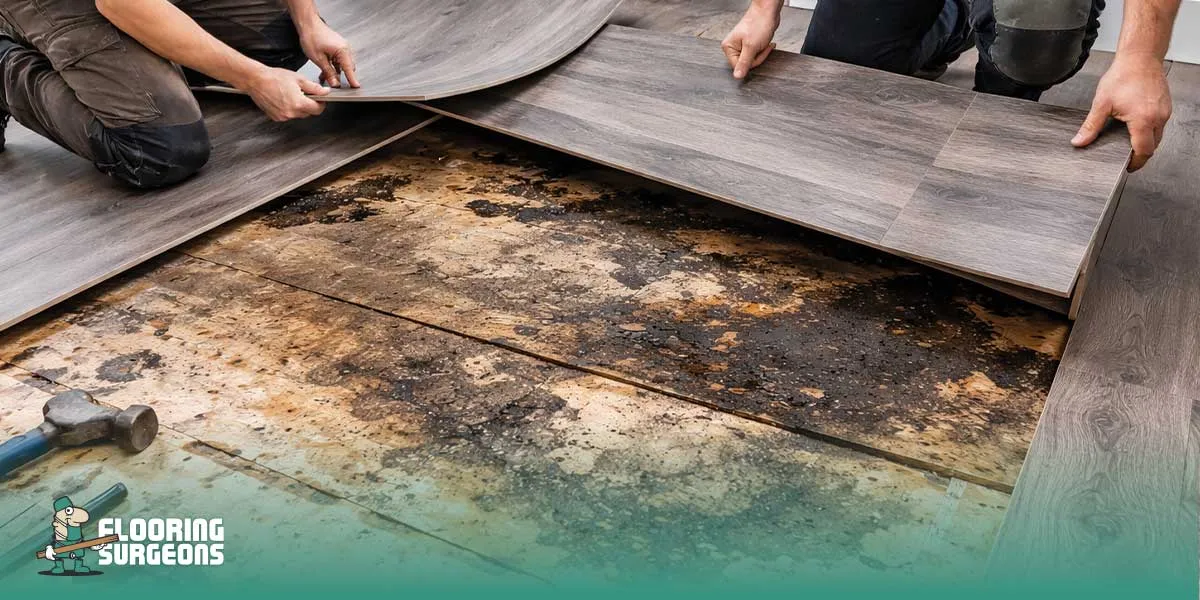
- Always level and prepare subfloors before planning transitions
- Select transition components early, not as an afterthought
- Align patterns, joints and edges precisely across materials
- Avoid unnecessary height changes or poorly aligned seams
- Never let installation constraints dictate design unintentionally
Most failed transitions are installation problems, not design ones.

Quick Decision Framework (Designer & User-Friendly)
Use this when choosing a flooring transition:
- Is the change functional or visual?
→ Functional = change material
→ Visual = change pattern, direction or colour - Do you want separation or continuity?
→ Separation = contrast
→ Continuity = seamless or tone-matched - What controls the space: movement or use?
→ Movement = directional transitions
→ Use = material-based transitions - Will the transition be seen or felt first?
→ Seen first = focus on design clarity
→ Felt first = prioritise comfort and safety
If each transition answers at least one of these questions clearly, it’s doing its job.
Conclusion
Flooring-only transitions have become a powerful design tool in modern interiors, allowing spaces to be defined clearly without sacrificing openness, flow or visual continuity. By understanding how materials, patterns, colours and installation details interact, transitions can move beyond simple functional solutions and actively shape how a space is experienced. When planned with intent and executed with precision, transitional flooring enhances both aesthetics and performance—guiding movement, supporting daily use and creating interiors that feel cohesive, balanced and purposefully designed rather than divided. At Flooring Surgeons, transitional flooring is approached as a balance of design intent, material performance and long-term usability.

Haniye Ayanmanesh
As an expert writer for Flooring Surgeons, I combine technical SEO knowledge with a practical understanding of flooring, producing content that helps users make confident decisions while supporting long-term organic growth.