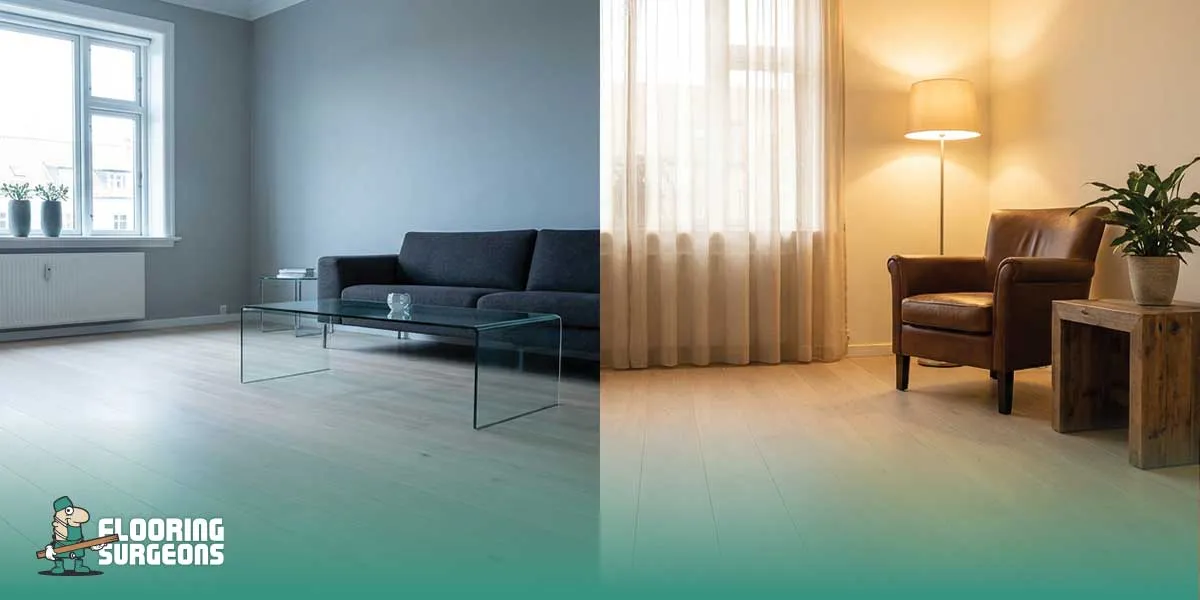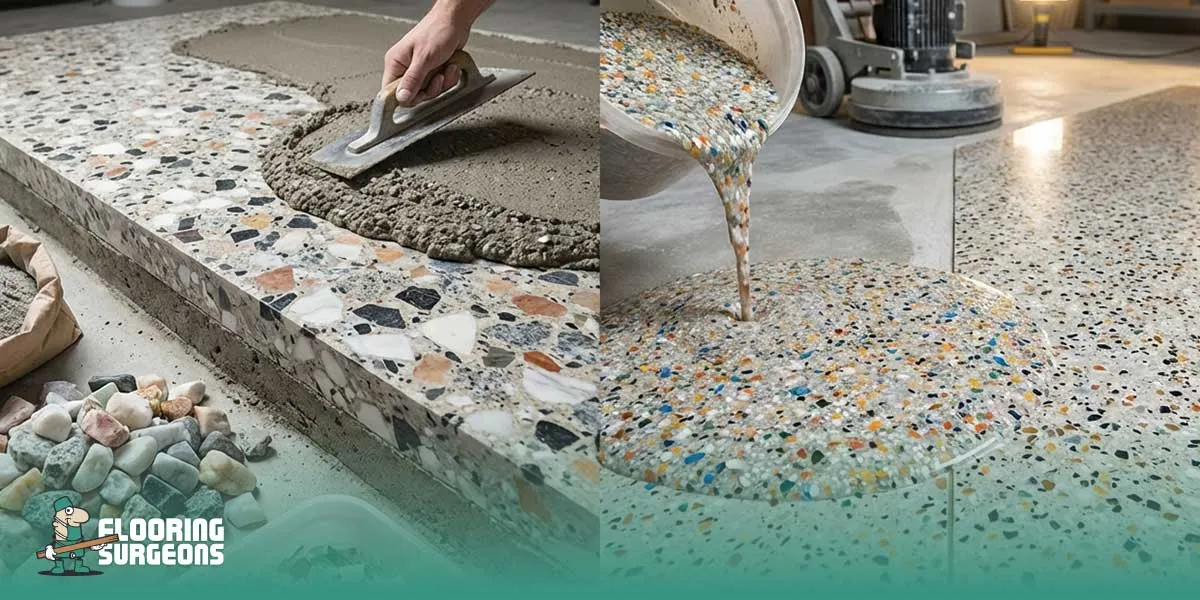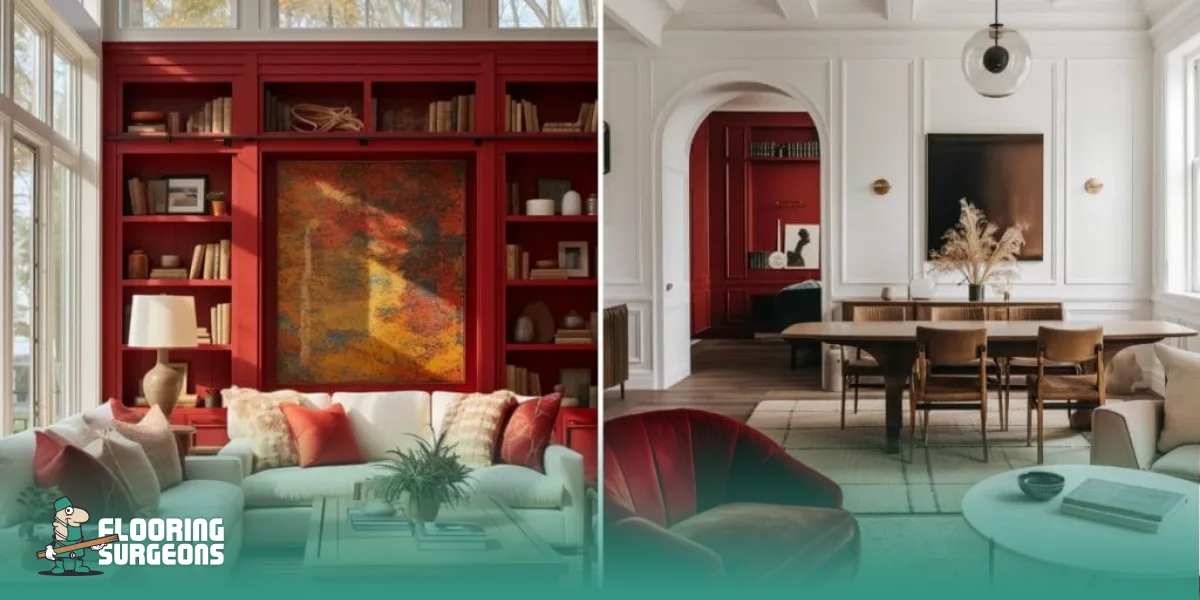


Mosaic flooring can enhance interior design when used with intention, not as a full-surface statement but as a controlled design tool. The short answer is that mosaic works best when it supports the central flooring system rather than competing with it. In modern interiors, mosaic flooring is rarely used to cover an entire room. Instead, it is used to guide movement, define zones, add texture or introduce contrast without breaking visual flow.
When applied correctly, mosaic flooring brings detail and depth to a space while allowing practical flooring systems like luxury vinyl, engineered wood floors or parquet to remain the structural foundation. When applied without logic, it quickly becomes visually heavy, difficult to maintain, and disconnected from how the space is actually used. This guide focuses on how mosaic flooring can elevate interiors while still working with real-world flooring systems, not against them, so you can decide early whether mosaic is right for your space and how to use it without regret.
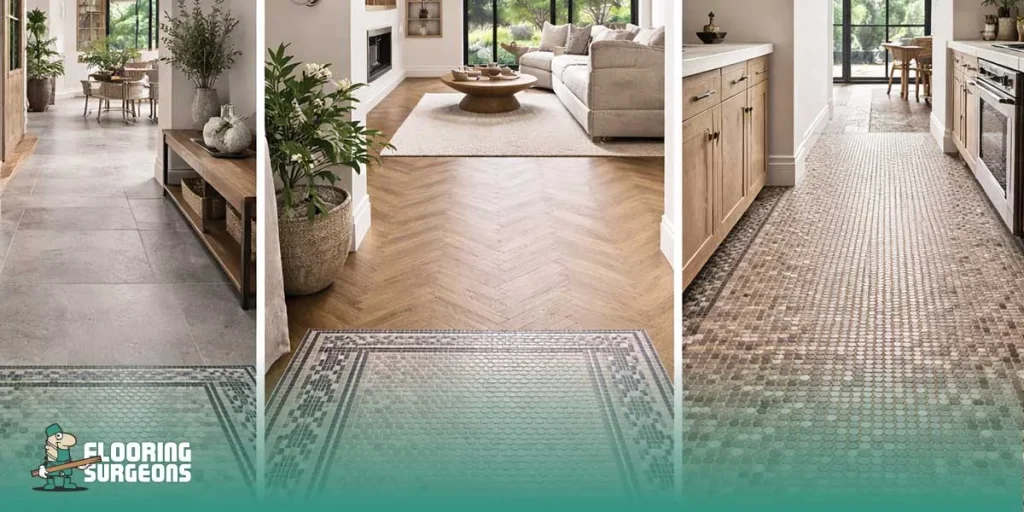
Decision Block
Yes
Mosaic flooring works when it is used as an accent to highlight zone transitions or focal areas within a larger flooring system.
No
Mosaic flooring fails when it covers large ,uninterrupted areas without considering traffic flow maintenance or visual balance.
Depends
The success of mosaic flooring depends on the room function, foot traffic, and how it integrates with the main flooring material.
Table of contents
What Is Mosaic Flooring and Why Designers Still Use It
Mosaic flooring is a flooring approach made from many small pieces of material arranged together to form a continuous surface. These pieces can be stone, ceramic, glass or porcelain and are usually mounted in sheets for precision and consistency. Unlike standard large-format tiles, mosaic flooring is defined by scale, pattern and visual rhythm rather than size.
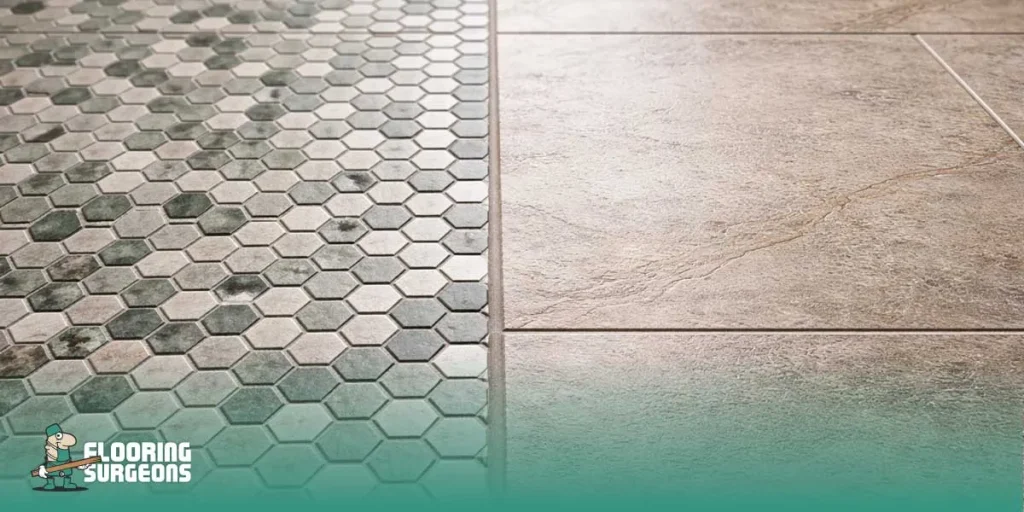
- Why designers still use mosaic flooring
Designers continue to use mosaic flooring because it solves problems that standard tiles cannot. It allows controlled visual emphasis without dominating the entire space. Mosaics adapt easily to curves, slopes and small zones, which makes them ideal for transitions, borders and accent areas. They also introduce texture and depth in a way that flat surfaces cannot achieve. In modern interiors, mosaic flooring is rarely used wall-to-wall. Instead, it is applied strategically to guide the eye, define zones and add character while the main flooring system carries the space.
- How mosaic flooring differs from regular tiles
Regular tiles are designed to create uniform, uninterrupted surfaces. Their strength is visual calm and simplicity. Mosaic flooring works differently. It creates detailed contrast and movement. Where large tiles simplify a space, mosaics add complexity and focus. Another key difference is function. Because mosaics use many grout lines, they often provide better slip resistance in wet areas compared to polished large tiles. This makes them especially relevant in bathrooms, kitchens, and entry zones when used intentionally rather than everywhere.
Practical takeaway
Mosaic flooring is not outdated or decorative by default. Designers still use it because it works as a design too, not as a surface replacement. When combined with modern flooring systems, it enhances interiors through contrast control and zoning rather than visual overload.
Where Mosaic Flooring Works Best in Modern Interiors
Mosaic flooring is most effective when it is used as a zoning tool, not as a full-surface solution. In modern interiors, its value comes from defining areas, creating transitions, and adding controlled visual focus without overwhelming the space. Below are the zones where mosaic flooring performs best, both visually and functionally.
| Area | Why Mosaic Works Here | Design Benefit | Practical Consideration |
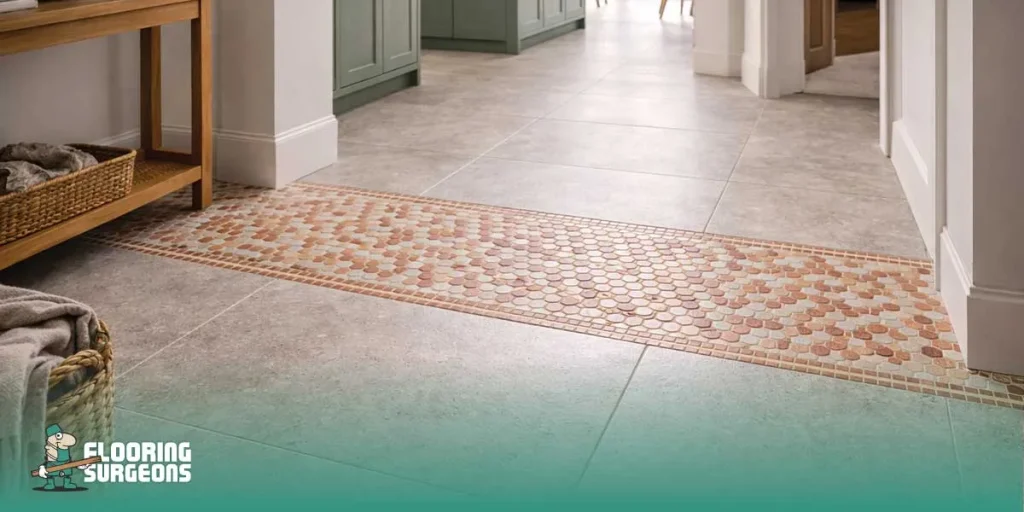
| Entrance & Hallway Accents | These spaces need visual definition without feeling heavy or cluttered | Creates a strong first impression and naturally guides movement | High durability required due to foot traffic, best used as an inset or border |
| Bathroom Feature Zones | Bathrooms benefit from texture and slip resistance in wet areas | Adds grip, visual interest, and zoning around showers or vanities | Use mosaics selectively to avoid excessive grout maintenance |
| Kitchen Transitions | Kitchens often connect to dining or living spaces | Clearly separates functional zones without physical barriers | Works best as a transition strip rather than a full kitchen floor |
| Fireplace & Statement Areas | These zones are visual anchors, not circulation paths | Adds depth and character without affecting usability | Focus on heat-resistant materials and pattern restraint |
Why zoning matters
Using mosaic flooring in defined zones keeps the interior balanced. It allows the mosaic to stand out as a design feature while letting the main flooring system maintain visual calm and continuity. This approach prevents the space from feeling busy and avoids the common mistake of overusing mosaics.
Decision logic
If the area is transitional, functional, or visually focal, mosaic flooring enhances it. If the area is large, open, and meant to feel calm, mosaic flooring should support the design, not dominate it. When applied with zoning in mind, mosaics elevate interiors rather than compete with them.
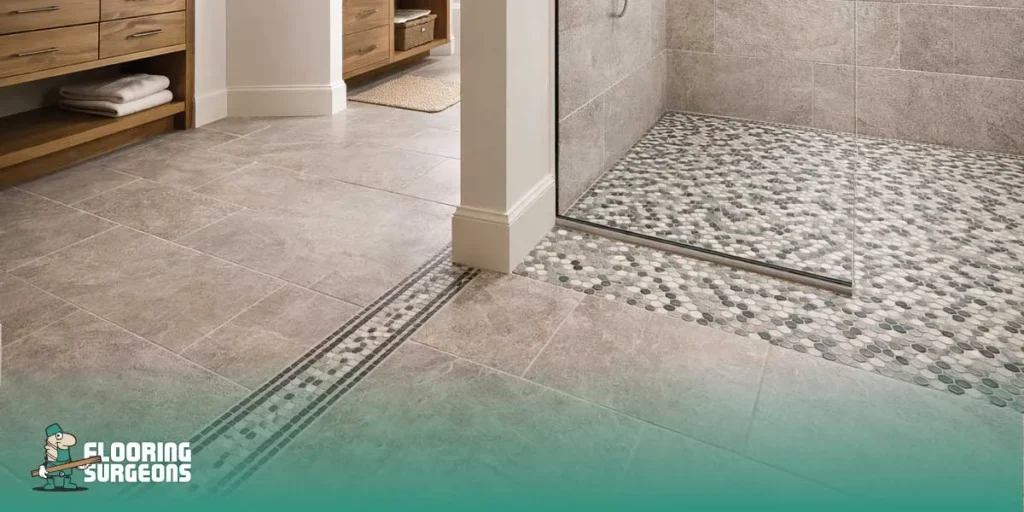
Mosaic Flooring as an Accent, Not the Main Floor
Mosaic flooring delivers its best results when it is treated as an accent, not as the dominant surface. Using it across an entire floor is one of the most common design mistakes, especially in modern interiors that rely on balance and visual flow.
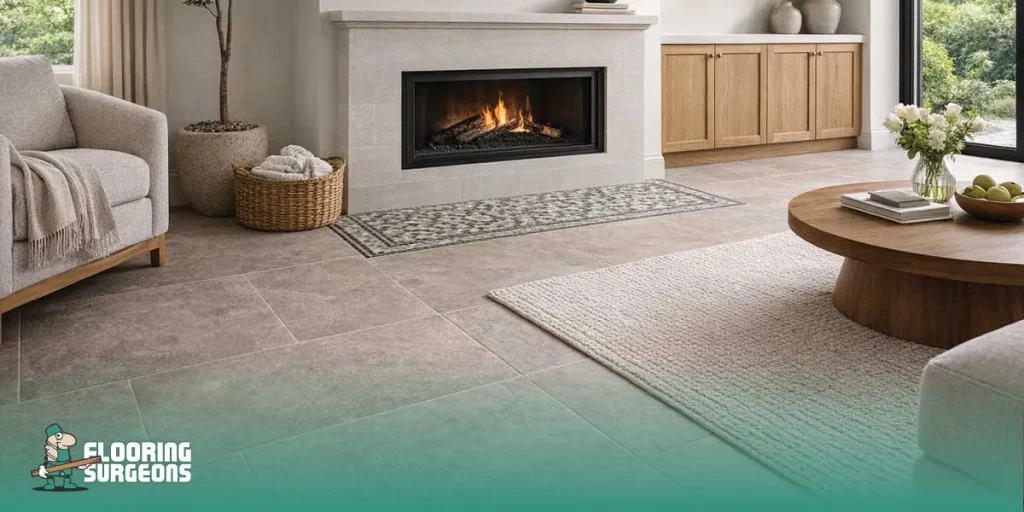
Why a full-floor mosaic is usually a mistake
Covering a whole space with mosaic creates constant visual noise. Because mosaics are pattern-dense by nature, the eye never gets a place to rest. This leads to visual fatigue, makes rooms feel smaller, and often dates the design faster than expected. From a practical standpoint, full mosaic floors also increase grout lines, which means higher maintenance and less tolerance for wear in high-traffic areas.
The real role of mosaic flooring
Mosaic works best as a design tool, not a base system. Its strength is in highlighting, framing, and defining specific areas. When used as an accent, mosaic adds depth and character while allowing the primary flooring to do its job of creating continuity, comfort, and long-term usability.
Common accent applications that work:
- Inset zones within larger floors to define movement paths
- Borders or framing elements that guide transitions between spaces
- Feature patches that draw attention without dominating the room
Preventing visual overload
The key to avoiding visual overload is contrast and restraint. Mosaic should interrupt the floor, not replace it. Pairing it with calmer flooring systems allows the mosaic to stand out intentionally rather than compete for attention. When everything is decorative, nothing feels special. When mosaic is used selectively, it becomes a focal point instead of a distraction.
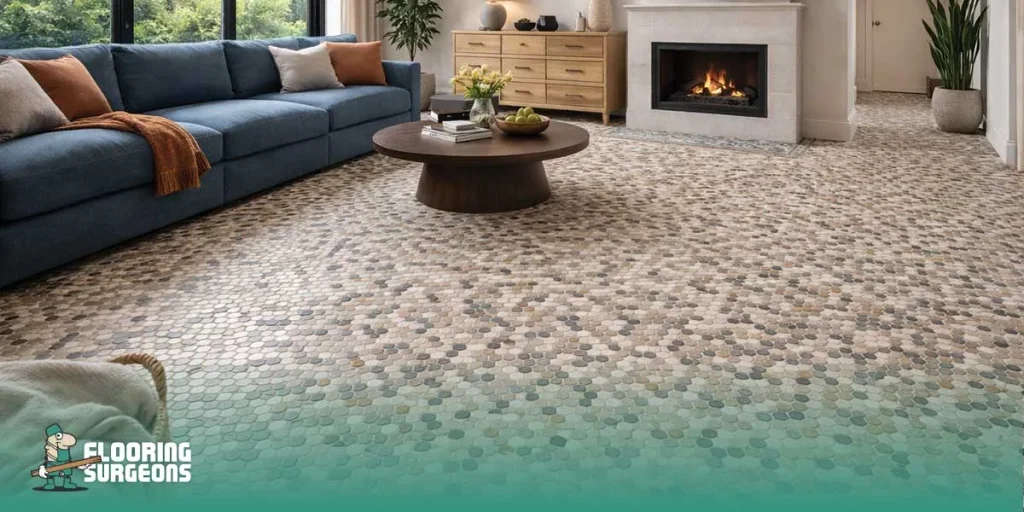
Design rule to remember
If the mosaic draws attention immediately and then fades into the background as you move through the space, it is doing its job. If it demands constant attention everywhere you step, it is overused.
Combining Mosaic Flooring with Modern Flooring Types
Mosaic flooring becomes truly effective when it works alongside a modern flooring system rather than competing with it. On its own, mosaic is a design tool, not a full flooring solution. When combined correctly, it adds character, zoning, and visual interest without sacrificing practicality, durability, or long term usability. This section focuses on combinations that make sense both visually and functionally.
Mosaic Flooring with Luxury Vinyl (LVT)
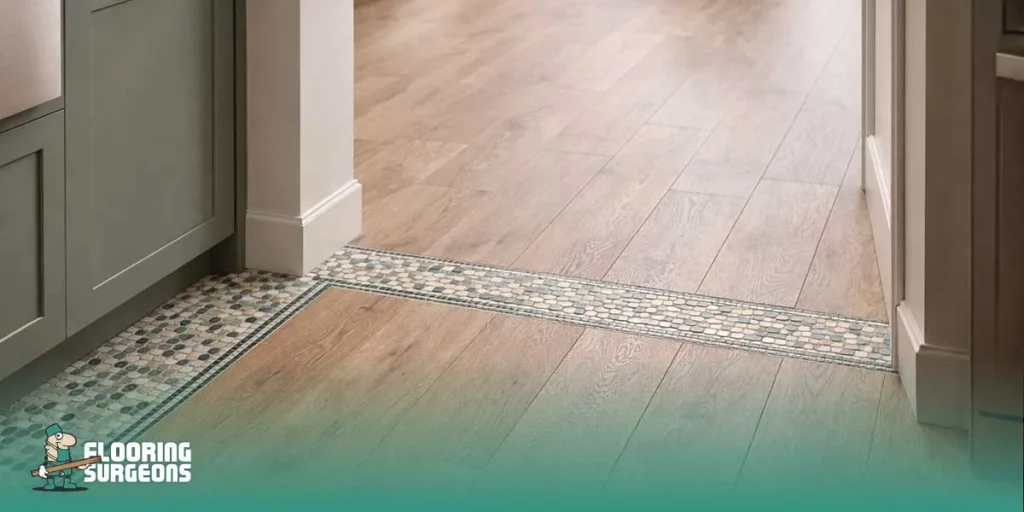
Pairing mosaic flooring with Luxury Vinyl (LVT) is one of the most practical and design-friendly combinations in modern interiors, especially in spaces where moisture control, durability, and visual clarity matter. Mosaic works best when paired with water-resistant vinyl flooring systems that can handle daily moisture without compromising durability.
Why this combination works
Luxury Vinyl provides a stable, resilient base floor. Mosaic is then used selectively to highlight specific zones without carrying the full functional load of the space.
Key advantages of this pairing:
- True water resistance
LVT performs reliably in moisture-exposed environments. This allows mosaic to be used nearby without increasing the risk of water-related issues, making the combination suitable for entrances, kitchens, and transitional areas. - Clear zoning without visual disruption
Mosaic can define entrances, feature strips, or functional transitions, while LVT maintains continuity across the main floor area. - Smooth and manageable transitions
Differences in texture and thickness between mosaic and LVT can be handled cleanly, resulting in a natural looking junction rather than an abrupt visual break.
Correct design logic
In this combination, Luxury Vinyl should remain the primary flooring surface. Mosaic works best as an accent or boundary element. Reversing these roles often leads to visual overload and reduces the functional advantages of LVT. If your goal is a space that feels modern, durable, and visually intentional, using mosaic as an accent alongside Luxury Vinyl is one of the safest and most effective design strategies. It delivers character without compromising performance, maintenance, or long-term comfort.
Mosaic Flooring with Engineered Wood
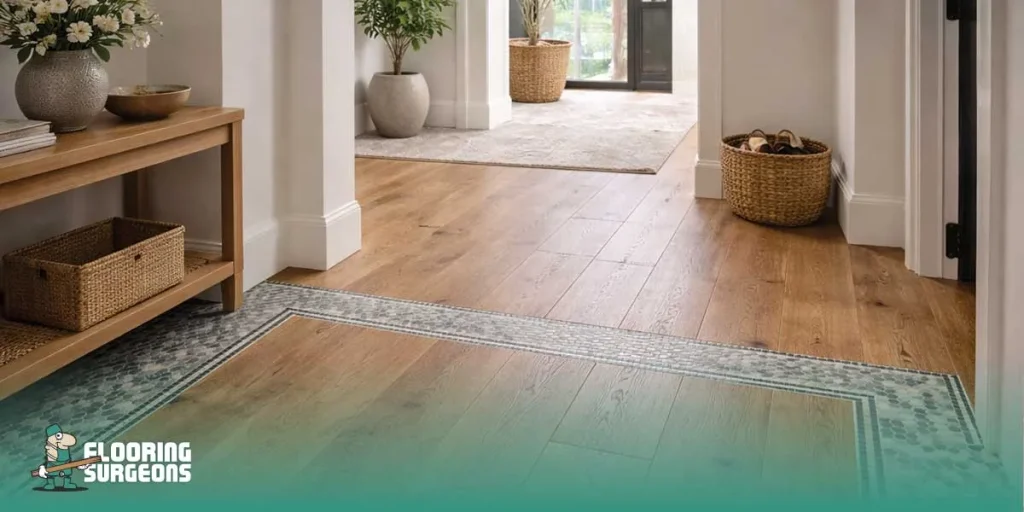
Combining mosaic flooring with engineered wood creates a controlled contrast between warmth and structure. Engineered wood brings visual softness and continuity, while mosaic introduces precision and definition. This contrast works best when the mosaic is used to guide the eye rather than dominate the floor.
Why this combination works
- Warm and cool balance
Engineered wood adds warmth through grain and tone. Mosaic introduces a cooler, more structured visual element that prevents the space from feeling flat or overly uniform. - Visual control in open layouts
Mosaic helps slow down sightlines in large or open plan spaces, while engineered wood keeps the overall flow calm and cohesive. - Clear functional boundaries
Mosaic can define entrances, thresholds, or feature zones without interrupting the natural movement created by engineered wood flooring.
Design logic
Engineered wood should remain the primary surface. Mosaic works best as a framing or zoning element that enhances depth and direction. When used sparingly, this pairing feels intentional and refined rather than decorative. If you want warmth without visual monotony, mosaic and engineered wood together offer structure, contrast, and control without overwhelming the space.
Mosaic Flooring with Parquet and Herringbone
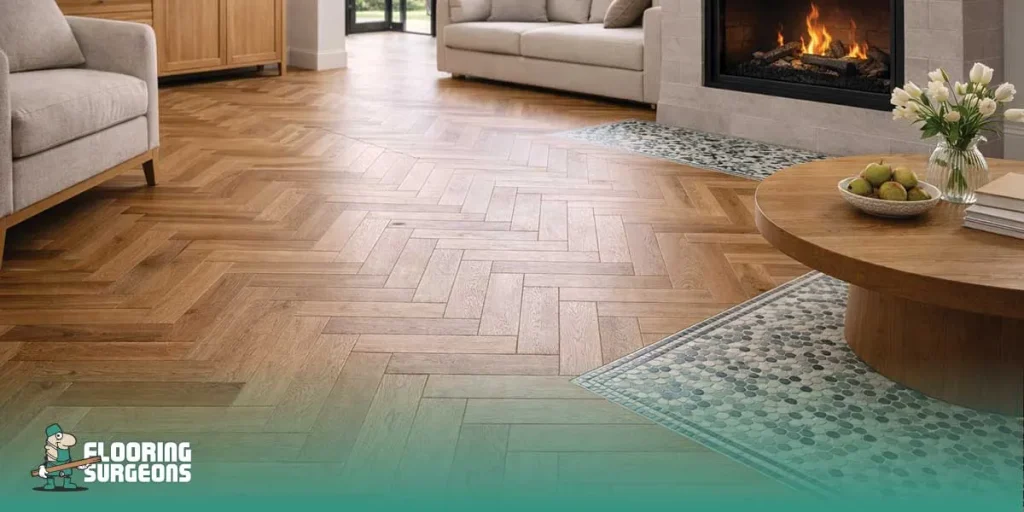
Parquet and herringbone floors already carry a strong visual rhythm. Mosaic flooring should not compete with that movement. Instead, it works best as a deliberate pause point that gives the eye a place to rest. In interiors with strong floor rhythm, mosaic should act as a pause point that supports classic patterned wood floors, rather than competing with their movement.
Why this combination works
- Rhythm with visual punctuation
Parquet and herringbone patterns create continuous motion. Mosaic acts as a visual stop that prevents the pattern from feeling endless or tiring. - Strong focal transitions
Mosaic can mark entrances, fireplace zones, or room transitions where a change in direction or function needs emphasis. - Design hierarchy without clutter
The structured repetition of parquet is balanced by mosaic detail when the mosaic is limited to defined zones.
Design logic
Parquet and herringbone should always lead the space. Mosaic should appear where movement needs to slow down or change. Using mosaic across large areas alongside these patterns usually results in visual overload. When parquet or herringbone is the star of the floor, mosaic becomes the accent that adds clarity and intention rather than distraction.
Mosaic Flooring Design Patterns That Actually Work
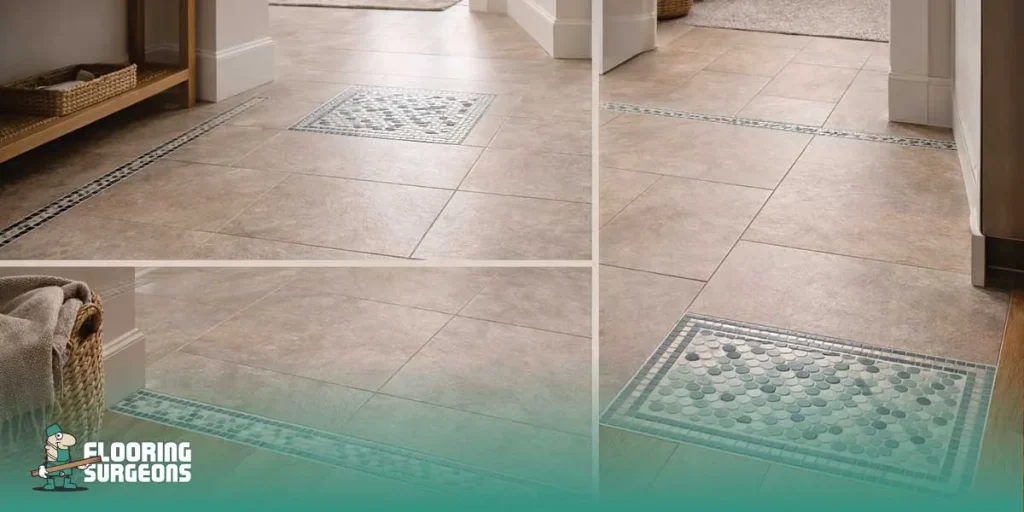
Some mosaic patterns borrow heavily from Victorian tile patterns adapted for modern interiors, where ornamentation is carefully balanced with structure rather than used as full-surface decoration. Not every mosaic pattern enhances a space. Some patterns guide the eye and support zoning, while others create visual noise. The key is choosing patterns that serve a purpose rather than filling space for decoration.
Practical comparison of mosaic flooring patterns
| Mosaic Pattern Type | Where It Works Best | What It Solves | Common Mistakes to Avoid |
| Geometric patterns | Modern interiors, controlled zones like entrances or powder rooms | Adds structure and direction without clutter | Using bold geometry across large floor areas |
| Border patterns | Room edges, transitions,and framing wood or vinyl floors | Defines boundaries and finishes spaces cleanly | Making borders too thick or visually dominant |
| Inlay designs | Feature points such as door thresholds or centre accents | Creates a focal point without breaking flow | Placing inlays in high-traffic movement lines |
| Transition frames | Between different flooring materials or zones | Smooths visual transitions and improves continuity | Treating transitions as decoration instead of structure |
How to use these patterns correctly
- Geometric patterns work when the surrounding flooring is calm and uniform. They bring order, not decoration, to modern spaces.
- Border patterns are most effective when they quietly frame a space rather than announcing themselves. Thin and consistent is usually better than bold.
- Inlay designs should mark intention, not interrupt movement. They work best where people pause, not where they walk through quickly.
- Transition frames are functional first. Their role is to connect different flooring systems visually, not to compete with them.
If a mosaic pattern does not define a zone, guide movement, or support a flooring transition, it probably does not belong on the floor. Patterns work best when they clarify design decisions, not when they try to become the design themselves.
Practical Considerations Before Choosing Mosaic Flooring
Before choosing mosaic flooring, the design appeal should never be the only factor. These practical considerations determine whether mosaic enhances a space or becomes a long-term problem.
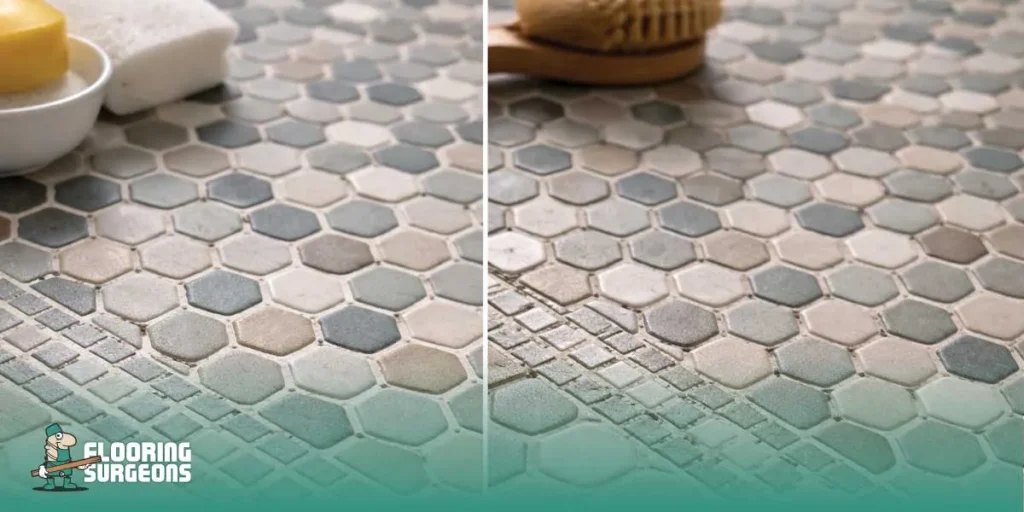
- Maintenance: Mosaic flooring has more grout lines than standard flooring. This increases cleaning frequency and makes maintenance more demanding in high-use areas.
- Slip resistance: Small tiles alone do not guarantee grip. Surface finish and grout texture matter more than pattern size, especially in wet zones.
- Grout density: High grout density improves visual detail but also increases the risk of discolouration if sealing and cleaning are inconsistent.
- Cleaning effort: Mosaic floors require targeted cleaning rather than quick mopping. Dirt and residue collect faster in joints than on larger-format floors.
- Durability: Mosaic works best in accent zones and low-impact areas. In heavy traffic spaces, improper installation or weak substrates shorten the lifespan quickly.
Mosaic flooring performs best when its use is controlled, its maintenance demands are understood, and it supports the main flooring system rather than replacing it.
Mosaic Flooring vs Large Format Flooring
Choosing between mosaic flooring and large format flooring is not about style preference. It is about function, scale, and control.
When mosaic flooring is the better choice
- Accent zones only: Entry points, borders, feature strips, or transitions.
- Design control: When you need visual rhythm or a focal break.
- Small or detailed areas: Powder rooms, alcoves, fireplace surrounds.
- Slip management: In wet zones, grout lines help break water flow.
- Layered interiors: When combined with wood, LVT, or patterned floors.
When mosaic flooring is the wrong choice
- Main floor areas: Large continuous spaces feel busy and fragmented.
- High traffic zones: Excess grout increases wear and maintenance.
- Minimal interiors: Visual noise clashes with clean design language.
- Low maintenance goals: Cleaning effort is significantly higher.
- Poor lighting: Patterns lose clarity and create visual clutter.
Large-format flooring works better when
- You need visual calm and flow
- The space is open-plan or high-traffic
- Maintenance simplicity matters
- The floor should support furniture and layout, not compete with them
Quick decision rule
- Need emphasis or zoning: Mosaic flooring
- Need continuity and practicality: Large format flooring
Mosaic flooring enhances interiors when it plays a supporting role. Large-format flooring should remain the structural base. Mixing them intentionally is what creates balance, not choosing one exclusively.
Is Mosaic Flooring Right for Your Home?
Mosaic flooring can work beautifully in the right home, but it is not a universal solution. Whether it fits your space depends less on taste and more on lifestyle, priorities, and how the floor is expected to perform over time.
In family homes, mosaic flooring is best kept to controlled accent areas rather than main walkways. High activity, spills, and frequent cleaning can quickly turn detailed grout lines into a maintenance burden. When used selectively, such as in entrances or feature zones, mosaic can add character without becoming impractical.
For rental properties, mosaic flooring usually needs restraint. While it can elevate perceived value in small areas like bathrooms or entry thresholds, large mosaic installations often increase upkeep and limit appeal to a broad audience. Simpler flooring systems tend to perform better in rentals, with mosaic reserved for subtle design moments.

In resale-focused homes, mosaic should support value rather than dictate it. Neutral, well-placed mosaic accents can suggest craftsmanship and design intent, but overly bold patterns risk narrowing buyer appeal. If the goal is flexibility for future owners, mosaic works best as an easily removable or visually contained feature.
In design-led interiors, mosaic flooring becomes a tool rather than a statement. When paired with calm, modern flooring systems, it can introduce rhythm, contrast, and texture without overpowering the space. In these homes, mosaic succeeds because it is intentional, limited, and structurally supported by the main floor. In projects where flooring decisions depend on long-term use, maintenance, and visual balance, Flooring Surgeons typically recommend evaluating how mosaic interacts with the primary flooring system before committing to a full design direction. Mosaic flooring works when it reflects how the home is used, not just how it looks. If the design choice still makes sense under daily wear, cleaning, and future change, it is likely the right fit.
When to Avoid Mosaic Flooring
Mosaic flooring is not a mistake when it is used correctly, but there are situations where avoiding it is the smarter decision. In high-traffic open-plan spaces, mosaic flooring often creates visual fragmentation and increases maintenance without adding functional value. Large, continuous floors perform better when the surface stays calm and easy to clean. For minimal interiors, mosaic patterns usually conflict with the design intent. Detailed surfaces introduce visual noise that undermines simplicity, even when colours are neutral.
If low maintenance is a priority, mosaic flooring is rarely the right choice. High grout density demands consistent cleaning and care. Without it, the floor quickly loses both clarity and appeal.
When a space depends on flow, simplicity, or minimal upkeep, mosaic flooring works against the design rather than enhancing it. In these cases, restraint is not a compromise. It is a good design.

Haniye Ayanmanesh
As an expert writer for Flooring Surgeons, I combine technical SEO knowledge with a practical understanding of flooring, producing content that helps users make confident decisions while supporting long-term organic growth.