

When people ask is terrazzo flooring expensive, the honest short answer is yes, the upfront cost is high, but that does not automatically make it a costly choice overall. Terrazzo flooring is more expensive to install than most common options such as laminate, vinyl, or standard tiles. This is mainly due to specialised materials, skilled labour, and a longer installation process.
However, focusing only on the initial terrazzo flooring cost can be misleading. Terrazzo is designed to last for decades, often outliving the building itself. It requires relatively low maintenance, does not need frequent replacement, and holds its appearance far longer than many cheaper alternatives. That means what feels expensive at the start can become cost-effective over time. In this article, we break down exactly why terrazzo flooring costs more upfront, what its real disadvantages are, how long it lasts, and whether it still makes sense as a modern flooring choice. You’ll get a clear answer quickly, and if you want the full picture behind the price, the sections that follow explain what most guides leave out.
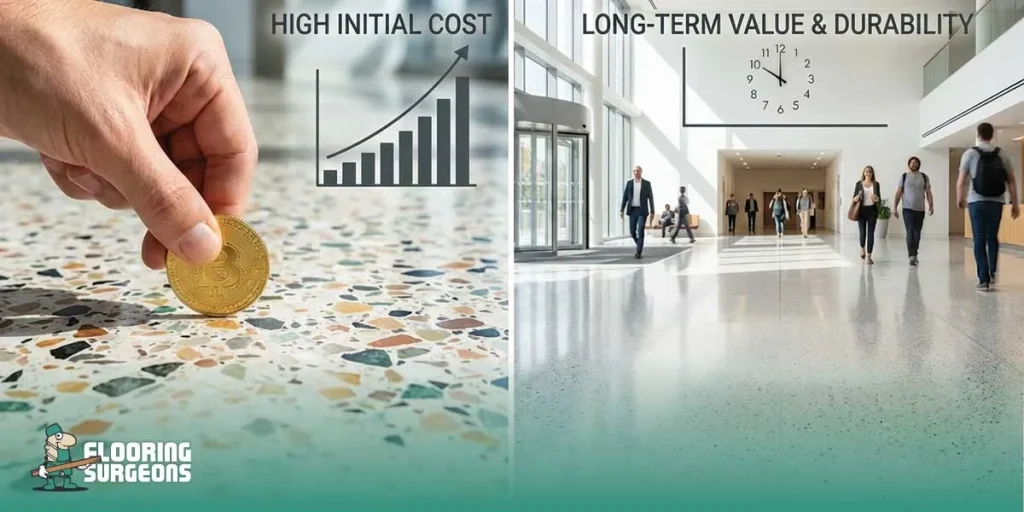
Table of contents
What Determines the Cost of Terrazzo Flooring?
The cost of terrazzo floors is driven by a combination of material choices, installation method, and the level of skill required on-site. Terrazzo is not priced like off-the-shelf flooring. Each decision you make directly affects the final figure.
Materials used in terrazzo
Terrazzo is made from a binder, either cement-based or epoxy-based, combined with marble, glass, quartz, or recycled aggregates. Higher-quality aggregates, custom colour blends, and epoxy binders all increase material costs. The more bespoke the mix, the higher the overall price.
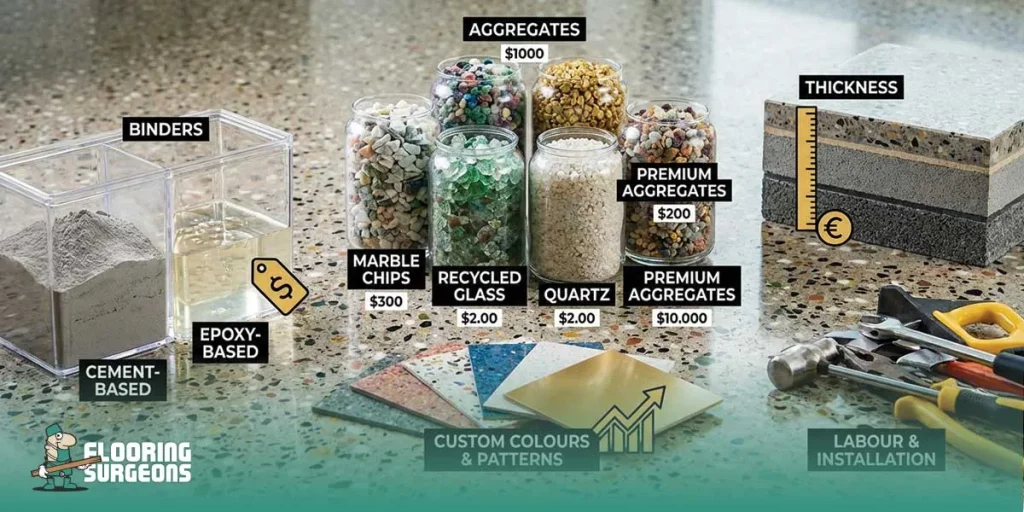
Key cost drivers include:
- Type and quality of aggregates
- Cement-based versus epoxy-based binders
- Custom colours or patterns
- Thickness of the terrazzo layer
Premium materials raise upfront cost but also improve durability and finish consistency.
Poured terrazzo vs terrazzo tiles
The installation method plays a major role in pricing. Poured terrazzo is installed on site and finished in place, while terrazzo tiles are manufactured off-site and installed like standard tiles.
General cost comparison:
- Poured terrazzo costs more due to labour, curing, and finishing time
- Terrazzo tiles are cheaper upfront and faster to install
- Poured systems offer seamless finishes and a longer lifespan.
Choosing tiles can reduce initial spend, but poured terrazzo often delivers better long-term value.
Installation complexity and labour
A large portion of the terrazzo installation cost comes from labour. Terrazzo requires specialist installers, precise surface preparation, curing time, and multiple finishing stages such as grinding and polishing.
Factors that increase installation cost:
- Subfloor preparation and levelling
- Skilled terrazzo specialists, rather than general installers
- Longer installation timelines
- Multiple grinding and polishing passes
This complexity is why terrazzo costs more to install than most flooring types, but it is also what gives it exceptional durability and longevity.
Terrazzo Flooring Cost Breakdown (Material vs Installation)
When people look at the cost of terrazzo floors, the biggest misunderstanding is assuming the materials are the main expense. In reality, materials are only part of the equation. The largest portion of the total price usually comes from installation.
Average cost ranges
Terrazzo pricing varies based on system type, finish level, and site conditions, but typical ranges follow a clear pattern.
| Cost Component | Typical Price Range | What This Covers |
| Terrazzo materials | Medium to high | Binder, aggregates, colour mix, thickness |
| Installation labour | High | Specialist labour, preparation, curing, finishing |
| Subfloor preparation | Medium | Levelling, moisture control, structural prep |
| Grinding and polishing | Medium to high | Multiple finishing stages |
| Total installed cost | High | Full system, ready-to-use floor |
The materials themselves are not cheap, but they are predictable. Installation costs are where pricing increases quickly if conditions are not ideal.
Why this installation the most significant cost factor
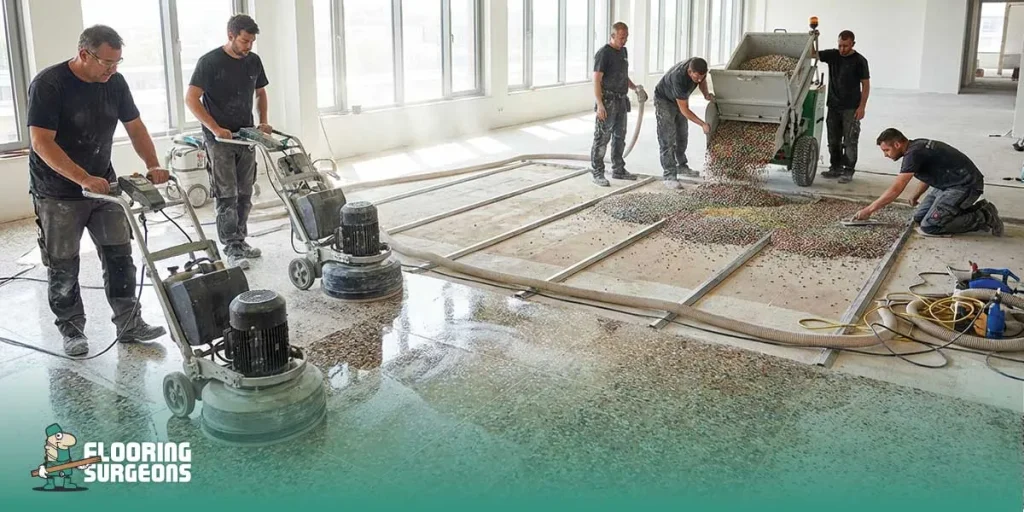
The terrazzo installation cost is high because terrazzo is not a simple lay-and-leave floor. It is a multi-stage process that requires time, precision, and experienced specialists.
Installation costs rise due to:
- Extensive subfloor preparation before pouring or laying tiles
- Skilled terrazzo installers, rather than general flooring crews
- Long curing times that slow project timelines
- Multiple grinding and polishing stages to achieve the final finish
Unlike many flooring options, terrazzo cannot be rushed without compromising quality. Time and expertise are what push installation costs above most alternatives. However, this same process is also why terrazzo floors last for decades and rarely need replacement.
Why Is Terrazzo Flooring So Expensive Compared to Other Floors?
Terrazzo flooring feels expensive because it is built through a process, not simply installed as a finished product. Unlike laminate, vinyl, or tiles that arrive ready to lay, terrazzo is created on site or assembled through multiple controlled stages. That difference alone puts it in a completely different cost category.
One major factor is the skilled labour requirement. Terrazzo installation is not handled by general flooring installers. It requires specialists who understand mixing ratios, curing behaviour, grinding depth, and finishing techniques. This expertise takes years to develop, and the labour cost reflects that. You are paying for precision and experience, not speed.
Customisation and preparation also add to the cost. Terrazzo is rarely a standard product. Colours, aggregate size, patterns, and finishes are often tailored to the project. Before installation even begins, the subfloor must be carefully prepared to meet strict tolerances. Any structural or moisture issues must be resolved in advance, which adds time and cost but prevents long-term failure.
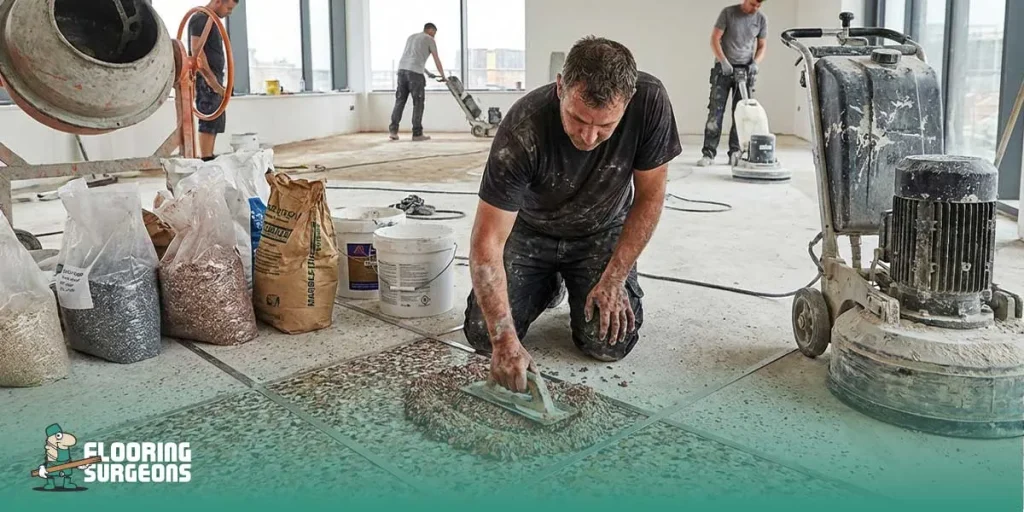
Finally, terrazzo involves a long curing and finishing process. After pouring or laying, the floor cannot be used immediately. It must cure properly, then go through multiple grinding and polishing stages to achieve a smooth and durable surface. Each stage adds labour time and extends the project timeline. While this makes terrazzo more expensive upfront, it is also the reason it performs far better and lasts far longer than many cheaper flooring options.
What Are the Disadvantages of Terrazzo Flooring?
While terrazzo offers exceptional durability and long-term value, it is not without drawbacks. Being clear about these disadvantages helps set realistic expectations and builds trust.
- High upfront cost
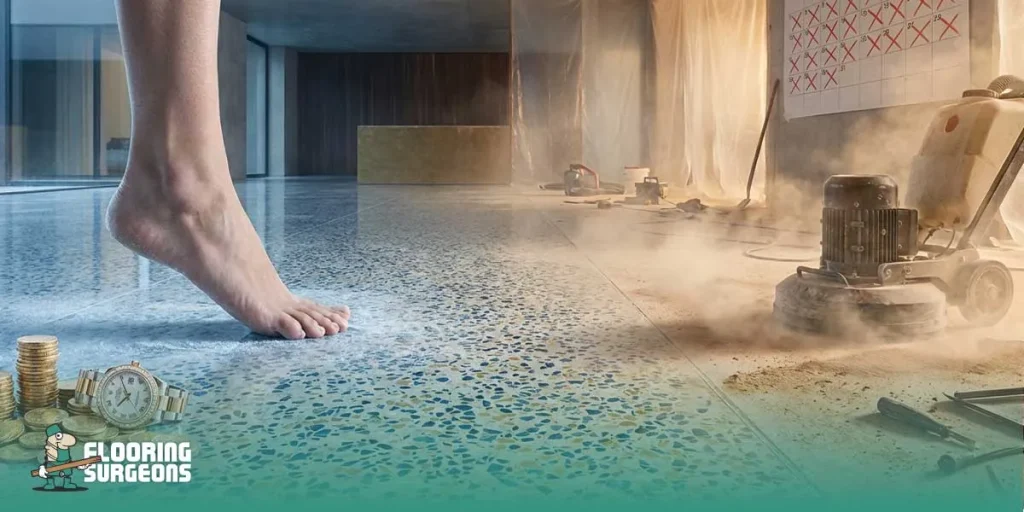
Terrazzo flooring has a significantly higher initial cost compared to many common flooring options. The price reflects specialised materials, skilled labour, and a complex installation process, which can make it unsuitable for tight budgets. - Cold and hard underfoot
Terrazzo is a hard surface and does not provide natural warmth or cushioning. It can feel cold to the touch, especially in colder climates, and may be uncomfortable for prolonged standing without underfloor heating or area rugs. - Installation time and disruption
Installing terrazzo is time-consuming. The process involves preparation, curing, grinding, and polishing, which can extend project timelines and cause disruption, particularly in occupied buildings or residential renovations.
These disadvantages do not make terrazzo a poor choice, but they do mean it is best suited for projects where longevity and performance justify the initial investment and installation effort
Is Terrazzo High Maintenance or Hard to Care For?
Terrazzo is often assumed to be high maintenance because it is a premium floor, but the reality is more balanced. While it requires proper care, it is not difficult to maintain when compared to many other long-lasting flooring options.
Day-to-day maintenance reality
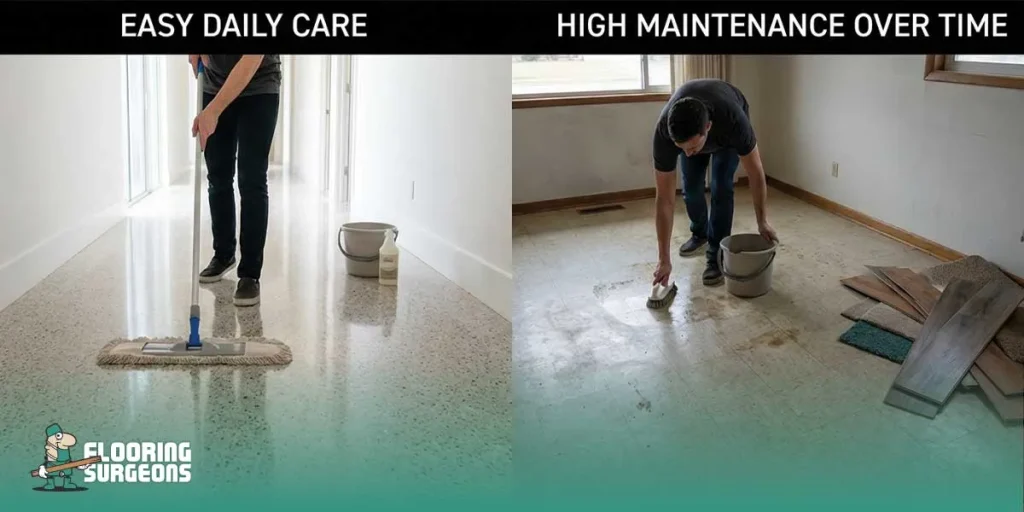
Every day care for terrazzo is straightforward. Regular sweeping or dust mopping removes abrasive dirt, and occasional damp mopping with a neutral cleaner is usually enough to keep the surface clean. Terrazzo does not require special daily treatments, and it holds up well in high-traffic areas without showing rapid wear.
Polishing and sealing frequency
Terrazzo does need periodic polishing or resealing, but not frequently. In most residential or light commercial settings, sealing may be required every few years, depending on use and foot traffic. Polishing is typically done to refresh appearance rather than to fix damage. This maintenance is planned and predictable, not constant or reactive.
Maintenance vs replacement cost
When comparing maintenance costs over time, terrazzo often performs better than cheaper floors. Materials like vinyl, laminate, or carpet may require complete replacement multiple times within the lifespan of one terrazzo floor. While terrazzo has occasional maintenance costs, it avoids the repeated tear-outs and reinstallation required by other materials. Over the decades, maintaining terrazzo has been far less expensive than replacing lower-cost flooring again and again.
What Is the Lifespan of a Terrazzo Floor?
One of the strongest arguments for terrazzo flooring is its lifespan. When installed correctly and maintained properly, terrazzo is one of the longest-lasting flooring systems available.
Expected lifespan compared to other floors
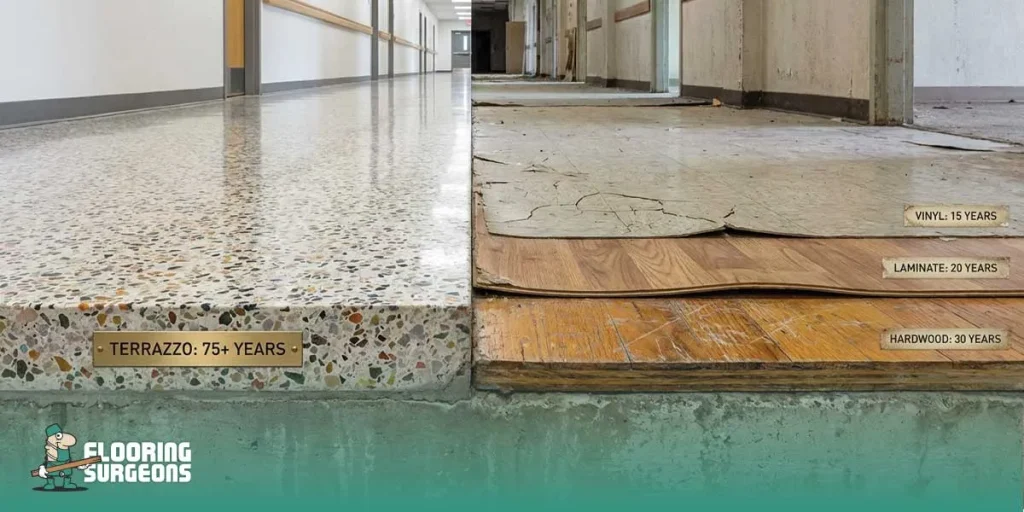
A well-installed terrazzo floor commonly lasts 50 to 75 years, and in many cases, far longer. By comparison, vinyl flooring often needs replacement after 15 to 25 years, laminate after 10 to 20 years, and even high-quality hardwood may require major refurbishment or replacement within 30 to 40 years. Terrazzo is not designed to be replaced on a cycle. It is designed to endure. This long lifespan is one of the reasons terrazzo is often considered alongside options designed for high-impact environments, such as those discussed in our guide to the best flooring for a gym.
Why terrazzo often outlasts the building itself
Terrazzo is a monolithic system. Once cured and finished, it becomes an integral part of the structure rather than a surface layer that wears away. Its thickness allows for multiple rounds of grinding and polishing over decades without compromising performance. That is why terrazzo floors in historic buildings are often still in use long after other materials have failed. In many projects, the floor does not dictate renovation timelines. The building does.
Is Terrazzo Worth the Price in the Long Run?
Whether terrazzo is worth the price depends less on the initial budget and more on how long the floor is expected to perform.
Cost per year comparison
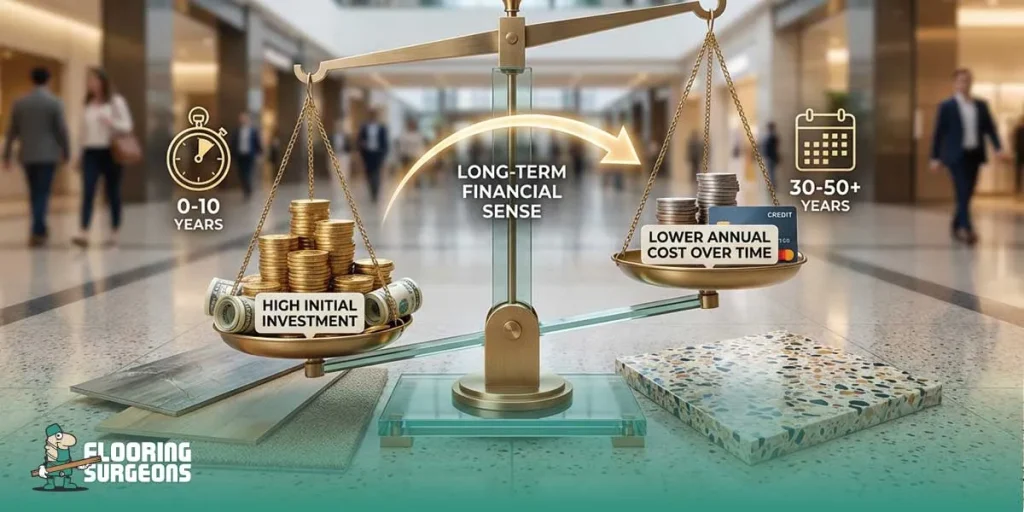
When the upfront cost is spread over its lifespan, terrazzo often becomes surprisingly economical. A floor that lasts several decades without replacement can cost less per year than a cheaper option that needs to be replaced multiple times. While the initial investment is high, the annualised cost is often lower than vinyl, laminate, or carpet when viewed over 30 to 50 years. For homeowners who prioritise long-term value over upfront price, terrazzo is often weighed against alternatives like luxury vinyl flooring, which offers a lower installation cost but a shorter lifespan.
When terrazzo makes financial sense
Terrazzo makes sense in projects where longevity matters. Commercial spaces, public buildings, high-end residential homes, and long-term properties benefit most. It is also a strong choice when future disruption or repeated renovations would be costly or impractical.
When it doesn’t
Terrazzo may not be the right choice for short-term properties, tight renovation budgets, or spaces likely to undergo frequent layout changes. If a floor is expected to be replaced within a decade, the long lifespan of terrazzo does not justify its cost.
In short, terrazzo is not a budget flooring option, but it can be a financially smart one when viewed through a long-term lens rather than an upfront price comparison.
Is Terrazzo Still Trendy in 2026?
Terrazzo has proven to be one of those materials that never fully disappears. Its appeal is not tied to short-lived design trends, which is why it continues to resurface in modern interiors.
Why terrazzo keeps coming back
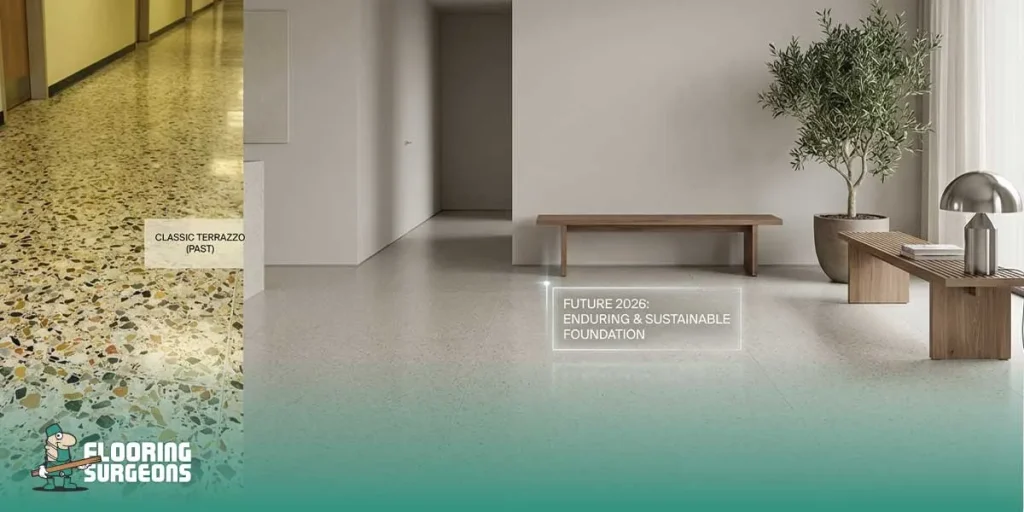
Terrazzo remains relevant because it balances durability with visual flexibility. Designers return to it whenever long-lasting materials regain priority over disposable finishes. As sustainability, longevity, and material honesty become more important, terrazzo naturally fits the conversation again and again.
Modern terrazzo vs old-school terrazzo
Older terrazzo floors were often associated with busy patterns and institutional spaces. Modern terrazzo is different. Today’s designs use finer aggregates, softer colour palettes, and cleaner layouts. The result feels controlled and contemporary rather than decorative or retro. This shift has helped terrazzo move comfortably into residential and design-led commercial spaces.
Where terrazzo fits in future interiors
Looking ahead to 2026 and beyond, terrazzo fits best in interiors that value permanence and restraint. It works well in minimalist architecture, mixed-material spaces, and projects that prioritise long-term performance. Rather than being a trend feature, terrazzo acts as a stable visual foundation that supports evolving interior styles over time.
Final Verdict – Should You Choose Terrazzo Flooring?
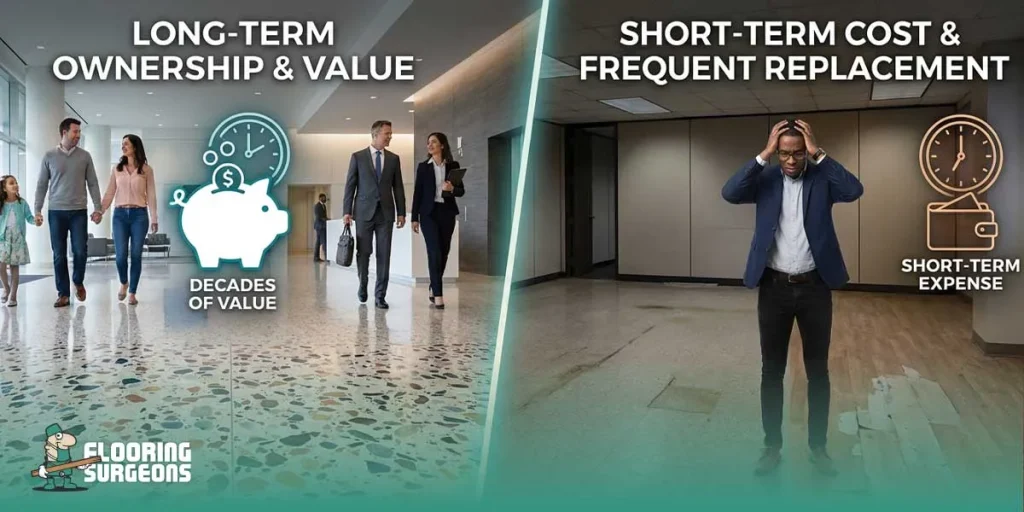
Choosing terrazzo flooring depends on how you evaluate cost and value. Terrazzo is expensive to install, but cheap to own. That distinction is where many comparisons fail. At Flooring Surgeons, we often see terrazzo chosen not for short-term savings, but for projects where long-term durability and lifetime value matter more than upfront cost.
Who terrazzo is perfect for
Terrazzo is ideal for people and projects that think long term. If you value durability, low replacement cycles, and consistent performance over decades, terrazzo delivers strong lifetime value. It suits commercial spaces, public buildings, and homeowners planning to stay put for many years. When cost is viewed as cost per year rather than upfront price, terrazzo often makes financial sense.
Who should avoid it
Terrazzo is not the right choice for short-term properties, tight renovation budgets, or spaces where frequent redesigns are expected. If the priority is quick installation, visual warmth, or short-term savings, other flooring options will feel more appropriate.
The key difference is a mindset. Terrazzo carries a luxury cost at installation, but it offers lifetime value in use. In 2026 and beyond, that shift from upfront price to long-term ownership cost is exactly why terrazzo continues to hold its place rather than fade away.

Haniye Ayanmanesh
As an expert writer for Flooring Surgeons, I combine technical SEO knowledge with a practical understanding of flooring, producing content that helps users make confident decisions while supporting long-term organic growth.