

If you’re trying to decide between tongue and groove and click-lock flooring, here’s the quick and honest answer: click-lock is easier to install, more DIY-friendly, and generally provides stronger long-term stability, while tongue and groove offers a more traditional fit and is better for glue-down or nail-down installations where extra rigidity is needed. In most modern homes — especially for floating floors like laminate, LVT, or engineered wood — click-lock is the more practical and reliable choice. But depending on your subfloor, moisture levels, and installation method, tongue and groove can still be the better option.
The problem is that most guides oversimplify the differences, making homeowners think the choice comes down to “old vs new.” But the real comparison is about joint strength, moisture behaviour, repairability, underfloor heating compatibility, noise levels, and how each system performs in real houses — not showrooms. The connection you choose affects how quiet the floor feels, how well the seams stay tight over time, how it responds to humidity changes, and even how easy it is to replace a damaged board five years later.
So if all you needed was the short answer, you already have it. But if you want the smart answer — the one that prevents gaps, lifting, creaking, moisture issues, and expensive installation mistakes — this guide breaks everything down clearly: how each locking system works, which one lasts longer, which performs better in high-moisture rooms, how they compare during installation, and when each type genuinely makes more sense for your home.
By the end, you’ll know exactly which flooring connection system fits your space, your skill level, and your long-term expectations — without guessing and without relying on outdated advice.
Table of contents
What Is Tongue and Groove Flooring?
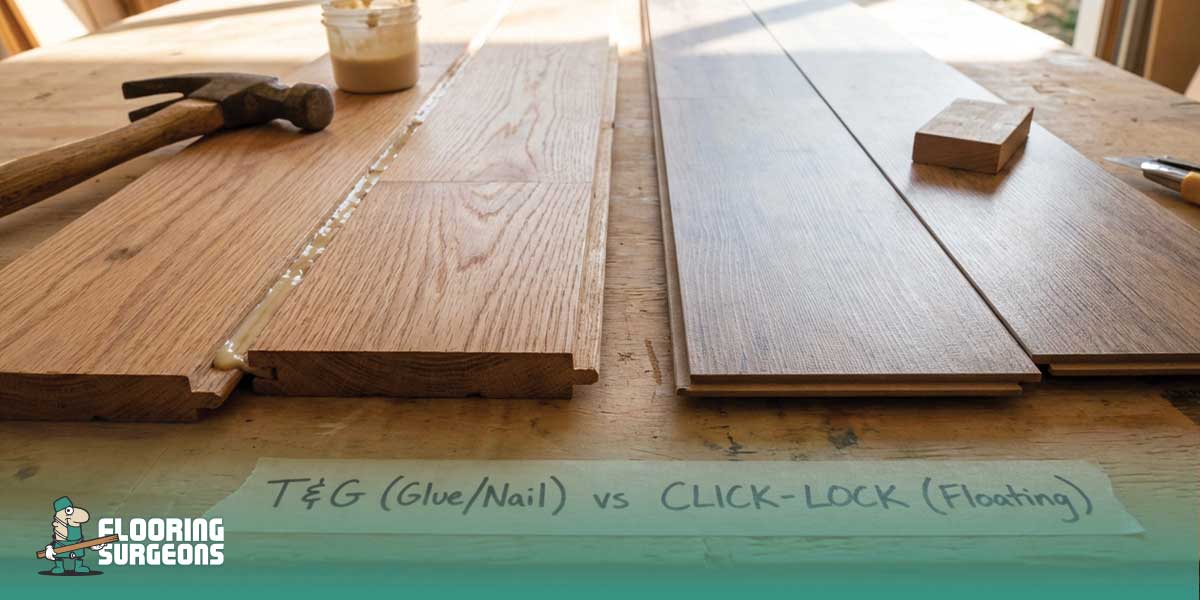
Tongue and groove flooring is a traditional joining system where each plank has two sides: a tongue (a small protruding ridge) and a groove (a matching recessed slot). During installation, the tongue of one board fits tightly into the groove of the next, creating a solid, interlocking connection. Unlike click-lock systems, tongue and groove does not snap into place — it typically needs to be glued, nailed, or stapled, depending on the type of flooring and subfloor.
This construction creates a strong, stable surface that feels firm underfoot, which is why tongue and groove is often used in hardwood flooring, engineered wood, and traditional carpentry-style installations. Because the boards don’t lock mechanically, the strength of the floor comes from the fit of the joint and the chosen installation method. This makes it ideal for situations where you want a fully glued-down floor or a fixed, permanent installation that won’t move with foot traffic.
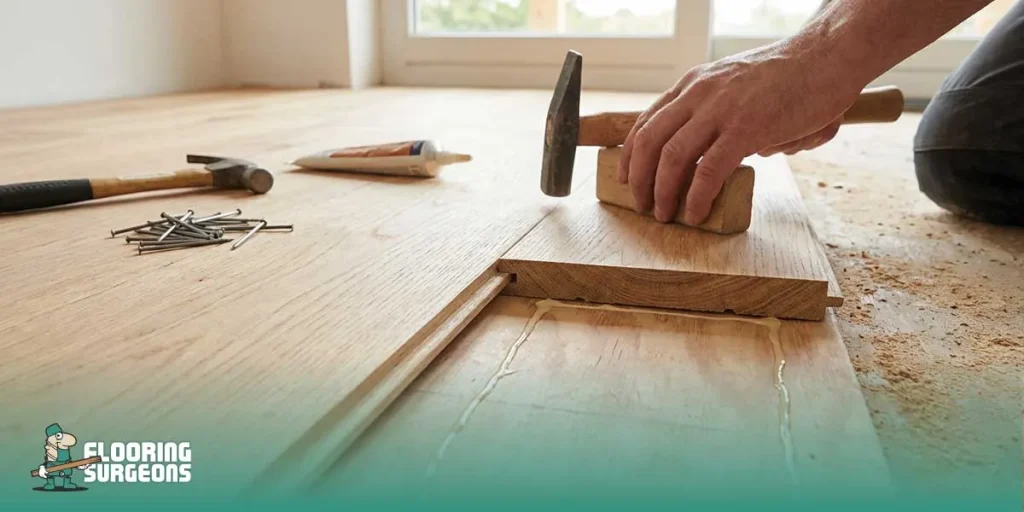
In simple terms, tongue and groove flooring offers a classic, reliable connection system designed for rigid, long-lasting installations, especially in spaces where structural stability matters more than quick installation. It’s less DIY-friendly than click-lock, but still one of the most trusted methods for creating a tight, seamless hardwood appearance.
What Is Click Lock Flooring?
Click lock flooring is a modern installation system where each plank is designed with built-in locking profiles that snap together without glue or nails. Instead of sliding a tongue into a groove, the boards connect through a mechanical “click” mechanism — usually by angling one plank and pressing it down until it locks into place. The result is a floating floor that sits above the subfloor without being fixed to it.
This system is used widely in LVT, laminate, SPC, engineered wood, and many modern floating-floor products because it offers a fast, clean, and DIY-friendly installation. With click lock, the planks stay tightly connected even as the floor expands and contracts, reducing gaps and eliminating the need for adhesives. It also makes repairs far easier: a damaged plank can usually be removed and replaced without dismantling the entire room.
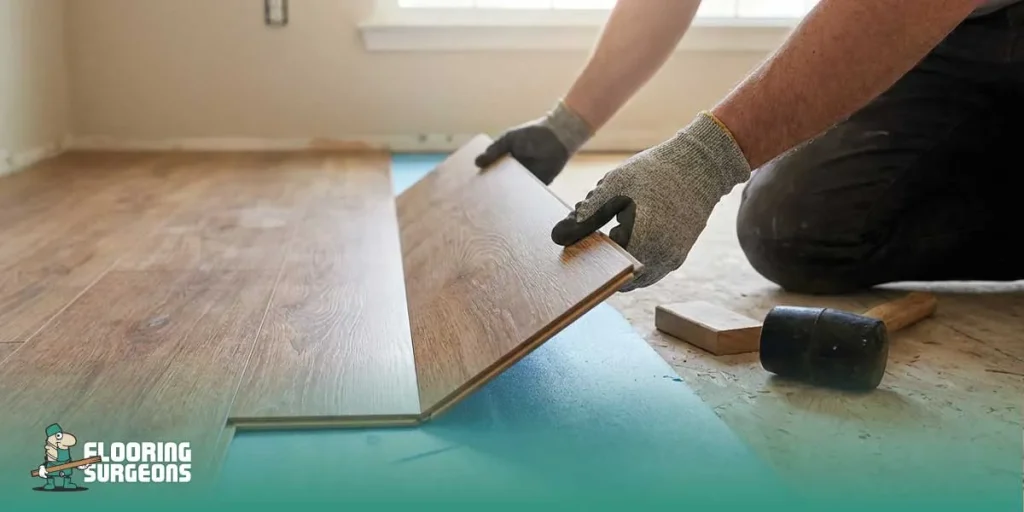
In practical terms, click lock flooring is ideal for homeowners who want a quick installation, a stable floating system, and a low-mess process. It performs exceptionally well in apartments, rental properties, and busy homes because it can be installed over existing floors, underlayments, and uneven (but prepared) subfloors. The combination of speed, convenience, and long-term stability is exactly why click lock systems dominate today’s DIY and modern flooring market.
Tongue and Groove vs Click Lock — Key Differences
Tongue and groove and click lock floors may look similar once installed, but the way they connect — and the experience they create for homeowners — is very different. Tongue and groove relies on manual alignment and often glue or nails, while click lock uses a mechanical locking system that snaps planks together. These differences affect installation speed, long-term stability, water performance, repairability, and which rooms each system is best suited for.
The comparison below breaks the systems down clearly so users can decide what works best for their home.
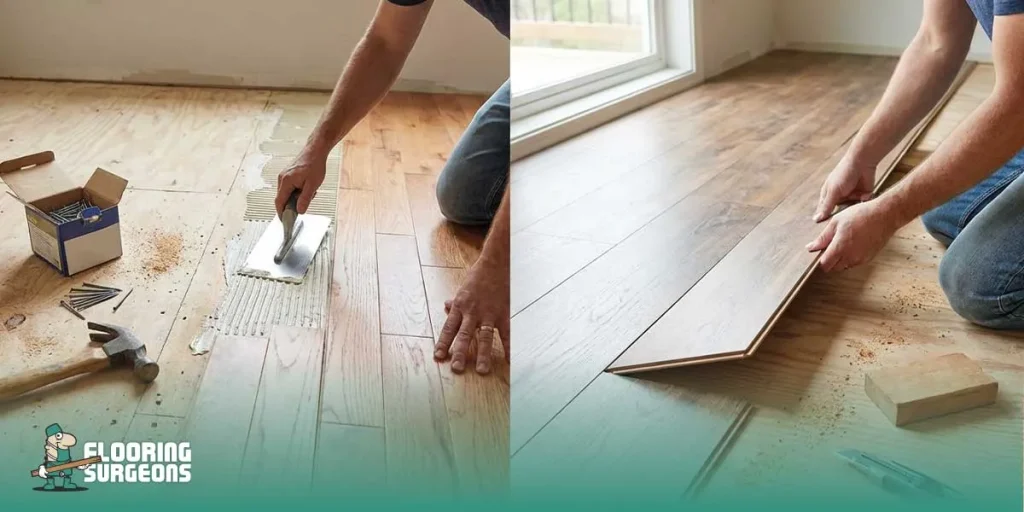
Full Comparison Table: Tongue & Groove vs Click Lock Flooring
| Feature / Factor | Tongue & Groove (T&G) | Click Lock Flooring |
| How It Connects | A tongue fits into a groove; it requires manual alignment | Planks lock together mechanically with a “click” action |
| Installation Method | Often glued or nailed; a floating installation is possible, but harder | Designed for floating floors; no glue or nails needed |
| Difficulty Level | More skilled installation; mistakes cause gaps | Extremely DIY-friendly; fast, clean installation |
| Speed of Installation | Slower — each joint must be aligned | Very fast — planks snap together |
| Water Resistance | Depends on product + glue seal | Stronger joint seal; better for spill-prone areas |
| Gap Prevention | More prone to seasonal gaps if not installed perfectly | The locking mechanism keeps the boards tighter over time |
| Repairability | Harder — glued planks must be cut out | Easier — sections can be unlocked and replaced |
| Subfloor Requirements | Needs a well-prepared, flat subfloor | More forgiving; works well as a floating system |
| Best For | Traditional wood installations, renovations, and structural flooring | Modern homes, DIY projects, LVT/laminate/SPC floors |
| Long-Term Stability | Very stable when glued or nailed | Excellent stability in floating installations |
| Noise Level | Quieter when glued down | Quieter depends on the underlay; floating floors may sound hollow |
| Cost of Installation | Higher due to labour | Lower — faster install, no adhesives |
| Common Materials | Engineered wood, hardwood | Laminate, LVT, SPC, engineered wood |
Installation Differences — Tools, Skill Level & Speed
The installation process is where tongue and groove and click lock flooring diverge the most. Even though both systems create a similar finished look, the effort, tools and experience required can be very different. Understanding these installation differences helps homeowners choose the option that fits their skill level, timeline and renovation style.
To understand the installation steps in more depth — especially if you’re considering fitting a floating laminate floor yourself- our How to Install Laminate Flooring guide walks you through the full process from start to finish.
Tongue and Groove: Traditional, Skill-Dependent Installation
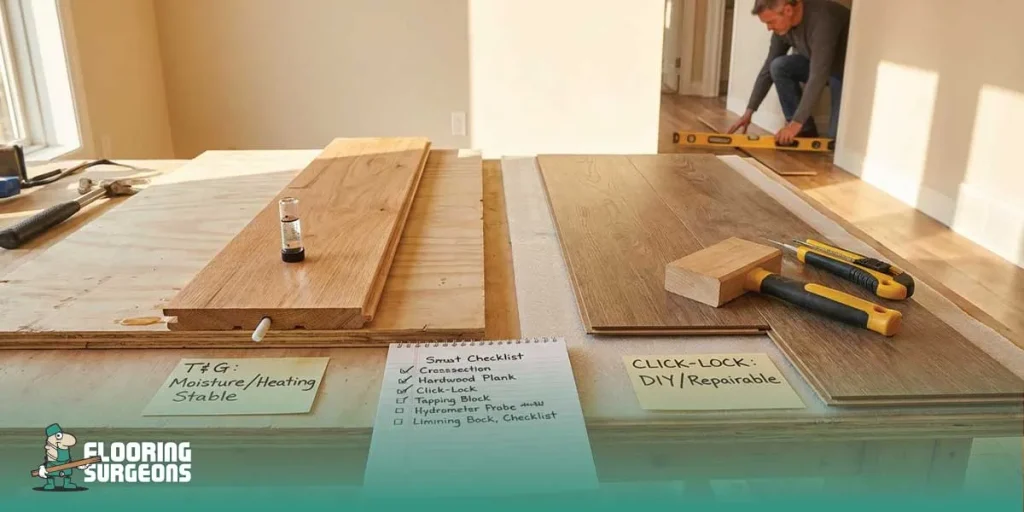
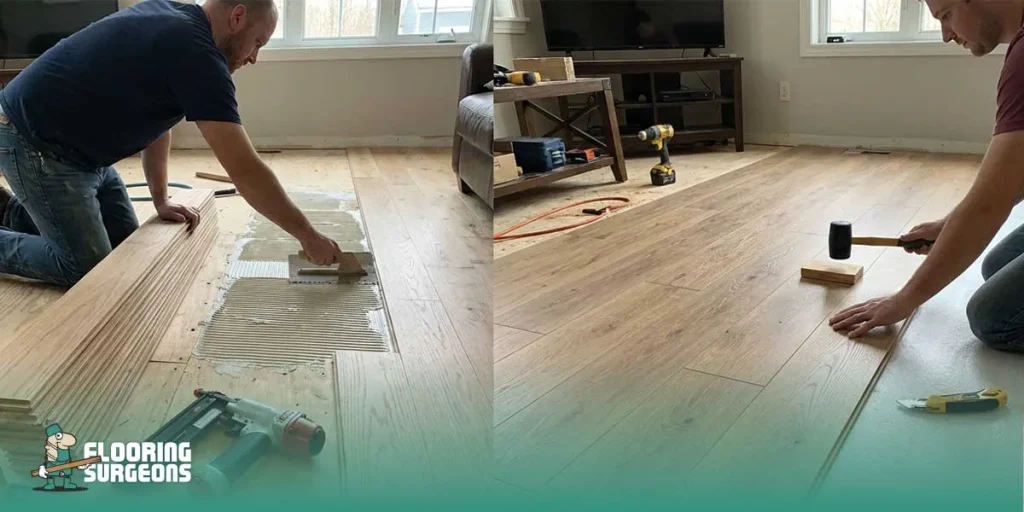
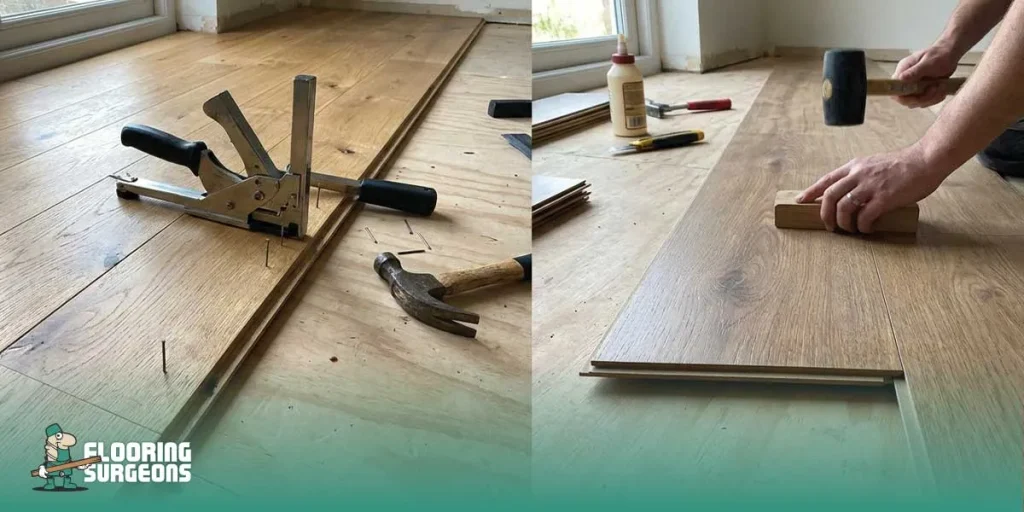
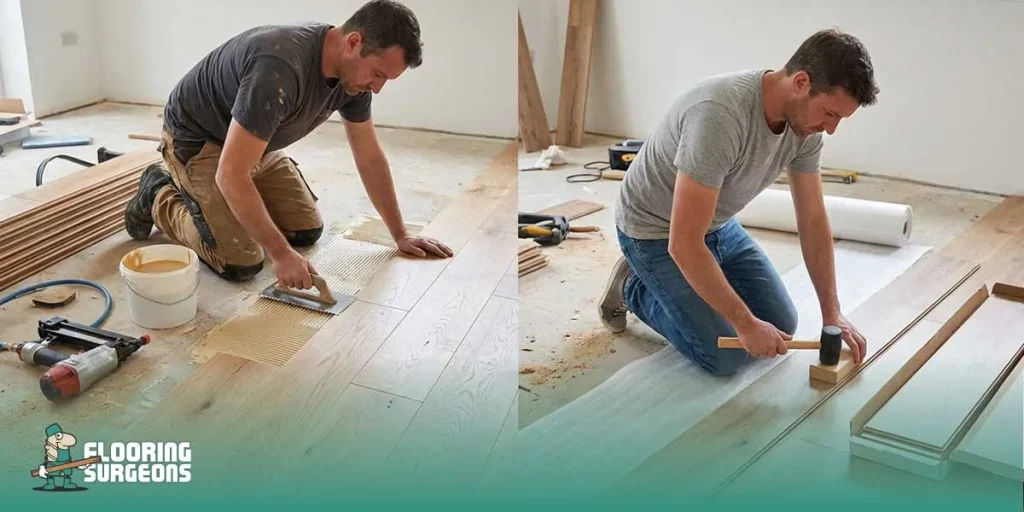
Tongue and groove flooring requires each plank to be manually fitted, and depending on the product, either glued, nailed or stapled. This approach demands greater precision because even small misalignments can create visible gaps. Installers typically need tools such as tapping blocks, mallets, flooring nailers or adhesives. As a result, T&G installations are slower and better suited to professionals or experienced DIYers who are comfortable with structural flooring methods. While the finished floor is stable and long-lasting, the process involves more labour and offers less margin for error.
Click Lock: Fast, Clean & Extremely DIY-Friendly
Click lock flooring uses a built-in locking mechanism that snaps planks into place, eliminating the need for glue or nails. Most homeowners can install it using simple tools like a utility knife, rubber mallet and spacers. Because the planks lock from angle to angle, large sections can be completed quickly, and mistakes are easy to correct. The floating installation style also reduces mess and shortens project time, making click lock the ideal choice for quick renovations, rentals or first-time DIY projects.
Installation Speed Comparison
Click lock systems are significantly faster because alignment is automated by the locking mechanism. Tongue and groove requires more careful positioning and additional drying time if adhesives are used. For most rooms, click lock can be installed in a single day, whereas tongue and groove may take considerably longer, especially for first-time installers.
Durability & Stability — Which Joint Performs Better?
The durability of a flooring system isn’t defined by the plank alone — the joint plays a significant role in how stable the floor feels years after installation. Tongue and groove and click lock perform very differently under pressure, movement and environmental changes, and these differences matter when you’re choosing a floor that needs to stay tight, level, and gap-free over time.
Tongue and Groove: Strong Structural Stability
Tongue and groove floors form a rigid, unified surface once glued, nailed or stapled. Because each board is physically anchored to the subfloor or to neighbouring boards, the entire system feels solid and resists vertical movement exceptionally well. This makes T&G ideal for real wood floors or rooms where long-term rigidity is essential. However, the joint’s durability heavily depends on how precisely it was installed. Poor alignment, insufficient adhesive or uneven subfloors can lead to squeaking, slight gaps or shifting. When installed correctly, though, a T&G floor can last decades without loosening.
Click Lock: Excellent Gap Resistance
Click lock floors rely on a mechanical locking system that grips tightly along the edges of each plank. Because the joint is engineered to snap securely into place, it maintains intense horizontal pressure — preventing gaps from forming even when the floor expands and contracts with temperature changes. Unlike T&G, click lock is designed to “float,” meaning the floor can move slightly as a unified sheet. This flexibility protects the joints from stress and reduces the risk of cracking or splitting. For modern laminates, vinyl planks and engineered flooring, the click system often outperforms T&G in long-term joint integrity.
Which One Truly Lasts Longer?
Both systems can be durable, but their strengths differ:
- Tongue and groove delivers superior structural solidity when professionally installed.
- Click lock offers better long-term resistance to gapping, seasonal movement and daily wear — especially in floating-floor environments.
If you want a floor that feels firmly anchored, choose tongue and groove.
If you want a floor that stays tight, stable and low-maintenance, choose click lock.
Water & Moisture Resistance in Real Homes
When choosing between tongue and groove and click lock flooring, water performance is one of the most significant deciding factors — especially in UK homes where kitchens, hallways and ground floors experience daily moisture, spills and humidity changes. The truth is that the joint design plays a significant role in how well a floor survives moisture, but the two systems behave very differently in real-life scenarios.
Tongue and Groove: Strong When Sealed — Vulnerable When Not
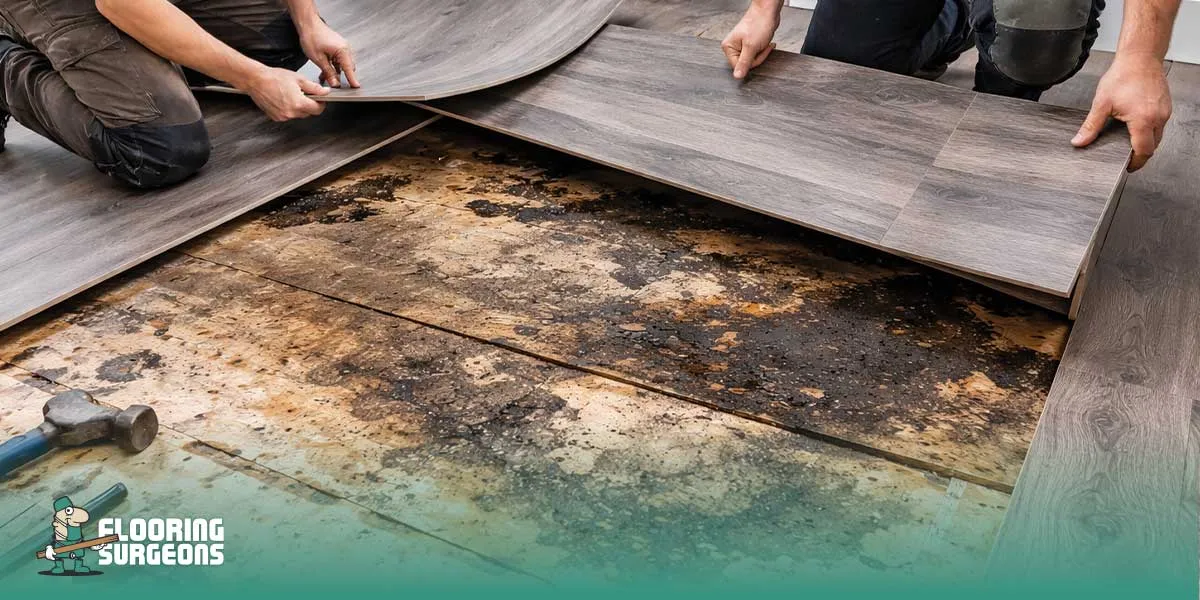
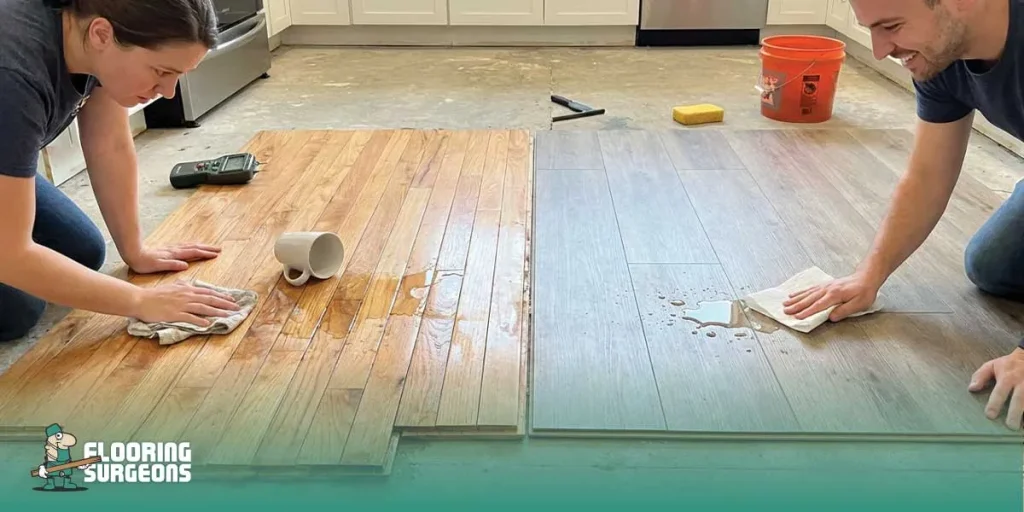
Tongue and groove floors are not naturally water-resistant. Because the boards slide together without a mechanical lock, even tiny gaps can allow moisture to seep between planks.
However, when properly glued and sealed, a T&G floor can resist everyday moisture reasonably well — excellent wood or engineered boards that are nail-down or glue-down. The challenge is that long-term protection depends entirely on installation quality. If the installer leaves micro-gaps or the adhesive weakens over time, moisture can creep in, causing swelling, cupping or edge damage.
In older homes or uneven subfloors, this risk increases because the boards don’t always sit perfectly flush.
Click Lock: Built for Better Everyday Water Resistance
Click lock flooring naturally performs better in damp or spill-prone rooms because the locking mechanism creates a tight seal along the edges. This engineered pressure helps keep moisture on the surface rather than letting it penetrate between boards.
Most modern click lock floors — especially LVT, SPC and many engineered laminates — are designed as floating systems with water-resistant cores, meaning occasional spills, wet mopping and humidity shifts don’t compromise the joints. This makes click lock the safer choice for kitchens, hallways, rentals and family homes where water exposure is unavoidable.
How They Perform in Real Homes
- In kitchens with regular spills → Click lock wins; the tight seams withstand everyday moisture far better.
- In basements or ground floors with humidity changes, → Click lock remains more stable, as the floating mechanism adapts to expansion.
- In traditional homes with solid wood flooring, → Tongue and groove works well, but only when sealed and maintained correctly.
- In bathrooms → Neither system is ideal unless using waterproof-rated products (SPC, rigid-core vinyl, or fully sealed engineered boards).
If you want a floor that can handle real-life water exposure — spills, damp shoes, pets, humidity — click lock is the more reliable system. Tongue and groove can be moisture-resistant, but only in professionally installed, well-maintained setups. In everyday homes, click lock simply delivers more consistent protection with less risk.
Sound, Comfort & Room Feel (A Major Overlooked Factor)
When homeowners compare tongue and groove with click lock flooring, most focus on installation and durability — but the actual feel of the room is one of the most significant long-term differences. Sound absorption, underfoot comfort and the overall “solidness” of the floor dramatically change depending on the joint system. This is where the two constructions behave very differently in real homes.
Tongue and Groove — The Most Solid, Quiet Underfoot Feel
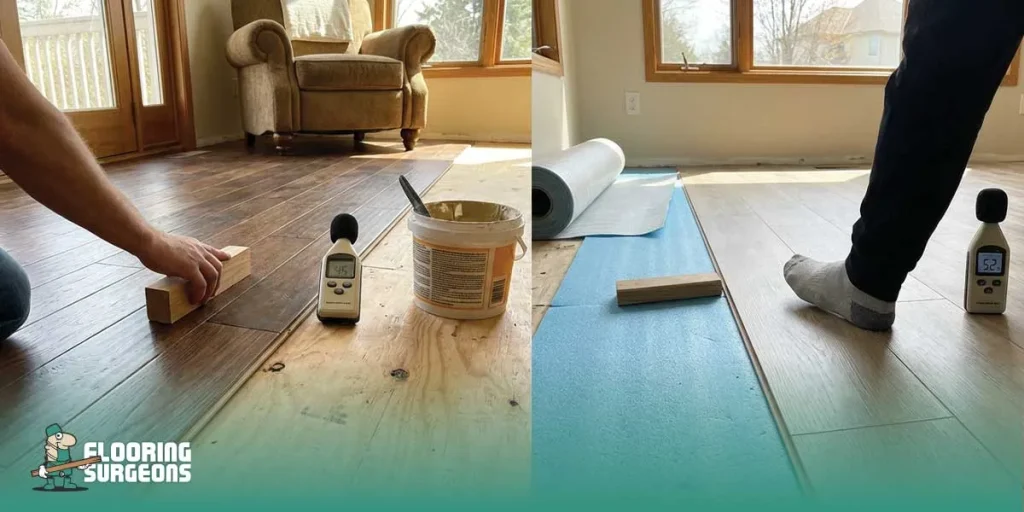
Tongue and groove floors are usually glue-down or nail-down, which means the boards sit firmly against the subfloor. This creates a dense, grounded feel that many people associate with traditional hardwood flooring. Because the planks are directly attached to the base, sound transfer is reduced:
- Fewer hollow noises
- Less echo
- A heavier, more premium “thud” when you walk
In bedrooms, living rooms or upper floors, this solid feel can make the entire space seem quieter and more stable. For homeowners who want their floor to feel like permanent, built-in woodwork, tongue and groove offers the closest experience.
Click Lock — Softer, More Cushioned, Sometimes Slightly Hollow
Click lock flooring is installed as a floating floor, meaning it sits on top of an underlay rather than being fixed to the subfloor. This creates a different acoustic and comfort profile.
You get:
- A softer, more cushioned underfoot feel
- Better step comfort, especially on LVT/SPC
- Strong sound insulation, depending on the underlay you choose
However, floating systems can produce a soft hollow or drum-like sound in certain areas, especially if:
- The subfloor isn’t perfectly level
- The underlay is low-quality
- The boards are thinner and more rigid (common in SPC)
While modern rigid-core click floors minimise this issue, it’s still a noticeable difference compared with the dense solidity of tongue and groove installations.
How Each Option Shapes the Room’s Atmosphere
Tongue and Groove:
Creates a warm, traditional, grounded room feel with excellent acoustic stability. Ideal for bedrooms, dining rooms and family spaces where sound matters.
Click Lock:
Feels softer and more forgiving underfoot — great for flats, high-traffic homes, kids’ rooms and spaces where comfort beats absolute solidity.
Which One Is Better for Noise Reduction?
It depends on the situation:
- Above-ground floors: Tongue and groove reduces impact noise best.
- Flats & rentals: Click lock with high-density acoustic underlay performs better because it isolates sound.
- Busy family homes: Click lock feels softer and absorbs impact from running kids and pets.
If your priority is a solid, premium, quiet hardwood feel, tongue and groove is unmatched.
If you want a comfortable, forgiving, modern floor with softer acoustics, click lock offers far more flexibility — especially when paired with quality underlay.
Underfloor Heating Compatibility (Gap Content)
Most comparison guides barely touch underfloor heating, yet it’s one of the most practical differences between tongue-and-groove and click-lock flooring. The way the boards connect — and whether they’re glued, nailed, or floating — directly affects heat transfer, expansion behaviour, and long-term stability. If your home already has UFH or you plan to install it later, choosing the wrong system can lead to cupping, gaps, noisy boards, or uneven heat.
Tongue and Groove — Excellent Heat Transfer but Higher Movement Risk
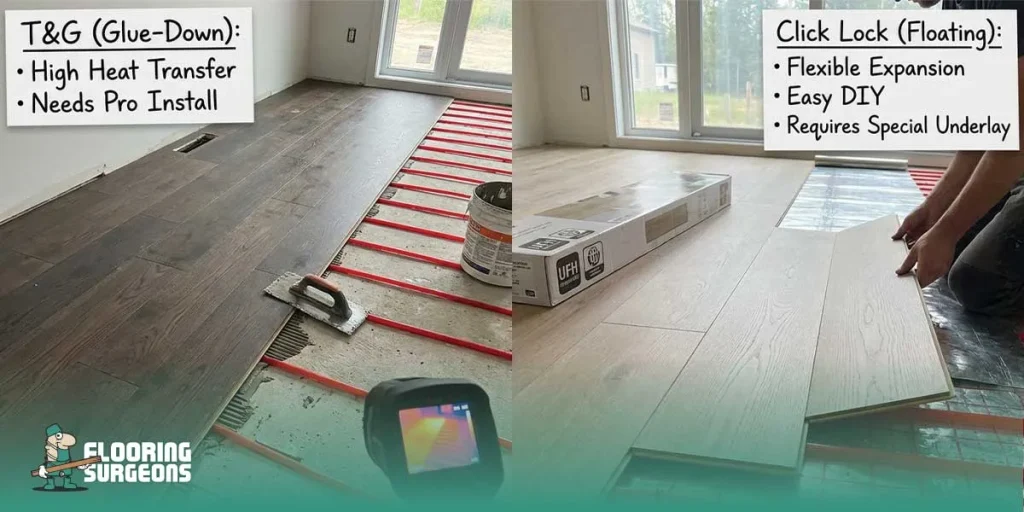
Tongue and groove floors perform very well with underfloor heating when installed correctly, because the boards sit tightly against the subfloor and transfer heat efficiently. Glue-down installations in particular create:
- Faster, more even heat distribution
- A solid, stable feel with minimal thermal lag
- No insulating air pockets beneath the boards
However, tongue and groove flooring is more sensitive to thermal expansion and contraction, especially in real wood or engineered boards. Because the planks are rigidly connected, rapid temperature swings or excessive heat may cause:
- Creaking sounds
- Seasonal gaps
- Pressure points along the joints
This doesn’t make T&G unsuitable — it simply means you must follow strict UFH rules: a proper acclimation period, controlled temperature gradients, and maximum surface temperature limits (usually 27°C). Glue-down T&G is significantly more UFH-friendly than nail-down, which creates uneven conduction.
Click Lock — Highly Compatible with UFH but Dependent on Underlay Quality
Click lock flooring is generally more forgiving with underfloor heating because the floating system allows the boards to expand and contract as a unit. Modern click-systems — especially LVT, SPC and engineered click woods — are designed with UFH in mind. Advantages include:
- Smooth, predictable thermal movement
- Lower risk of cupping or joint stress
- Easy installation over UFH-compatible underlays
- Quick removal and replacement if repairs are needed
The only limitation is the underlay. If the underlay has poor thermal conductivity or is too thick, it acts as insulation and:
- Slows heat transfer
- Creates cold spots
- Reduces UFH efficiency
For best performance, the underlay must be low tog (0.3–0.5), heat-resistant, and approved explicitly for floating floors over underfloor heating.
Which One Performs Better Long-Term with UFH?
It depends on the flooring material and installation style:
Tongue and Groove (Glue-Down):
Best heat transfer
Very stable when acclimated properly
Higher installation skill required
Sensitive to temperature mismanagement
Click Lock (Floating):
Safest option for expansion movement
Ideal for LVT/SPC over UFH
Easier repairs if damaged
Heat efficiency relies on underlay quality
Best Choice for Homes Using Underfloor Heating
- Engineered wood: Glue-down tongue and groove performs exceptionally well but requires careful installation.
- LVT/SPC/Rigid Core: Click lock is the clear winner — perfectly stable and highly heat-efficient.
- Laminate: Click lock is usually recommended due to its predictable movement and UFH-approved construction.
If you want the fastest, most even heat and don’t mind a more technical installation, tongue and groove (glue-down) provides top-tier UFH performance. If you want the safest, easiest, most future-proof UFH option with minimal risk, especially for laminates, vinyl and SPC, click lock is the more reliable choice.
Repair, Replacement & Maintenance Requirements
Repairing and maintaining flooring doesn’t just depend on the material — the joint system plays a significant role in how easy (or difficult) it is to fix everyday problems. Tongue and groove and click lock behave completely differently when a plank gets damaged, when the floor needs refinishing, or when you’re dealing with long-term wear. Understanding this upfront saves enormous time and cost later.
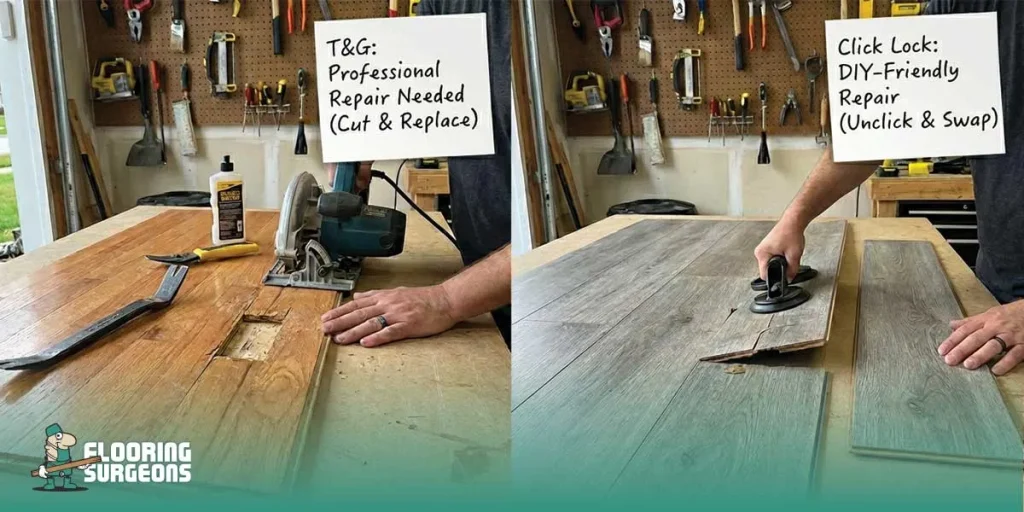
Tongue and Groove — Strong, Long-Lasting, but Harder to Repair
Tongue and groove floors are built for structural stability, which makes them highly durable, but that same construction also makes repairs more complicated. Because boards interlock and are often glued or nailed in place, accessing a damaged plank usually involves:
- Cutting out the affected board
- Removing adhesive or nails
- Precisely shaping a replacement board to fit.
Re-glueing or re-nailing without disturbing the surrounding planks
This process requires skill, tools, and time — meaning professional help is often necessary.
However, tongue and groove shines in long-term maintenance for real wood or engineered wood floors:
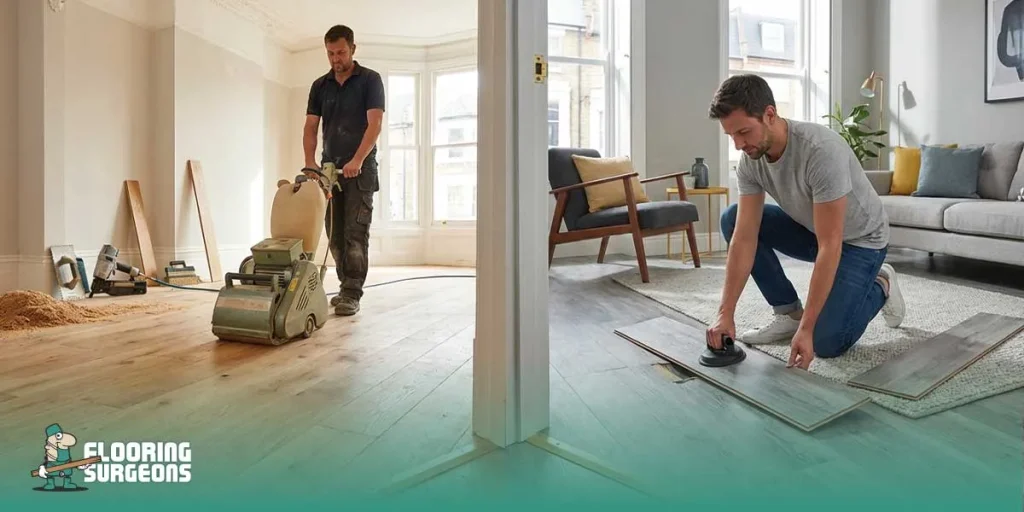
- Boards can be sanded and refinished multiple times
- Scratches and dents can be restored without replacing planks.
- A complete finish renewal can extend the life of the entire floor.
This makes T&G ideal for homeowners who prioritise longevity over ease of repairs.
Click Lock — Easiest System to Repair or Replace
Click lock flooring is designed with maintenance in mind. Because the floor floats as a single unit, repairs are dramatically more straightforward:
- You can unlock the boards from the nearest wall
- Remove planks one by one like a zipper.
- Replace the damaged plank.
- Re-click everything back into place.
This process requires no cutting, no glue, and typically no professional tools, making it highly DIY-friendly. For rentals, family homes or busy spaces where accidents happen, click lock can save a high cost over time.
Maintenance depends on the material:
- Click LVT/SPC: resistant to scratches and water, low maintenance
- Click laminate: easy to clean but not refinishable
- Click engineered wood: can be lightly sanded, but not as profoundly as glue-down T&G
Overall, click lock wins for convenience — but not always for refinishing depth.
Which System Handles Damage Better?
If you prioritise ease of repairing or swapping individual planks, click lock is the clear winner.
If you prioritise restorability and full refinishing potential, especially with real wood, tongue and groove offers a longer lifespan, even if repairs are more complex.
Maintenance Summary — Side-by-Side Insight
| Feature | Tongue & Groove | Click Lock |
| Plank Replacement | Difficult; requires cutting and pro skills | Very easy; unlock and replace |
| DIY Repair Friendly | Not ideal | Excellent |
| Refinishing Ability | High (wood/engineered) | Limited to moderate |
| Long-Term Appearance Renewal | Strong — can be sanded | Depends on material; LVT/SPC cannot be refinished |
| Best For | Long-term investment, premium wood floors | Rentals, family homes, quick repairs |
- Choose Tongue & Groove if you want a floor you can sand, refinish, and restore for decades.
- Choose Click Lock if you want simple, inexpensive repairs and the flexibility to replace planks without professional help.
Cost Comparison — Installation + Long-Term Value
When comparing tongue and groove with click lock flooring, the actual cost difference isn’t just in the price per square metre — it’s in how much you pay to install, maintain, repair, and eventually replace the floor over its lifetime. The two systems behave very differently, which means the cheapest option upfront is not always the most cost-effective long term. For homeowners who want professional guidance on choosing the right system — and ensuring it’s fitted correctly — the team at Flooring Surgeons offers expert advice across all laminate, LVT and engineered flooring installations.
Installation Costs — Where Click Lock Takes the Lead
Click lock floors are designed for fast, tool-light installation, which dramatically reduces labour costs. Because the planks snap together without glue or nails, most homeowners can install the floor themselves, making it the most budget-friendly option for DIY projects. Even when hiring professionals, installation time is shorter and therefore cheaper.
Tongue and groove, on the other hand, requires more precision. Whether it’s glued, nailed, or stapled, each board must be positioned accurately and secured in place. This takes more time and skill, so the labour cost is higher — especially for real or engineered wood where expert fitting is essential. In short, T&G costs more upfront purely due to meticulous installation requirements.
Lifetime Value — T&G Wins for Longevity, Click Lock Wins for Convenience
Although tongue and groove is more expensive to install, it often delivers a better lifetime value, particularly when used with solid or engineered wood flooring. These floors can be sanded and refinished multiple times, extending their life by decades. The higher upfront cost pays off long term because the flooring rarely needs complete replacement — only surface refinishing, which is considerably cheaper over decades.
Click-lock flooring has a different value proposition. Laminates, LVT and SPC click-lock floors are not refinishable, which means once the wear layer is damaged, the plank must be replaced entirely. While this is easy to do, the flooring does have a more limited lifespan, especially in high-traffic areas. The long-term cost can be lower or higher depending on how often the floor is replaced, but refinishing is not an option, which limits total lifespan.
Maintenance & Repair Costs — The Practical Difference
Click lock provides the cheapest and easiest repair process. A damaged plank can be removed and replaced without special tools, adhesives or professional help, which significantly reduces maintenance costs over time. This makes click lock especially attractive for rentals, family homes, or high-use spaces where occasional plank replacement is expected.
Tongue and groove repairs are more labour-intensive and typically require a professional. Cutting out the damaged board and preparing a precise replacement increases time and cost. However, the ability to fully refinish T&G wood floors makes long-term maintenance highly cost-effective, especially in premium homes.
Overall Cost Verdict — Which One Is More Affordable?
If your priority is the lowest upfront cost and cheapest repairs, click lock is the more economical option. If your priority is maximum lifespan, premium quality, and long-term investment value, tongue and groove delivers higher overall ROI, despite the higher installation cost.
In summary:
- Click Lock = cheaper today, easier tomorrow
- Tongue & Groove = more expensive today, better value over decades
Best Use Cases — When Each Flooring Type Makes More Sense
Choosing between tongue and groove and click lock isn’t just about installation preference — it’s about how the floor behaves in specific environments. Each joint system has situations where it performs better, lasts longer, or offers a more cost-efficient setup. Understanding these use cases ensures the floor you pick actually matches how the space is used day-to-day. If you’re leaning towards modern floating systems — especially for busy family homes or rentals — click-lock Laminate Flooring offers one of the best balances of durability, ease of installation and long-term practicality.
When Tongue and Groove Makes More Sense
Tongue and groove is the stronger choice for long-term installations where stability, refinishing potential and a premium finish matter most. Solid wood and engineered wood floors fitted with T&G joints feel more substantial underfoot and can be sanded and refinished multiple times, making them ideal for forever homes or high-value properties. T&G also performs better in rooms where subtle subfloor imperfections exist because the glued or nailed installation creates a more solid, unified structure.
For traditional interiors or luxury renovations, the seamless, continuous look of T&G typically outperforms click lock both visually and structurally.
When Click Lock Makes More Sense
Click lock flooring shines in homes where ease, speed and practicality are the priority. It is perfect for DIY installations, rentals, spare rooms, or any space where floors may need to be replaced or updated without heavy tools or long installation times. It’s also the more intelligent choice for floating-floor systems like LVT, laminate and SPC, where dimensional stability and fast fitting matter more than refinishing capability. For busy family homes, click lock’s simple repair process — popping out a damaged plank — makes it particularly appealing.
In short: choose T&G for longevity and premium wood finishes; choose click lock for convenience, speed and modern floating floors.
Tongue and Groove vs Click Lock: Pros and Cons
To decide confidently, homeowners need a realistic look at what each system does well — and where it falls short. Here is a clear, user-friendly comparison that avoids marketing fluff and focuses on real-world performance.
Tongue and Groove — Pros
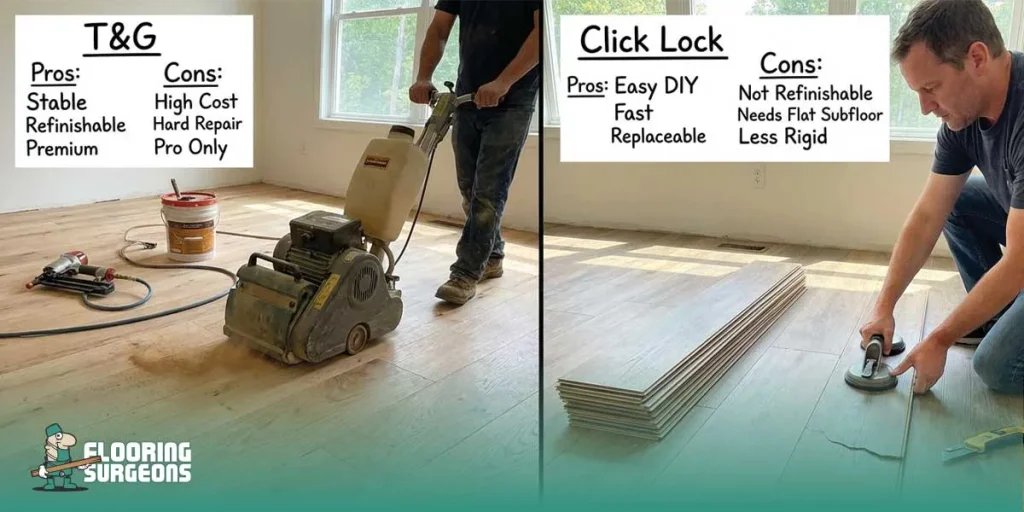
• Superior long-term stability
Once glued, nailed or stapled, T&G creates a rigid, unified floor structure that feels solid underfoot.
• Can be refinished multiple times (for wood floors)
Huge advantage for engineered and solid wood — refinishing extends lifespan for decades.
• Premium, seamless appearance
Joints are tight and discreet, ideal for high-end interiors.
• Performs well over imperfect subfloors
Professional installation compensates for minor subfloor irregularities.
Tongue and Groove — Cons
• Higher installation cost + slower fitting
More labour-intensive and requires professional skill.
• Repairs are more complicated
Damaged boards often require cutting out, which increases cost.
• Not designed for DIY installers
Requires adhesives or nails and precise handling.
Click Lock — Pros
• Easiest installation method available
Perfect for DIY; snaps together with minimal tools.
• Fastest fitting time
Ideal for tight project timelines or large open-plan spaces.
• Easy plank replacement
Single-plank repairs are simple and do not require specialist skills.
• Works exceptionally well with LVT, SPC & laminate
Designed for modern floating floor systems.
Click Lock — Cons
• Cannot be refinished
Once the wear layer is damaged, the plank must be replaced.
• Less forgiving over uneven subfloors
Requires a very flat subfloor to prevent movement or noise.
• Slightly less rigid feel compared to glued/nail-down T&G
Especially noticeable in floating laminate or LVT installations.

Haniye Ayanmanesh
As an expert writer for Flooring Surgeons, I combine technical SEO knowledge with a practical understanding of flooring, producing content that helps users make confident decisions while supporting long-term organic growth.