


A manifold for underfloor heating is the central control point that distributes heated water to each heating loop and regulates how much heat each area of the building receives. In simple terms, it acts as a traffic controller for your underfloor heating system, directing flow, balancing pressure, and allowing different zones to operate at different temperatures. Without a properly configured manifold, underfloor heating cannot deliver consistent, controllable, or efficient heat.
What often causes confusion is that the manifold is not just a pipe connector. It plays an active role in temperature control, system efficiency, and long-term reliability. Understanding what it does, how it works, and why its setup matters helps explain why some underfloor heating systems perform evenly and quietly, while others suffer from cold spots, imbalance, or control issues. The sections below break this down clearly, without assuming technical knowledge or focusing on products.
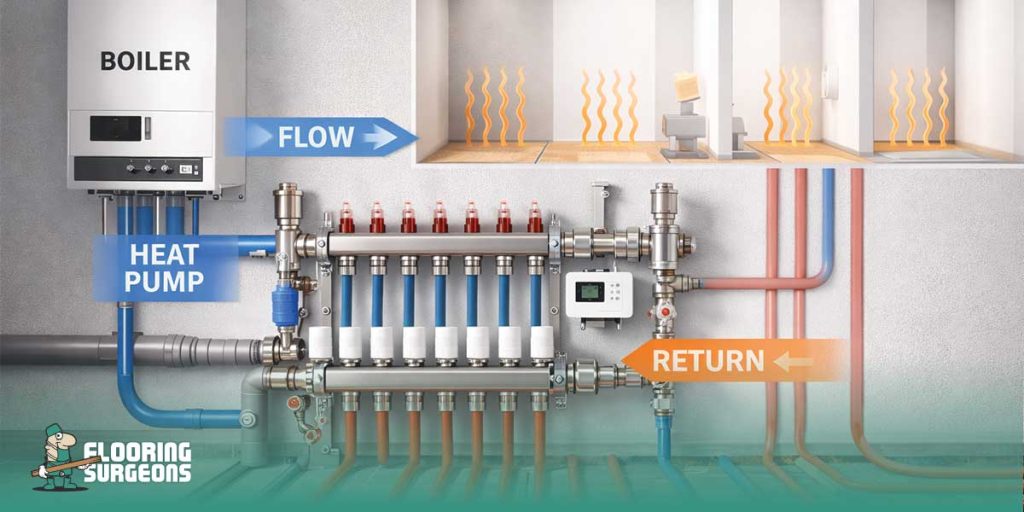
Table of contents
How Does a Manifold Work in an Underfloor Heating System?
In an underfloor heating system, the manifold manages how heated water moves from the heat source into the floor and back again. Warm water enters the manifold from the boiler or heat pump, is divided across multiple circuits, and is then returned after releasing heat through the floor. Each circuit typically serves a specific area or zone, which allows the system to operate in a controlled and balanced way rather than sending the same heat everywhere.
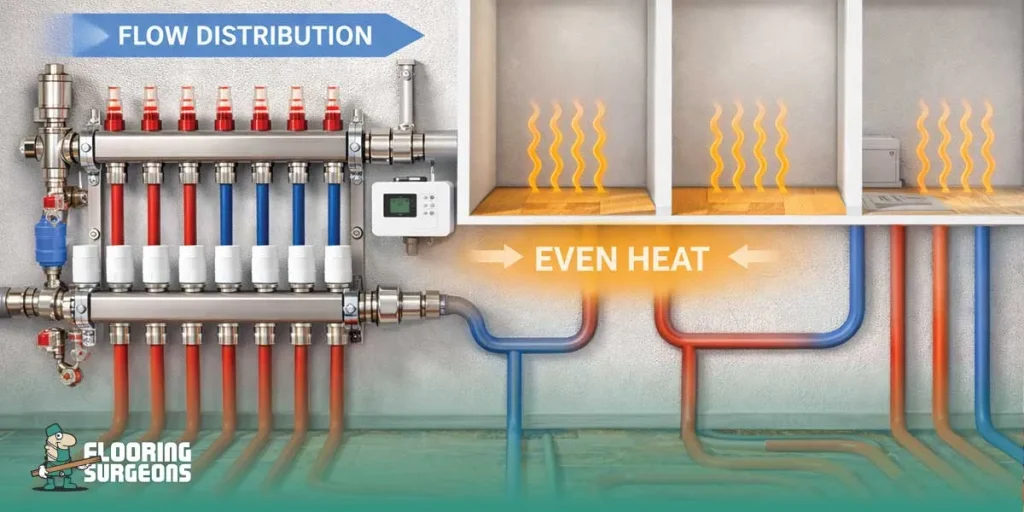
The flow side of the manifold controls how much warm water enters each loop, while the return side manages how that water exits the system. By regulating flow rates and pressure across these loops, the manifold helps maintain even heat output and prevents certain areas from overheating while others remain cold.
What Role Does the Manifold Play in Heat Distribution?
The manifold is responsible for distributing heat evenly across different areas of the building. Each loop connected to the manifold corresponds to a section of the floor, and the manifold ensures that water is shared between these loops in a controlled manner. Without this regulation, water would naturally favour the shortest or easiest paths, leading to uneven heating. Some rooms would warm up quickly, while others would struggle to reach the desired temperature. The manifold corrects this imbalance by controlling flow to each loop, allowing the system to deliver consistent heat where it is needed rather than relying on chance. Even with a well-balanced manifold, overall system performance is still influenced by external factors such as pipe layout, insulation quality, and how the flooring type affects underfloor heating performance across different rooms.
How Manifold Zoning Improves Efficiency
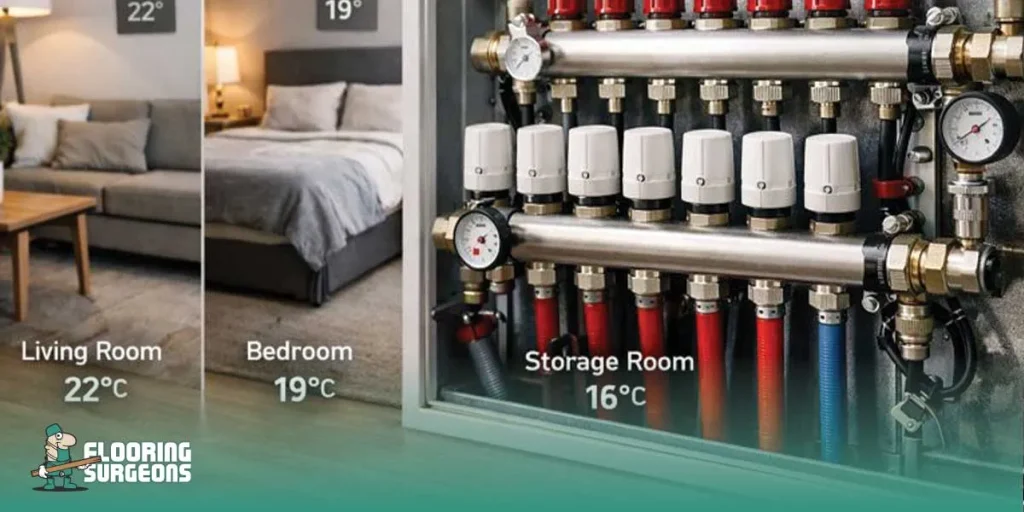
Zoning allows different areas of a building to be heated independently, and the manifold is what makes this possible. By separating the system into zones, each with its own control, the manifold allows rooms with different heat demands to operate at different temperatures. Zoning becomes even more effective when combined with materials that respond predictably to heat, such as engineered wood flooring compatible with underfloor heating, allowing each area to reach target temperatures without unnecessary energy loss.
This improves efficiency because heat is only delivered where and when it is required. Living spaces, bedrooms, and less frequently used areas can all be managed separately, reducing unnecessary energy use. Instead of the entire floor running at a single output level, the manifold enables precise control that supports both comfort and efficient system operation.
Key Components of an Underfloor Heating Manifold
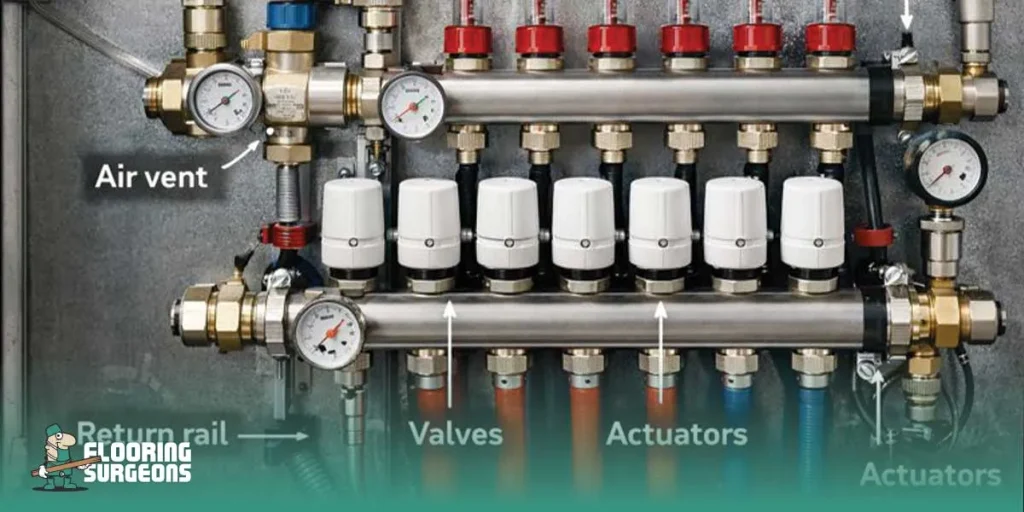
An underfloor heating manifold is made up of several components that work together to control water flow, balance heat output, and keep the system operating safely and efficiently. Each part has a specific function, and problems in any one of them can affect how well the entire heating system performs.
Below are the core components you will typically find on a manifold, explained in practical terms rather than technical jargon.
- Flow rail
This is the section where heated water enters the manifold and is distributed to each underfloor heating loop. It controls how water is supplied to different zones and is often fitted with flow meters to regulate output. - Return rail
The return rail collects water after it has circulated through the floor and sends it back to the heat source. It plays a key role in maintaining system balance and stable operating temperatures. - Flow meters
These allow installers to measure and adjust how much water passes through each loop. Correct flow rates are essential for even heat distribution and preventing cold or overheated areas. - Valves
Valves control whether water can enter or leave each circuit. They are used to isolate loops, balance the system, and regulate performance during setup and maintenance. - Actuators
Actuators open and close valves automatically based on signals from thermostats or control systems. This is what enables zoning and independent temperature control for different rooms. - Mixing valve
In systems where water from the heat source is too hot for underfloor heating, the mixing valve blends hot and cooler return water to achieve a safe operating temperature for the floor. - Pressure gauge
This shows the operating pressure within the system. Abnormal readings can indicate leaks, blockages, or air in the system and help diagnose issues early. - Air vents
Air vents release trapped air from the system, which is critical for preventing noise, circulation problems, and uneven heating.
Types of Underfloor Heating Manifolds
Underfloor heating manifolds are not all built the same. Differences in materials and structural design affect durability, compatibility with heat sources, ease of installation, and long-term maintenance. This is an area where many competitor articles stay vague, but understanding these distinctions helps avoid mismatched systems and future performance issues.

Broadly, manifolds can be grouped by material and by system design.
Material-Based Variants
The material used in a manifold influences corrosion resistance, lifespan, and suitability for different system types.
| Manifold Material | Typical Characteristics | Where It Is Commonly Used | Key Considerations |
| Brass | Strong, traditional construction with good pressure tolerance | Residential and light commercial systems | Reliable and durable, but heavier and less flexible in layout |
| Stainless steel | High corrosion resistance and clean internal surfaces | Modern systems and mixed heat sources | Higher cost, but well suited to long-term, low-maintenance setups |
| Polymer (composite) | Lightweight, corrosion-free, modular designs | Contemporary installations and retrofits | Easier handling, but quality varies by manufacturer |
Standard, Modular and Integrated Manifolds
Beyond materials, manifolds also differ in how their components are assembled and expanded.
| Manifold Type | Structural Design | Practical Advantage | Potential Limitation |
| Standard manifolds | Fixed layout with predefined connections | Simple and cost-effective | Limited flexibility for future expansion |
| Modular manifolds | Sections can be added or reconfigured | Scales well with system size | Requires careful planning to balance loops |
| Integrated manifolds | Built-in mixing, pumps, and controls | Compact and streamlined installation | Higher upfront cost and less component interchangeability |
Why this distinction matters
Choosing the wrong manifold type is rarely obvious at the installation stage, but it often shows up later as balancing issues, limited zoning control, or difficulties when upgrading heat sources. Material choice affects durability, while structural design determines how adaptable the system will be over time.
Where Should You Install a Manifold?
The location of the manifold has a direct impact on system performance, accessibility, and long-term maintenance. A well-placed manifold supports balanced heat distribution and easier control, while a poorly chosen location can make even a good system harder to manage or adjust later. In most cases, the goal is to place the manifold where it can serve all heating loops efficiently, remain accessible, and operate within safe temperature and pressure conditions.
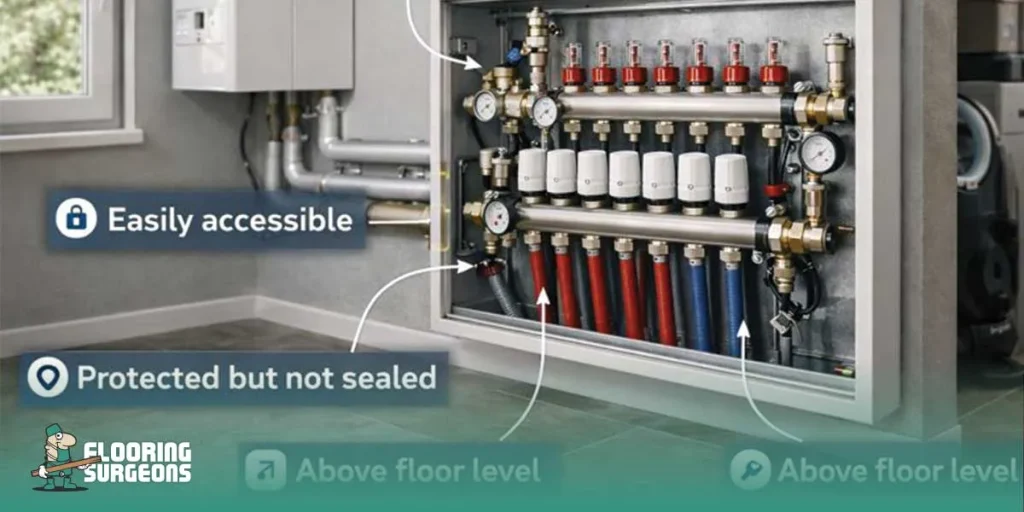
Key placement principles to consider:
- Central to the heating zones
The manifold should be positioned as close as possible to the centre of the areas it serves. This helps keep pipe lengths more even, which makes balancing the system easier and improves consistent heat delivery. - Easily accessible for adjustment and maintenance
Manifolds require occasional access for balancing, pressure checks, or actuator replacement. Installing one behind fixed furniture or in sealed voids creates unnecessary problems later. - Protected but not sealed
Typical locations include utility rooms, airing cupboards, or dedicated manifold cabinets. These spaces protect the manifold while still allowing airflow and access. - Above floor level where possible
Installing the manifold slightly above the floor helps with air removal and makes visual checks and adjustments easier during commissioning. - Close to the heat source, but not restrictive
Proximity to the boiler or heat pump reduces pipe runs, but the manifold should not be cramped into spaces that limit access or expansion. - Consistent environmental conditions
Avoid areas exposed to extreme cold, moisture, or high humidity. Stable conditions reduce stress on seals, valves, and actuators.
Poor placement often does not cause immediate failure, but it can lead to ongoing inefficiency, difficult balancing, and higher servicing effort over time. Choosing the right location from the start supports both performance and long-term reliability.
Common Problems and Troubleshooting
This is where underfloor heating systems often fail in real homes, not because the technology is complex, but because small issues inside the manifold are overlooked. Most performance problems can be traced back to flow control, trapped air, or component failure rather than the heat source itself.
Air Locks and Pressure Issues
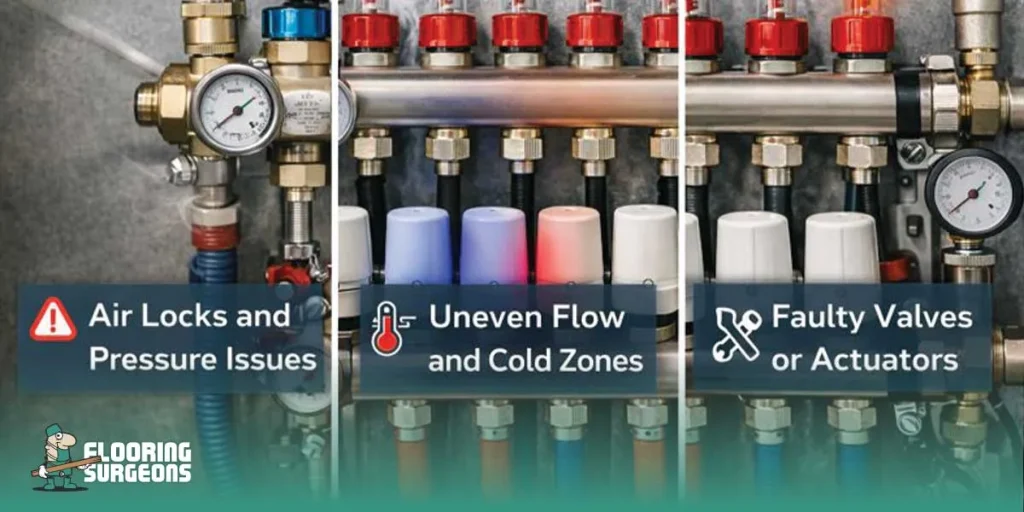
Air trapped in the system is one of the most common causes of poor performance. When air builds up in the manifold or pipe loops, it restricts water circulation and reduces heat transfer.
Typical signs include sections of the floor staying cold, gurgling noises, or fluctuating pressure readings. Low system pressure can also prevent actuators and valves from operating correctly. These issues usually indicate that the system needs proper venting and pressure stabilisation rather than changes to the heat source.
Uneven Flow and Cold Zones
Uneven heating across rooms or zones is often the result of imbalanced flow rates. Water naturally follows the path of least resistance, so shorter loops may receive more heat while longer loops struggle. If the manifold is not balanced correctly, some zones will overheat while others remain noticeably cooler. This is not a thermostat problem in most cases, but a flow regulation issue at the manifold that needs adjustment rather than redesign.
Faulty Valves or Actuators
Valves and actuators are responsible for opening and closing individual circuits based on temperature demand. When they fail, zones may stop responding to thermostat signals or remain permanently open or closed. Common symptoms include rooms that do not heat up despite correct settings, or zones that stay warm even when turned off. These faults usually relate to mechanical wear, electrical issues, or incorrect installation, and they highlight why manifolds must remain accessible for inspection and replacement.
Why this section matters
These problems rarely appear immediately after installation. They develop gradually and are often misdiagnosed as boiler or heat pump faults. Understanding how the manifold contributes to these issues helps prevent unnecessary system changes and focuses attention on the actual source of underfloor heating performance problems.
How to Balance and Commission Your Manifold
Balancing and commissioning are the final steps that determine whether an underfloor heating system performs as designed or struggles from day one. This process is not about installation technique, but about setting the manifold so each heating loop receives the correct amount of flow. When a manifold is commissioned properly, heat is delivered evenly, response times are predictable, and the system operates efficiently over the long term.

Key points to understand:
- Balancing is about flow, not temperature.
The goal is to ensure each loop receives an appropriate flow rate based on its length and demand. Thermostats control temperature, but balance determines whether heat can reach the floor evenly. - Longer loops need more careful adjustment.
Without balancing, shorter loops dominate flow while longer loops underperform, leading to cold zones even when controls appear correct. - Flow meters are set intentionally, not left at default.
Commissioning involves adjusting flow meters so no single circuit starves others of heat. - Pressure stability matters.
Correct system pressure supports reliable circulation and prevents actuator and valve issues later. - Commissioning is not a one-time task.
Systems may need minor rebalancing after initial operation, especially once air is fully purged and materials settle.
Skipping or rushing this stage often results in complaints that are wrongly blamed on boilers, heat pumps, or thermostats, when the underlying issue is an unbalanced manifold. Skipping or rushing this stage often results in complaints that are wrongly blamed on boilers, heat pumps, or thermostats, when the underlying issue is an unbalanced manifold — something experienced installers like Flooring Surgeons identify and resolve during proper system setup.

Haniye Ayanmanesh
As an expert writer for Flooring Surgeons, I combine technical SEO knowledge with a practical understanding of flooring, producing content that helps users make confident decisions while supporting long-term organic growth.