

Semi-solid wood flooring is a type of real wood flooring that sits between solid wood and engineered wood in both structure and performance. It uses a genuine hardwood top layer, but instead of being solid all the way through, it is bonded to a supportive core designed to improve stability and reduce excessive movement. In simple terms, semi-solid wood flooring gives you the look and feel of real wood, with better dimensional control than traditional solid planks, but without the full flexibility of modern engineered flooring. This makes it a popular option for homeowners who want authentic timber underfoot while managing cost, thickness, and installation limitations.
However, semi-solid flooring is often misunderstood. Many buyers assume it behaves like solid wood in all conditions, or that it performs the same as engineered flooring. Neither is true. Its suitability depends heavily on factors such as room conditions, moisture exposure, subfloor type, and long-term expectations around durability and maintenance. If you just want the short answer, semi-solid wood flooring can be a smart choice in stable, low-moisture environments where you want real wood without the full drawbacks of solid flooring.

If you want to know when it works well, when it doesn’t, and how it truly compares to solid wood, the rest of this guide breaks it down clearly and honestly, without marketing gloss or vague claims.
Table of contents
What Is Solid Wood Flooring? (Clear Definition Without Marketing Fluff)
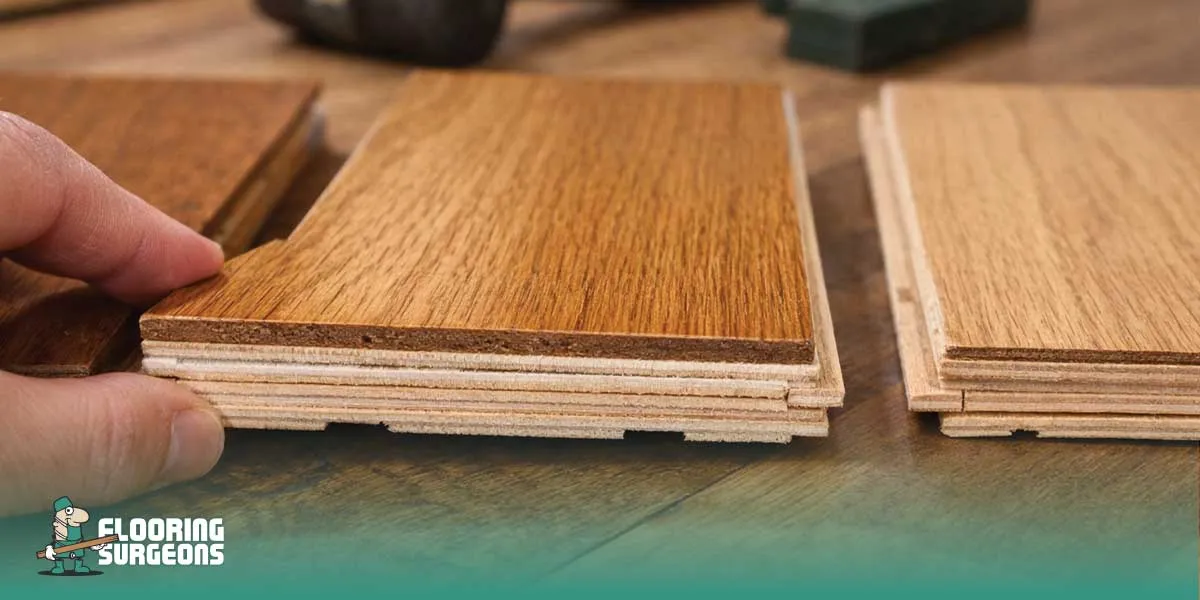
Semi-solid wood flooring refers to a flooring category defined by its internal structure rather than its appearance. It consists of a solid hardwood top section that is permanently bonded to a stabilising base layer, creating a plank that is neither fully solid throughout nor built with the multi-layer cross-ply system typical of engineered wood.
What separates semi-solid flooring from solid wood is continuity. In solid wood flooring, the plank is made from a single piece of timber from top to bottom. In semi-solid flooring, only the visible surface and upper section are solid hardwood, while the lower section exists purely to control movement, thickness, and cost.

At the same time, semi-solid wood flooring does not follow the standard engineered wood model. Engineered flooring relies on multiple layers arranged in opposing grain directions to maximise dimensional stability. Semi-solid flooring usually uses a simpler bonded construction, often with a single solid lamella attached to a supportive core, without the full cross-layer engineering used in modern engineered boards.
Because of this structure, semi-solid wood flooring behaves differently from both categories. It offers more authenticity and surface depth than thin engineered products, but it does not provide the same environmental tolerance or installation flexibility. Understanding this middle-ground construction is essential because performance, lifespan, and suitability are determined by how the plank is built, not by how it is marketed.
How Semi-Solid Wood Flooring Is Constructed
The performance of semi-solid wood flooring is determined by how the board is built, not by how it looks. Understanding this structure removes much of the confusion around where it sits compared to solid and engineered options.

Solid Wood Lamella Explained
The top layer is a genuine piece of hardwood known as the lamella.
This is the visible surface, the layer you walk on, and the only part that can be lightly sanded if refurbishment is ever required.
The lamella provides the natural grain, texture, and underfoot feel of real timber. However, unlike solid wood flooring, it does not extend through the full depth of the board. Its role is surface authenticity rather than structural control.
Core Layer Materials in Semi-Solid Flooring
Beneath the lamella sits a supporting core layer.
This layer exists to reduce material use and help manage basic movement within the board.
The construction is simpler than engineered flooring. Instead of multiple cross-laid layers designed for maximum stability, the core acts as a bonded support. It improves consistency and thickness control but offers limited resistance to environmental changes. Because of this, installation conditions and room suitability become far more important.
Thickness and Wear Layer Comparison
Overall thickness typically falls between solid wood and engineered flooring.
The wear layer is usually thicker than entry-level engineered boards but thinner than a full solid plank.
In practical terms, this means:
- The surface feels like real wood, not a veneer
- Refinishing is possible but limited
- Long-term durability depends heavily on correct installation and stable indoor conditions
Thickness and wear layer depth ultimately define how long the floor can perform before replacement becomes the only option.
Semi-Solid vs Solid Wood Flooring: What’s the Real Difference?
The difference between semi-solid and solid wood flooring is not cosmetic. It comes down to how each option reacts to movement, moisture, and installation conditions over time. While both use real timber, their behaviour in real homes can be very different. Understanding these differences early prevents common mistakes, especially in properties where temperature changes, humidity, or subfloor conditions are not perfectly controlled.

Stability and Movement Comparison
Solid wood flooring expands and contracts as a single piece of timber. This natural movement is predictable but can be significant, particularly in wider planks or larger rooms. Semi-solid boards reduce this movement slightly by limiting solid timber to the upper section only. The bonded construction helps control excessive expansion, but it does not eliminate movement altogether. This places semi-solid flooring between solid and engineered in terms of stability.
Moisture Tolerance Differences
Solid wood is highly sensitive to moisture and humidity changes. Prolonged exposure can lead to cupping, gaps, or permanent distortion. Semi-solid flooring offers marginally better moisture tolerance due to its construction, but it is still not suitable for damp environments or areas with fluctuating humidity. It should never be treated as a moisture-resistant solution.
Installation Limitations
Solid wood flooring requires strict subfloor conditions and often needs acclimatisation and professional fixing methods. Semi-solid flooring can be easier to install in certain situations due to reduced thickness and material use, but it still has limitations. Incorrect subfloor preparation or poor environmental control will affect both options.
Side-by-Side Comparison Table
| Feature | Semi-Solid Wood Flooring | Solid Wood Flooring |
| Timber structure | Solid hardwood top bonded to a core | Single piece of solid timber |
| Movement behaviour | Reduced but still present | High natural movement |
| Stability in changing conditions | Moderate | Low |
| Moisture tolerance | Slightly improved but limited | Very limited |
| Installation flexibility | Moderate | Restricted |
| Suitable room conditions | Dry, stable environments | Very dry, well-controlled environments |
| Refinishing potential | Limited | Multiple times |
| Risk of movement-related issues | Medium | High |
Semi-Solid Wood Flooring vs Engineered Wood: Which One Makes More Sense?
This comparison is often avoided because it exposes practical trade-offs rather than promoting a single product category. While both options use real timber on the surface, they are designed for different priorities and living conditions. The choice between these two is less about appearance and more about how the floor performs over time in a real home. If you are still weighing how engineered solutions differ at a structural level, this comparison of engineered wood compared to solid wood flooring helps clarify where each option performs best in real homes.

Structural Approach and Stability
Engineered wood flooring is built with multiple bonded layers arranged to counteract natural timber movement. This construction is specifically designed to improve stability across changing temperatures and humidity levels. By contrast, semi-solid boards rely on a simpler bonded structure. The solid upper section delivers authenticity, but the supporting layer provides only limited control over movement. This difference becomes noticeable in larger rooms or properties with fluctuating indoor conditions.
Environmental Tolerance
Engineered flooring handles variation in humidity far better. This makes it suitable for a wider range of spaces, including areas with underfloor heating or less predictable environments. Semi-solid constructions require more controlled conditions. They perform best where moisture levels remain stable and ventilation is consistent. Treating them as a flexible alternative to engineered products often leads to disappointment.
Installation and Long-Term Flexibility
Engineered boards are more forgiving during installation. They work across a broader range of subfloors and allow for more installation methods.
Semi-solid flooring offers fewer installation options and tighter environmental requirements. While not as restrictive as full solid wood, it still demands careful assessment before fitting.
Comparison Table
| Aspect | Semi-Solid Construction | Engineered Wood Flooring |
| Internal structure | Solid hardwood surface bonded to a support layer | Multiple cross-layered timber sheets |
| Dimensional stability | Moderate | High |
| Moisture tolerance | Limited | Improved |
| Suitability for underfloor heating | Often restricted | Commonly suitable |
| Installation flexibility | Moderate | High |
| Environmental adaptability | Narrow | Wide |
| Best suited for | Dry, stable rooms | Mixed-use and modern homes |
| Risk if misused | Movement and distortion |
Advantages of Semi-Solid Wood Flooring
- Provides a clear balance between cost and real wood authenticity, making natural timber more accessible without the expense of full solid boards
- Uses a genuine hardwood surface that delivers natural grain, texture, and underfoot feel
- Allows limited sanding and surface refurbishment, offering more flexibility than thin engineered finishes
- Performs well in dry, stable rooms where temperature and humidity remain consistent
- Offers a middle-ground option for homeowners who want real wood without extreme movement behaviour

Disadvantages of Semi-Solid Wood Flooring You Should Know Before Buying
- Remains sensitive to moisture and humidity changes, requiring careful environmental control
- Not naturally suited to underfloor heating and may face performance issues if heat is uneven or poorly regulated
- Has restricted repair and refinishing potential due to the finite depth of the surface layer
- Less adaptable to challenging subfloor conditions compared to engineered alternatives
- Can lead to movement-related issues if installed outside recommended room conditions
Who Is Semi-Solid Wood Flooring Actually Suitable For?
Best Rooms for Semi-Solid Flooring
- Living rooms and dining rooms with stable indoor temperatures
- Bedrooms where foot traffic is moderate, and moisture exposure is minimal
- Upper floors, where humidity levels are easier to control
- Homes without frequent temperature swings throughout the day
- Properties where visual authenticity matters more than maximum technical tolerance

When Semi-Solid Flooring Is a Bad Idea
- Kitchens, bathrooms, or utility rooms with regular moisture exposure
- Homes with underfloor heating systems that lack precise temperature control
- Ground floors with uncertain subfloor moisture conditions
- Properties with poor ventilation or seasonal humidity swings
- High-traffic areas where long-term refinishing flexibility is essential
Is Solid Wood Flooring a Good Choice for Your Home?
Yes, but only under the right conditions. It can be a good choice if your home has stable indoor humidity, dry rooms, and no reliance on underfloor heating. In these environments, it delivers a convincing real wood feel while keeping material costs and thickness more manageable than full solid boards.
It is not a good choice if your property has fluctuating moisture levels, heated floors, or rooms exposed to daily environmental stress. In those cases, engineered wood flooring will usually perform more reliably over time. If your home has fluctuating humidity or relies on underfloor heating, exploring engineered wood flooring options is often a more reliable long-term choice.

The correct decision depends less on appearance and more on how your home behaves throughout the year. If conditions are controlled, this flooring type can work well. If not, it often becomes a source of avoidable problems.
Installation Considerations for Semi-Solid Wood Flooring
Correct installation plays a major role in long-term performance and durability. Many reported semi-solid wood flooring problems are caused by rushed fitting decisions rather than material faults.
Subfloor requirements
A dry, flat, and structurally sound subfloor is essential. Moisture levels must be checked and documented before installation, particularly on ground floors. Any unevenness or residual dampness increases the risk of movement and surface stress over time.
Floating vs glued installation
Floating installation may be possible in limited situations, but a glued fitting is often preferred for better stability. Adhesive choice, curing time, and environmental conditions must be carefully controlled. Poor adhesive compatibility is a common source of early failure.

Common installation mistakes
- Skipping moisture testing or acclimatisation
- Installing over unsuitable subfloors
- Using incorrect adhesives
- Ignoring expansion allowances
- Treating this flooring type as fully compatible with underfloor heating systems
In particular, semi-solid flooring for underfloor heating should only be considered where temperature control is precise, and manufacturer guidance is followed exactly.
How to Maintain Semi-Solid Wood Flooring Properly
Maintenance is straightforward, but consistency matters. Long-term semi-solid wood flooring durability depends more on daily habits than on occasional deep cleaning.
- Keep indoor humidity stable throughout the year
- Clean using dry or lightly damp methods only
- Wipe spills immediately to prevent moisture absorption
- Use protective pads under furniture and in high-use areas
- Avoid aggressive cleaning products or excess water
Periodic inspection helps catch early signs of wear before damage becomes irreversible. While light surface refurbishment is possible, it should be approached cautiously and not treated as a repeatable solution.

Final Verdict: Should You Choose Semi-Solid Wood Flooring?
This flooring type makes sense when conditions are right and expectations are realistic. It can be a good option if you want real timber character, controlled costs, and a construction that sits between solid and engineered solutions. In stable, dry homes, it offers a convincing balance of appearance and performance. This is where the semi-solid parquet flooring pros and cons lean towards value rather than compromise.
It is not the right choice for homes with underfloor heating uncertainty, fluctuating humidity, or high exposure to moisture. In those cases, engineered products generally provide more reliable results, especially when comparing semi-solid vs engineered wood flooring UK installations. The key question is not whether this flooring looks good, but whether your home environment supports it. When matched correctly, it performs well. When forced into unsuitable conditions, it becomes one of those flooring decisions people later regret. At Flooring Surgeons, flooring recommendations are based on real installation experience and long-term performance, not just product specifications.

Haniye Ayanmanesh
As an expert writer for Flooring Surgeons, I combine technical SEO knowledge with a practical understanding of flooring, producing content that helps users make confident decisions while supporting long-term organic growth.