

Asbestos flooring was effectively outlawed in the UK on 24 November 1999, when the final ban extended to white asbestos (chrysotile) and most remaining asbestos-containing products. Blue and brown asbestos had already been banned in 1985. In practical flooring terms, that means floor tiles, vinyl flooring, thermoplastic tiles, and some older bitumen adhesives installed before 2000 may still contain asbestos. If those materials are intact, the immediate risk is generally lower; the bigger issue is when they are disturbed during refurbishment, uplift, sanding, grinding, or floor preparation, which can release fibres.
Table of contents
Asbestos Flooring Was Effectively Banned in the UK in 1999
The short answer is that asbestos flooring was effectively banned in the UK on 24 November 1999, when the prohibition on white asbestos (chrysotile) came into force. Earlier rules had already banned blue and brown asbestos in 1985, but 1999 is the key date for most people researching old floors today. As a rule of thumb, any flooring system installed before 2000, including tiles and sometimes the adhesive beneath them, deserves caution before removal or refurbishment.
| Question | Answer |
| When was asbestos flooring finally banned in the UK? | 24 November 1999 |
| What happened in 1985? | Blue and brown asbestos were banned |
| What type remained until 1999? | White asbestos (chrysotile) |
| What does that mean for old floors? | Flooring installed before 2000 may still contain asbestos |
Asbestos Ban Timeline in UK Flooring
To understand old flooring properly, it helps to separate the legal ban timeline from the real-world flooring timeline. The law changed in stages, but many floors fitted before 2000 can still remain in place today, especially beneath carpet, laminate, or later coverings. That is why the ban date matters less as a piece of history and more as a practical checkpoint during flooring surveys, refurbishments, and replacement planning.
1985: Blue and Brown Asbestos Were Banned
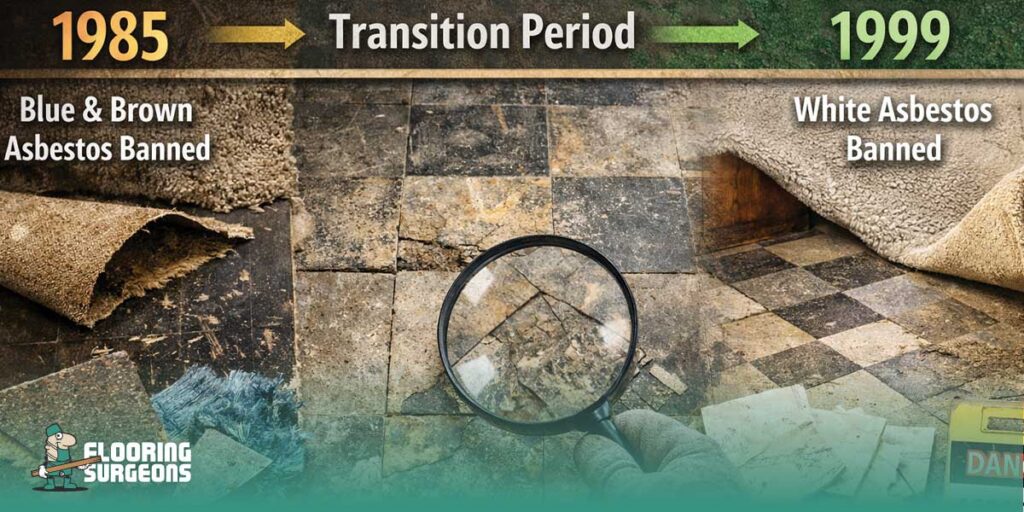
The first major step came in 1985, when blue asbestos (crocidolite) and brown asbestos (amosite) were banned in the UK. That was an important shift, but it did not mean all asbestos disappeared from flooring products at that point. Some asbestos-containing materials, including products using white asbestos, remained in circulation after that date. For readers trying to date an old floor, 1985 matters legally — but it is not the final cutoff you should rely on for flooring decisions.
1999: White Asbestos and Most Remaining Products Were Banned
The decisive date for most flooring-related searches is 24 November 1999, when the ban on white asbestos (chrysotile) came into force under the 1999 regulations. In practical terms, this is the point at which asbestos-containing flooring products were effectively outlawed from continued supply and use. That is why articles, surveyors, and HSE-aligned guidance repeatedly treat 1999 as the most useful answer for people asking whether old floor tiles or flooring materials may contain asbestos.
Why Flooring Installed Before 2000 Still Matters
Floors do not disappear when a law changes. A kitchen, hallway, corridor, office, or utility room fitted before 2000 may still contain older vinyl tiles, thermoplastic tiles, or asbestos-containing adhesive, even if the surface has since been covered over. That is why the most useful real-world rule is simple: if a flooring system appears to pre-date 2000, treat it as potentially asbestos-containing until proper assessment says otherwise. That approach is especially important before uplift, mechanical preparation, or refurbishment work.
Where Asbestos Was Commonly Found in Flooring
When people think about asbestos flooring, they often imagine only the tile itself. In practice, the bigger picture is the entire flooring build-up: the tile, the backing, the adhesive, and any older layers hidden under later finishes. That broader view is important because official HSE guidance includes thermoplastic and vinyl floor tiles, mastics, and similar materials among asbestos-related work examples, which means flooring decisions should never focus on the visible surface alone.
- Vinyl Floor Tiles
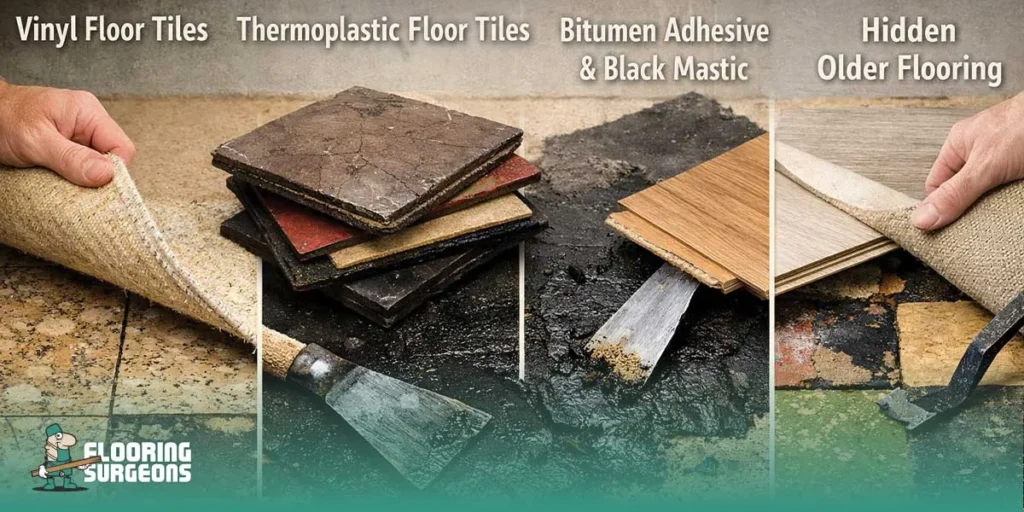
Older vinyl floor tiles are one of the most commonly discussed asbestos-containing flooring materials in UK properties. They often appear in kitchens, hallways, utility rooms, schools, public buildings, and older commercial interiors because they were durable, practical, and widely used. The key point for this article is not that every old vinyl tile contains asbestos, but that vinyl tiles installed before 2000 sit in the caution zone, especially where age, original fit-out history, or hidden sub-layers suggest the floor may be much older than it looks.
- Thermoplastic Floor Tiles
Thermoplastic floor tiles are another important category, and they are specifically referenced by HSE in asbestos-related work examples. These tiles were widely used because they offered a hard-wearing finish and could cope with busy footfall in domestic and commercial settings. For a flooring-led article, the practical takeaway is simple: if you uncover an older thermoplastic tile floor during a strip-out or refit, do not treat it as a routine flooring rip-out until its age and composition have been checked properly.
- Bitumen Adhesive and Black Mastic
One of the biggest mistakes in asbestos flooring content is treating the tile as the whole story. In reality, the bitumen adhesive or black mastic beneath older flooring can matter just as much. This is where many generic articles become incomplete: a reader may remove a tile and assume the job is now straightforward, when the real flooring issue may be the residue left on the subfloor. From a refurbishment and floor-prep perspective, that adhesive layer can affect whether a floor can be safely lifted, overlaid, mechanically prepared, or scheduled for further assessment first. HSE examples explicitly include mastics alongside asbestos-containing floor tiles.
- Older Flooring Hidden Under Carpet or Newer Coverings
A large share of real-world discoveries happen when someone lifts carpet, laminate, sheet vinyl, or another later floor finish and finds an older tile floor underneath. That is one reason this topic has strong search demand: users are often not researching asbestos in theory, they are reacting to something they have just uncovered. For Flooring Surgeons, this is where the article becomes commercially powerful — because the reader is no longer just asking a legal question; they are trying to work out what this hidden floor means for refurbishment, replacement, budget, and next steps.
- asbestos vinyl tiles may appear in older domestic and commercial interiors
- thermoplastic floor tiles asbestos concerns are especially relevant in pre-2000 properties
- black mastic asbestos risk may sit below the visible tile layer
- bitumen adhesive asbestos is often overlooked in generic flooring advice
- old floor tiles under carpet are a common real-life discovery during renovation
| Flooring element | Why it matters |
| Tile surface | May be the visible clue that the floor is older |
| Thermoplastic or vinyl tile | Often appears in asbestos-related flooring discussions |
| Black bitumen adhesive | Can remain on the subfloor after tile uplift |
| Hidden older layer under carpet | Common source of surprise during renovation |
| Whole floor build-up | Better reflects real flooring risk than judging the surface alone |
How to Tell if Old Flooring Might Contain Asbestos
No visual clue can confirm asbestos on its own, but some signs can tell you when an old floor deserves extra caution. For ranking and user value, this section should not pretend readers can “spot asbestos” with certainty. The smarter approach is to show the most useful suspicion signals, age, tile type, common sizes, adhesive, and hidden older layers — while making it clear that testing or a proper survey is the confirmation step. That balance builds trust and keeps the article aligned with both search intent and real-world flooring practice.
Check the Installation Age First
The first and most useful question is simply: how old is the flooring system? If the floor, or the layer beneath it, appears to have been installed before 2000, it should be treated with caution. That does not prove asbestos is present, but it immediately places the floor in the category where further checks make sense. In many cases, the age of the building alone is not enough — what matters is the likely age of the specific flooring layer you are dealing with.
Common Visual Clues in Older Tiles
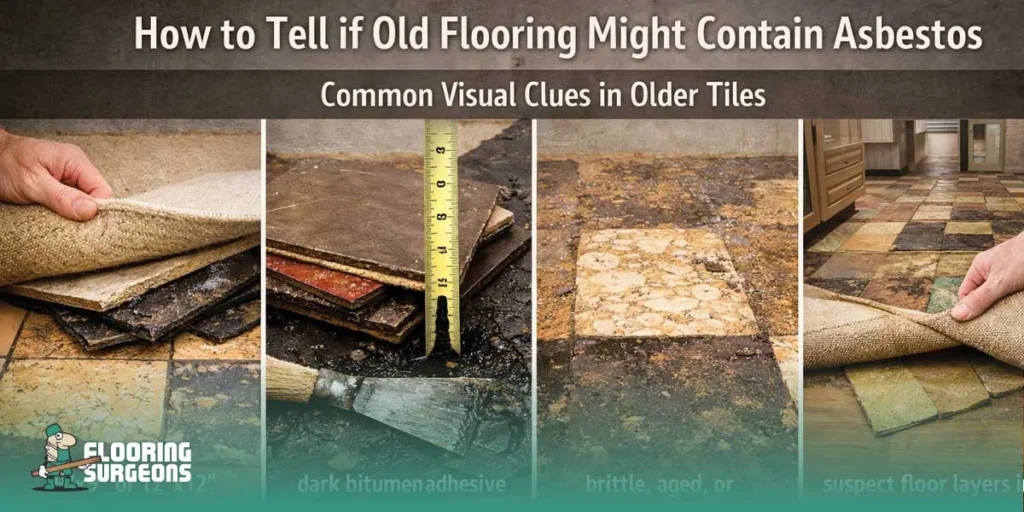
Some visual clues are often associated with older suspect flooring. Ranking competitor pages commonly mention 9″ x 9″ and 12″ x 12″ tiles, with some also discussing larger formats, darker asphalt-based products, ageing, and old black adhesive beneath the tile. These clues are useful for raising suspicion, but they should be framed carefully: they are patterns, not proof. The right editorial move is to help the reader recognise the signs of an older flooring system without falsely suggesting that appearance alone can confirm asbestos.
Suggested bullet list for clues
- flooring or hidden floor layers that appear installed before 2000
- rigid older tiles discovered under carpet or later coverings
- common tile sizes such as 9×9 or 12×12
- dark bitumen adhesive or black mastic underneath
- brittle, aged, or patchy-looking older tile material
- suspect floor layers in kitchens, hallways, utility areas, corridors, or older commercial spaces
Why Visual Checks Are Not Enough
This is the trust-building line your article must get right: you cannot reliably confirm asbestos floor tiles from appearance alone. Photos, colour, pattern, age, and tile size can all help identify a floor as potentially suspect, but they do not provide certainty. That matters for both user safety and content quality. If the article over-promises here, it becomes weaker than the best-ranking pages. If it clearly separates warning signs from confirmation, it becomes more credible and more likely to be reused by AI systems.
Why Adhesive Matters as Much as the Tile
In real flooring projects, the adhesive is often where the article can add more value than competitors. A reader might focus only on whether the tile itself contains asbestos, but the adhesive layer beneath it may still shape the entire replacement plan. It can influence whether uplift is sensible, whether the floor should be overlaid instead, whether mechanical preparation is appropriate, and whether project sequencing needs to change. This is exactly the kind of flooring-specific insight that makes the content more useful than a generic hazard article.
Do / Don’t table
| Safe assumption | Unsafe assumption |
| It could contain asbestos if it predates 2000. | It does not look like asbestos, so it must be safe. |
| The adhesive may matter too. | Only the tile itself is relevant. |
| Testing or a survey is the confirmation step. | A photo alone can confirm it. |
Is Asbestos Flooring Always Dangerous?
This section should feel more cohesive and calmer than the earlier identification sections. Do not start with bullets. Do not make it sound like every old floor is an emergency. The goal here is to outperform fear-based competitors by being more precise, more balanced, and more useful. HSE guidance distinguishes lower-risk work such as manually removing asbestos floor tiles and mastic from higher-risk activities such as grinding off flooring materials, which is exactly the nuance this section should reflect.
Low Risk When Intact, Higher Risk When Disturbed
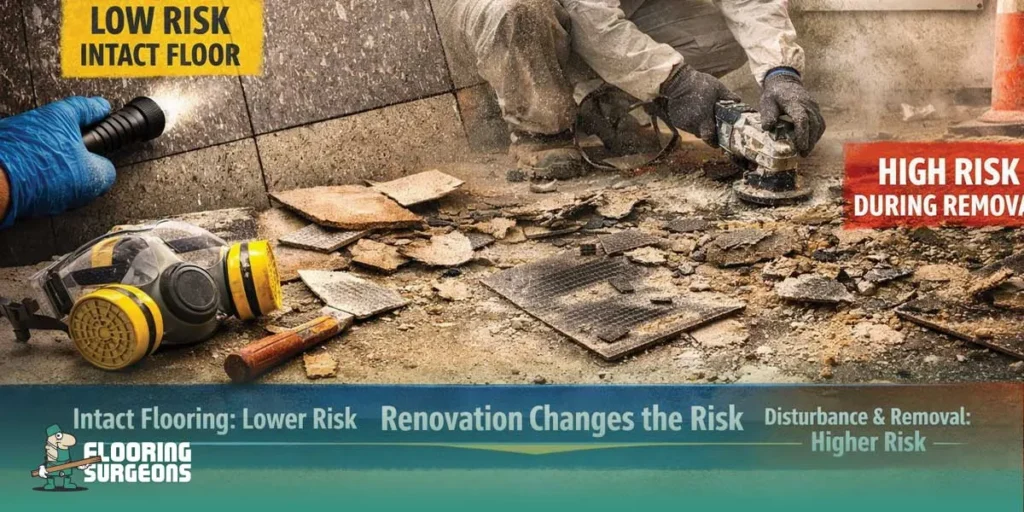
Asbestos flooring is not always dangerous in the same way. In general, intact and bonded materials such as older floor tiles are considered lower risk than friable asbestos products, because the fibres are more tightly bound. The real concern starts when the floor is disturbed during uplift, sanding, grinding, drilling, or refurbishment, which can increase the chance of fibre release.
Why Refurbishment and Floor Removal Change the Risk
This is why old flooring becomes a bigger issue during renovation than during normal day-to-day use. A floor that has been sitting undisturbed for years may present a very different risk once someone starts removing tiles, scraping adhesive, or preparing the subfloor for a new finish. For flooring projects, the danger is often less about the material simply being there and more about how the work is carried out.
What HSE Guidance Means in Practice
In practice, HSE guidance supports a simple rule: do not treat suspect old flooring as a standard rip-out job until its age, material, and condition are understood. That is especially important in properties built or refurbished before 2000, and in any project where old tiles, mastics, or hidden floor layers may be disturbed.
Intact asbestos flooring is generally lower risk than damaged or heavily disturbed flooring, but refurbishment, removal, and floor preparation can change the situation quickly. That is why early assessment matters.
What This Means If You’re Replacing Flooring Today
This is one of the most important sections in the entire article because it is where the page stops being a generic asbestos explainer and starts becoming a genuinely useful flooring asset. The writing here should feel more applied, more project-led, and more commercially adjacent — but still not promotional. The job of this section is to show that the real question is often not just “does this contain asbestos?” but “what does this mean for my flooring project now?” HSE guidance supports this approach because it focuses heavily on the nature of the work being done, the likely disturbance involved, and whether a survey is needed to understand the materials present.
Do Not Treat Old Flooring as a Standard Rip-Out Job
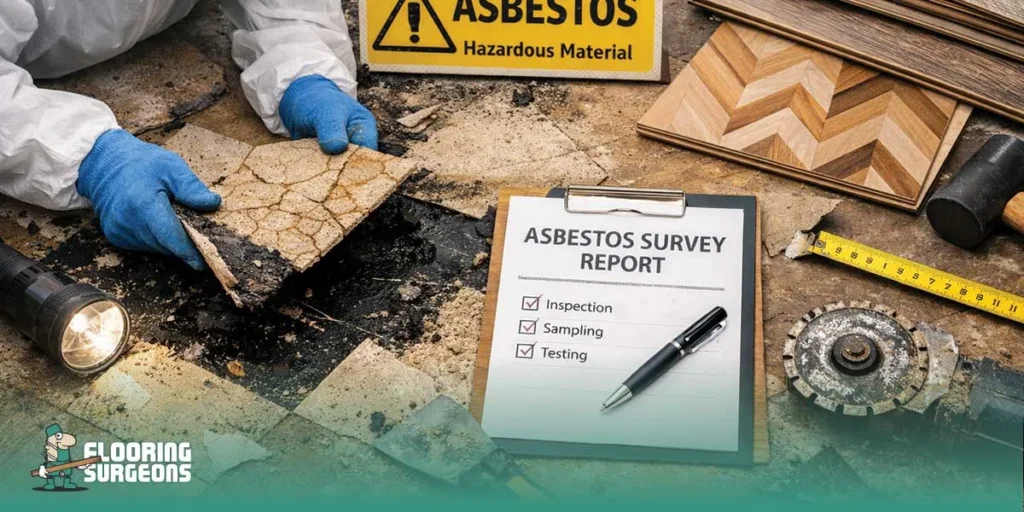
If a flooring system appears to pre-date 2000, it should not be treated like a routine uplift and refit. Old tiles, hidden layers, and black adhesive can all affect what happens next, so the safest approach is to assess the floor properly before removal begins.
When to Pause Before Uplifting Tiles
Pause before uplift if old tiles are discovered during quoting, if black bitumen adhesive is visible, or if the project will involve aggressive subfloor preparation. Once the job moves from inspection to disturbance, the risk profile changes.
Can You Lay New Flooring Over Existing Asbestos Tiles?
In many refurbishment projects, luxury vinyl flooring becomes one of the first replacement options people consider because it offers a practical balance of durability, design flexibility, and easier day-to-day maintenance once the existing floor has been assessed properly.That depends on the condition of the floor, the adhesive beneath it, and the preparation method needed for the new finish. If the replacement plan later moves towards a more decorative finish, it is worth understanding the difference between chevron and herringbone flooring before narrowing down the final pattern.
How Suspect Adhesive Affects Floor Preparation
Adhesive is often what complicates the project. A floor may look simple on the surface, but once black mastic or bitumen residue is involved, the replacement strategy, subfloor prep, and product choice may all need to change.

Why Proper Planning Protects Budget, Timeline, and Safety
Good planning reduces disruption. It also gives you more time to compare realistic replacement routes, whether that means laminate flooring options, LVT, or a wood-based option better suited to the room and the condition of the subfloor.
If the room is moving towards a timber look, it also helps to understand whether engineered wood or solid wood flooring makes more sense before the final specification is locked in. If suspect old flooring is identified early, it is easier to decide whether the best route is testing, management, overlay, or a different replacement strategy before the installation schedule is affected.
| Scenario | Recommended next step |
| Old tiles discovered during quote stage | Pause uplift and assess age/history before planning removal |
| Tiles intact and staying in place | Consider management or overlay only after proper advice |
| Adhesive or subfloor needs mechanical prep | Treat it as a higher-risk planning issue |
| Renovation or major refit planned | Build asbestos checks into the project sequence early |
Practical checklist before replacing suspect old flooring:
- Check whether the floor or hidden layer may pre-date 2000.
- Look for black adhesive, mastic, or older residues.
- Pause before uplift if the floor system may be disturbed.
- Use proper assessment to guide the replacement plan.
- Finalise prep and product choice only after that step.
For a flooring-led brand like Flooring Surgeons, the real value in this topic is helping readers move from uncertainty to a safer, better-planned replacement decision.
Who Needs to Be Most Careful With Suspect Asbestos Flooring?
- Homeowners renovating older properties
- Landlords managing repairs or void works
- Commercial occupiers planning refurbishments
- Schools and public buildings with older floor coverings
- Office refurbishment teams
- Retail and hospitality fit-out teams
- Contractors and floorlayers disturbing old tiles or mastics

Haniye Ayanmanesh
As an expert writer for Flooring Surgeons, I combine technical SEO knowledge with a practical understanding of flooring, producing content that helps users make confident decisions while supporting long-term organic growth.