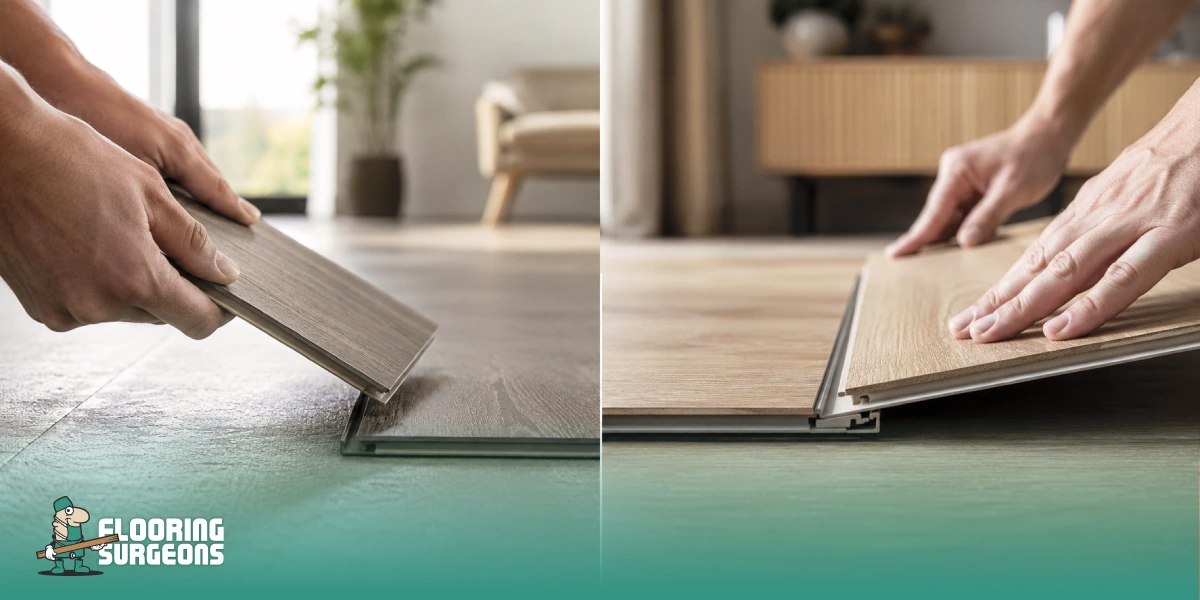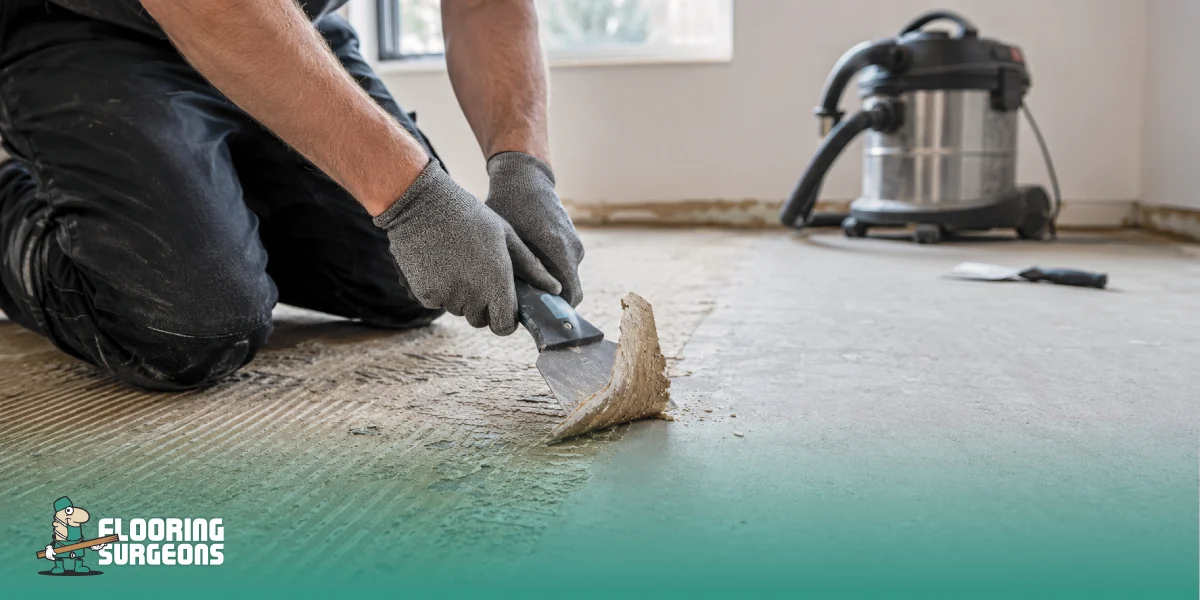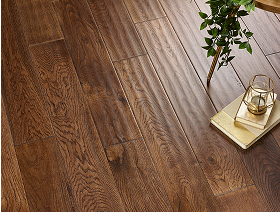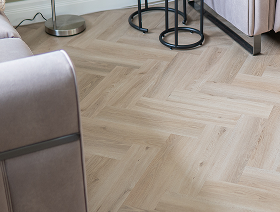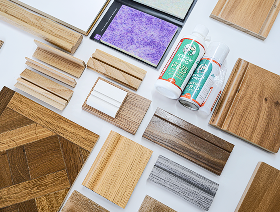
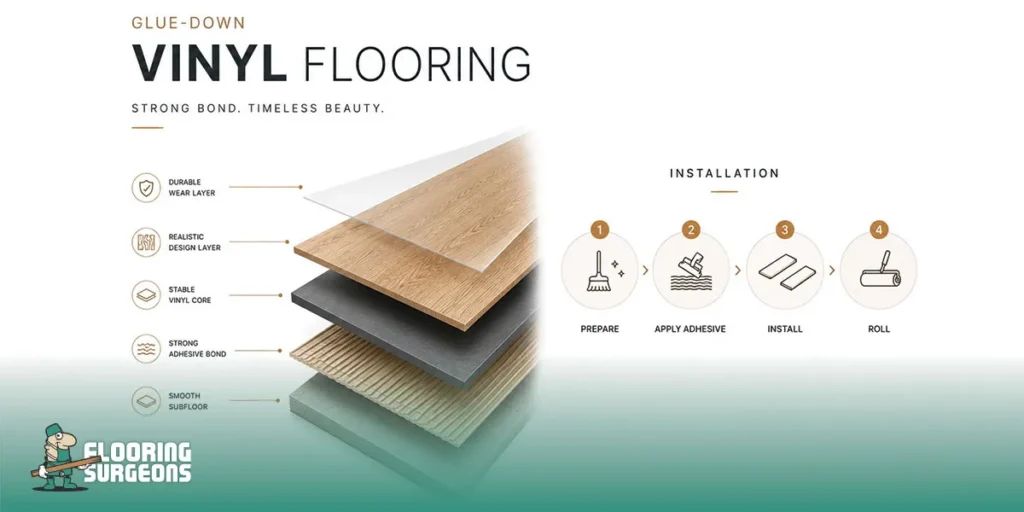
Glue-down vinyl plank flooring is one of the most durable and stable flooring options for residential and commercial spaces. Unlike floating floors, glue-down vinyl is bonded directly to the subfloor using adhesive, creating a secure and long-lasting installation with excellent water resistance and floor stability.
Successful installation depends heavily on proper subfloor preparation, moisture control, adhesive selection, layout planning, and curing conditions. Even small installation errors can lead to lifting edges, loose planks, visible gaps, or adhesive failure over time.
This guide explains the complete glue-down vinyl flooring installation process for both straight plank and herringbone layouts, including:
✔ Room preparation
✔ Moisture testing
✔ Subfloor preparation
✔ Adhesive application
✔ Layout planning
✔ Rolling techniques
✔ Curing times
✔ Finishing details
✔ Common installation mistakes
Whether you are planning a home renovation or researching professional installation methods, this guide provides a complete step-by-step overview for glue-down vinyl flooring projects.
Proper glue-down vinyl plank flooring installation requires careful preparation, accurate adhesive application and stable room conditions to achieve a durable and professional-quality result. This guide also explains the complete glue-down vinyl flooring installation process step by step, helping reduce the risk of lifting edges, adhesive failure and long-term floor movement.
Table of contents
Understanding Glue-Down Vinyl Flooring Before Installation
Glue-down vinyl flooring is a fully bonded flooring system where the planks are fixed directly to the subfloor using adhesive rather than floating above it. Because the flooring is permanently bonded to the subfloor, glue-down installations provide:
✔ Improved dimensional stability
✔ Reduced floor movement
✔ Stronger long-term adhesion
✔ Better suitability for heavy traffic areas
✔ Improved heat transfer over underfloor heating
Glue-down vinyl flooring also requires a much smoother and more stable subfloor than click flooring. Even minor imperfections beneath the surface may become visible after installation.
Modern luxury vinyl flooring products are designed to improve:
✔ Scratch resistance
✔ Moisture resistance
✔ Visual realism
✔ Long-term durability
However, proper installation remains essential for achieving long-term flooring performance.
Straight Plank vs Herringbone Glue-Down Installation
There are two main layout styles used for glue-down vinyl flooring installation.
| Installation Type | Difficulty | Waste Level | Labour Time |
|---|---|---|---|
| Straight plank | Moderate | Lower | Faster |
| Herringbone | Advanced | Higher | Slower |
Straight plank installation uses a traditional linear layout and is generally faster to install. Herringbone glue-down vinyl flooring creates a more decorative and premium appearance but requires greater installation accuracy throughout the fitting process.
Herringbone installation typically involves:
✔ Accurate centre-line positioning
✔ Detailed layout planning
✔ More perimeter cutting
✔ Frequent alignment checks
✔ Higher installation precision

Recommended Waste Allowance
| Installation Type | Recommended Waste |
|---|---|
| Straight plank | 5–10% |
| Herringbone | 10–15% |
Herringbone glue-down vinyl flooring installations typically require more material due to angled perimeter cuts, layout balancing, and additional pattern alignment.
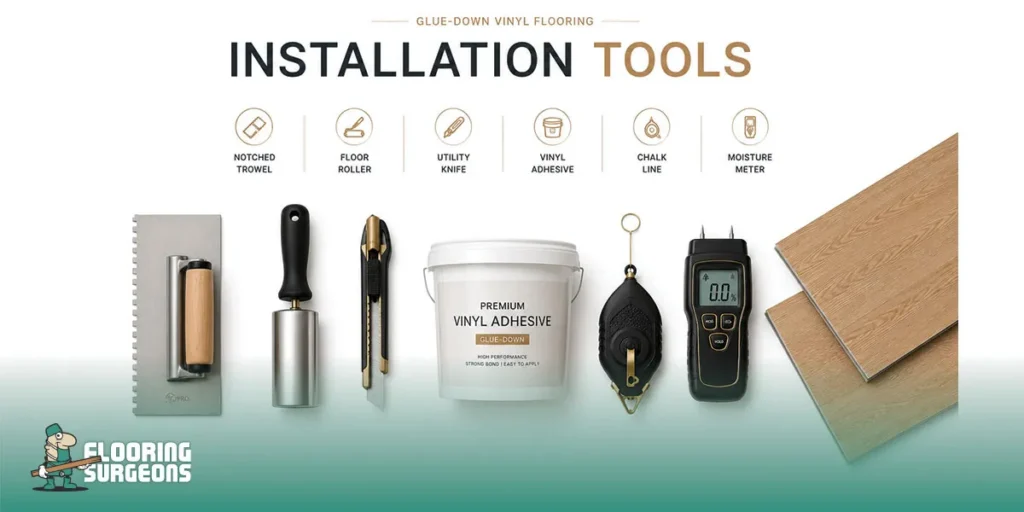
Tools and Materials Needed for Glue-Down Vinyl Installation
Using the correct tools and materials helps improve installation accuracy, adhesive performance, and long-term floor stability.
Essential Installation Tools
| Tool | Purpose |
|---|---|
| Tape measure | Measuring layouts and cuts |
| Utility knife | Straight plank cutting |
| Jigsaw | Curved and detailed cuts |
| Notched trowel | Spreading adhesive evenly |
| Chalk line | Marking layout lines |
| 50kg floor roller | Securing adhesive bonding |
| Moisture meter | Moisture testing |
| Straight edge or spirit level | Checking subfloor flatness |
| Pull bar | Tight edge fitting |
Additional Materials Required
| Material | Purpose |
|---|---|
| Glue-down vinyl flooring | Main flooring material |
| Flooring adhesive | Permanent bonding |
| Damp-proof membrane | Moisture protection |
| Self-levelling compound | Smoothing uneven subfloors |
| Primer | Surface preparation |
| Plywood overlay | Timber floor stabilisation |
| Adhesive cleaner | Removing adhesive residue |
| Transition strips | Joining floor sections |
| Scotia or skirting | Finishing edges |
Always use the adhesive recommended by the flooring manufacturer to help prevent bond failure and warranty issues.
Preparing the Room Before Glue-Down Vinyl Flooring Installation
The room should be fully prepared before installation begins. Glue-down vinyl flooring is highly sensitive to moisture, dust, temperature fluctuations, and subfloor imperfections.
Before installation, the room should already be:
✔ Dry and weather-tight
✔ Fully decorated
✔ Free from wet trades
✔ Heated consistently
✔ Cleared of furniture and obstacles
Painting, plastering, screeding, and other moisture-heavy work should be completed before installation begins. A clean and stable working environment helps improve adhesive performance and installation accuracy.
Recommended Room Conditions
| Condition | Recommended Level |
|---|---|
| Room temperature | 18–27°C |
| Relative humidity | 35–65% |
| Heating | Stable and operational |
| Room condition | Dry and clean |
Avoid installing glue-down vinyl flooring in unstable environmental conditions, as temperature and humidity fluctuations may affect adhesive performance and floor stability.
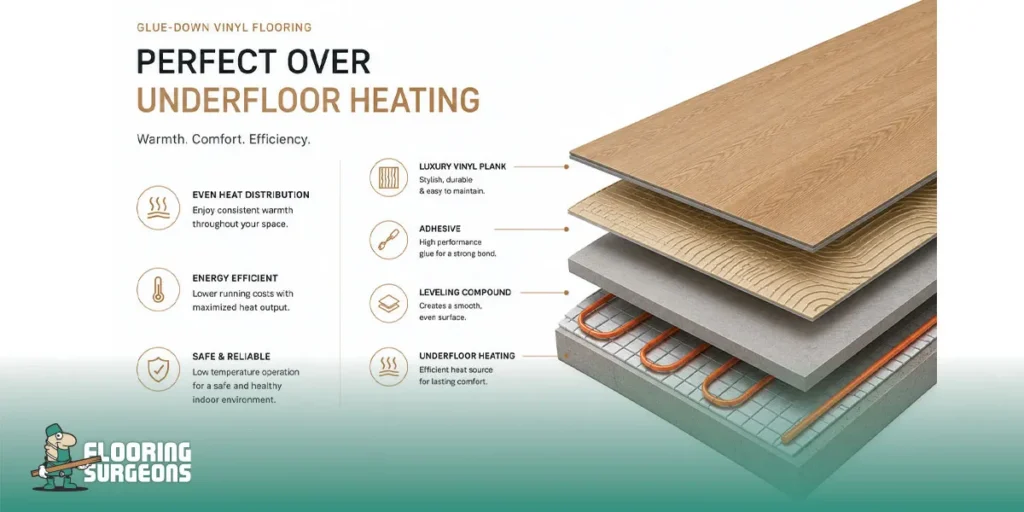
Glue-Down Vinyl Flooring Over Underfloor Heating
Glue-down vinyl flooring is often suitable for underfloor heating systems because the direct bond improves heat transfer efficiency. However, the heating system must be commissioned correctly before installation begins.
Important underfloor heating guidelines include:
✔ Gradual temperature increases
✔ Stable subfloor temperatures
✔ Avoiding excessive heat exposure
✔ Following maximum floor temperature recommendations
Most manufacturers recommend keeping the floor temperature below 27°C.
If you are also comparing floating floor systems, our guide to vinyl click flooring installation explains how click flooring performs over underfloor heating systems.
Correct Acclimatisation Process
Glue-down vinyl flooring should acclimate to the room conditions before installation begins. Temperature, humidity, and subfloor conditions can all affect flooring performance and adhesive bonding.
Improper acclimatisation may lead to:
✔ Plank shrinkage
✔ Adhesive failure
✔ Visible gaps
✔ Lifting edges
✔ Poor adhesive transfer
Both straight plank and herringbone glue-down vinyl flooring require proper acclimatisation before fitting.
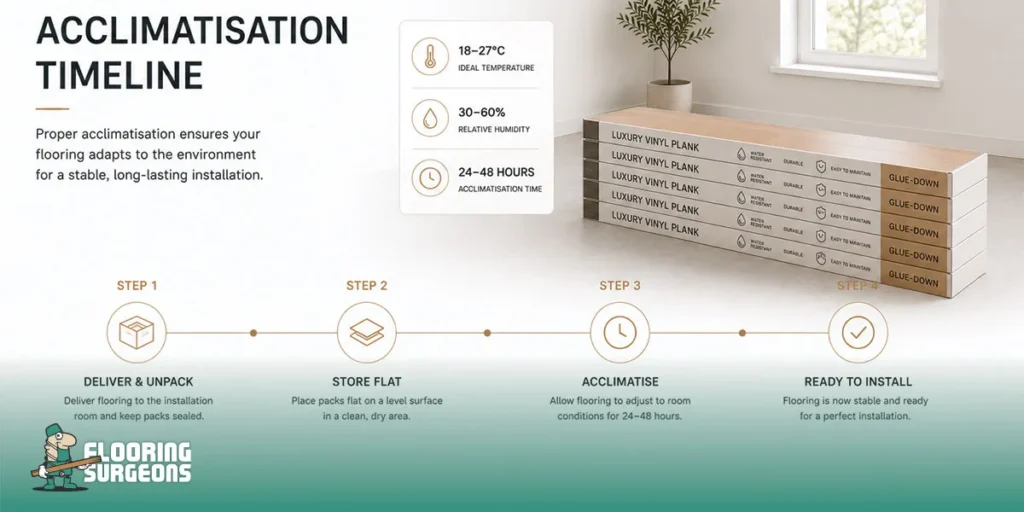
Step 1: Bring Flooring Into the Installation Room
Place all flooring packs inside the exact room where installation will take place.
✔ Store flooring in a dry and heated room
✔ Keep packs away from direct sunlight
✔ Avoid damp or unheated storage areas
✔ Do not place flooring near strong heat sources
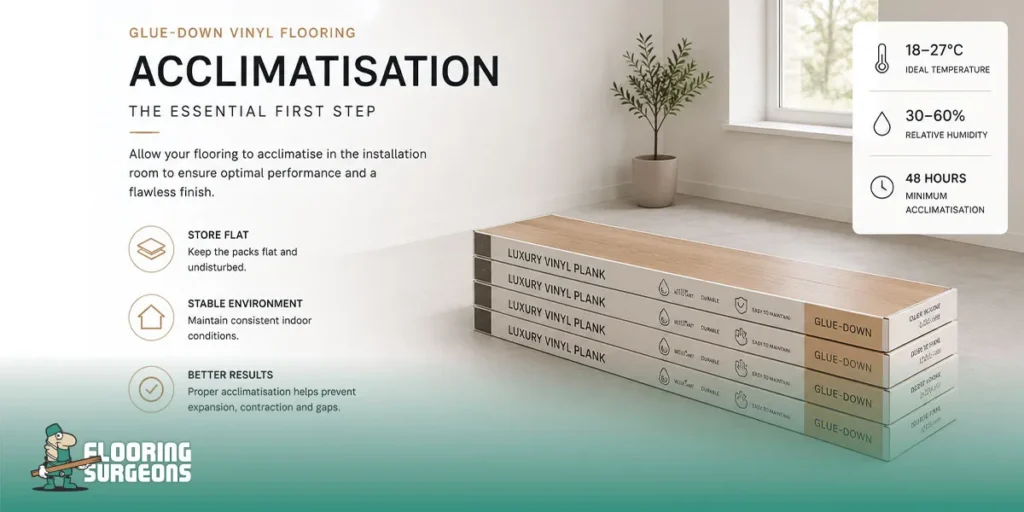
Step 2: Store Packs Flat
Store all flooring packs flat on a clean and dry surface before installation.
✔ Keep packs fully supported across the floor
✔ Avoid leaning planks against walls
✔ Protect flooring from moisture exposure
✔ Maintain stable room conditions throughout acclimatisation
Leaning flooring packs vertically may cause plank distortion.
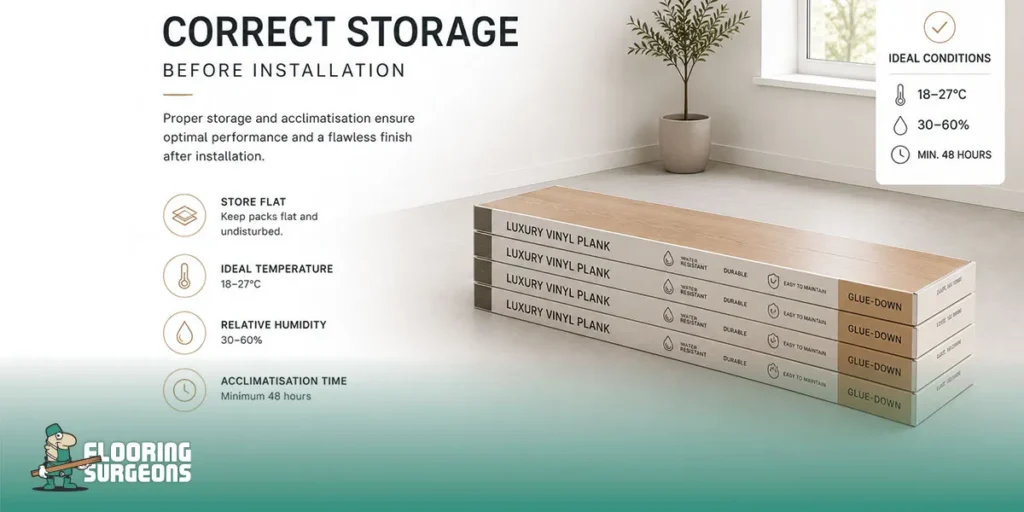
Step 3: Maintain Stable Conditions
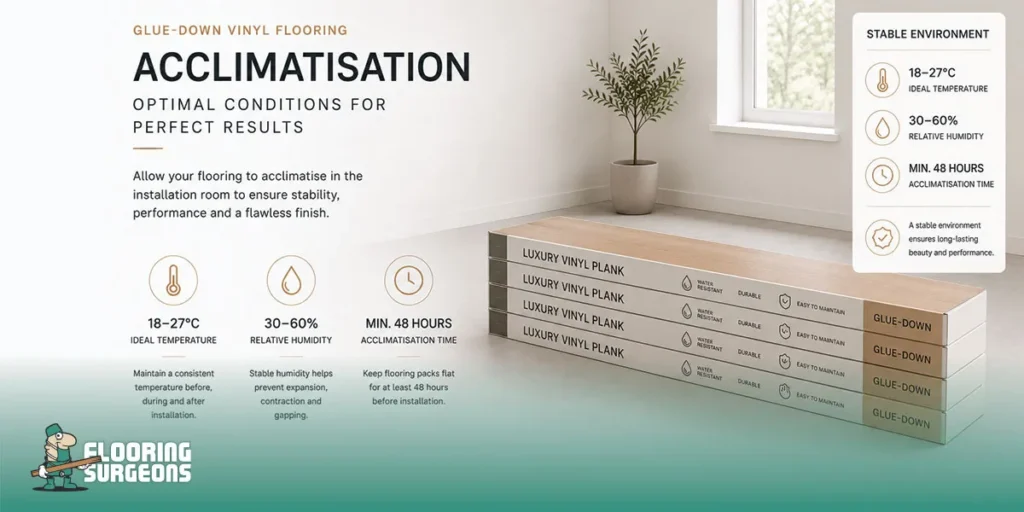
Room temperature and humidity should remain stable throughout the acclimatisation process.
✔ Keep room temperature between 18–27°C
✔ Maintain relative humidity between 30–60%
✔ Store adhesives within the manufacturer’s recommended temperature range
✔ Avoid sudden environmental changes before installation
Stable conditions help improve adhesive bonding and dimensional stability.
Step 4: Leave Flooring for 24–48 Hours
Most glue-down vinyl flooring products require acclimatisation for at least 24–48 hours before installation.
✔ Allow flooring to adjust to room conditions fully
✔ Follow the manufacturer’s acclimatisation guidelines
✔ Extend acclimatisation time if conditions are unstable
✔ Keep flooring packs unopened where recommended
Some products may require longer acclimatisation depending on plank thickness and room conditions.
Step 5: Inspect the Flooring
Before installation begins, inspect all flooring packs and planks carefully.
✔ Check for damaged edges or corners
✔ Inspect for bent or warped planks
✔ Review colour variation between packs
✔ Look for transport or handling damage
✔ Do not install visibly damaged flooring
Inspecting the flooring before installation helps prevent visible defects after fitting.

Subfloor Preparation for Glue-Down Vinyl Flooring Installation
Subfloor preparation is one of the most important stages of glue-down vinyl flooring installation. Because the flooring is bonded directly to the subfloor, even minor imperfections may become visible after installation.
The subfloor must be:
✔ Flat
✔ Dry
✔ Structurally stable
✔ Smooth
✔ Clean
✔ Free from movement
Recommended Flatness Standards
| Requirement | Recommended Standard |
|---|---|
| Surface variation | Maximum 3mm over 2m |
| Structural movement | None |
| Moisture | Within manufacturer limits |
| Cleanliness | Dust-free |
Glue-down vinyl flooring typically requires a smoother and more stable subfloor than click flooring systems.
Concrete Subfloor Preparation
Concrete subfloors require careful moisture testing and surface preparation before installation begins. Even when the surface appears dry, hidden moisture may still be present beneath the concrete.
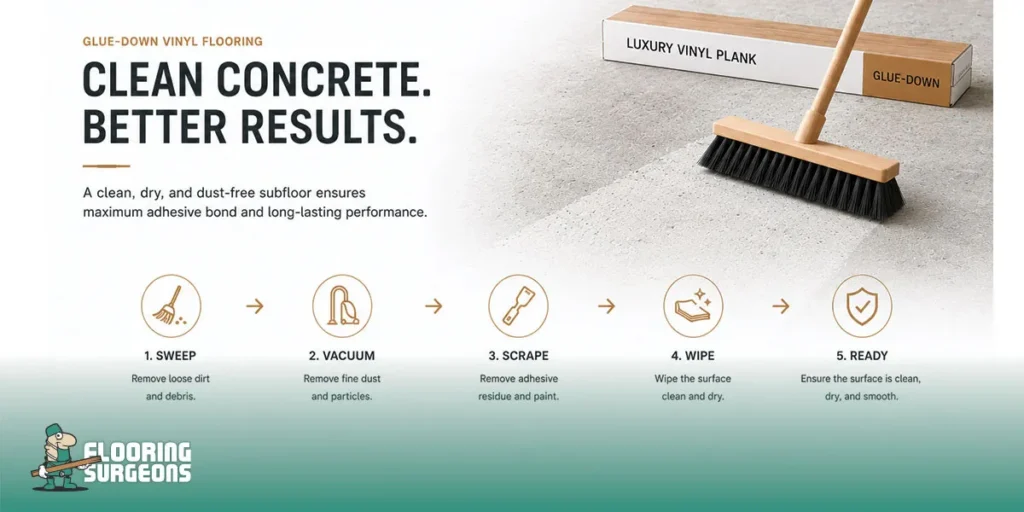
Clean the Surface
Remove all surface contamination before applying adhesive.
✔ Dust and debris
✔ Paint residue
✔ Old adhesive residue
✔ Plaster and construction materials
✔ Oil or grease contamination
Any contamination may reduce adhesive bonding strength.
Test Moisture Levels
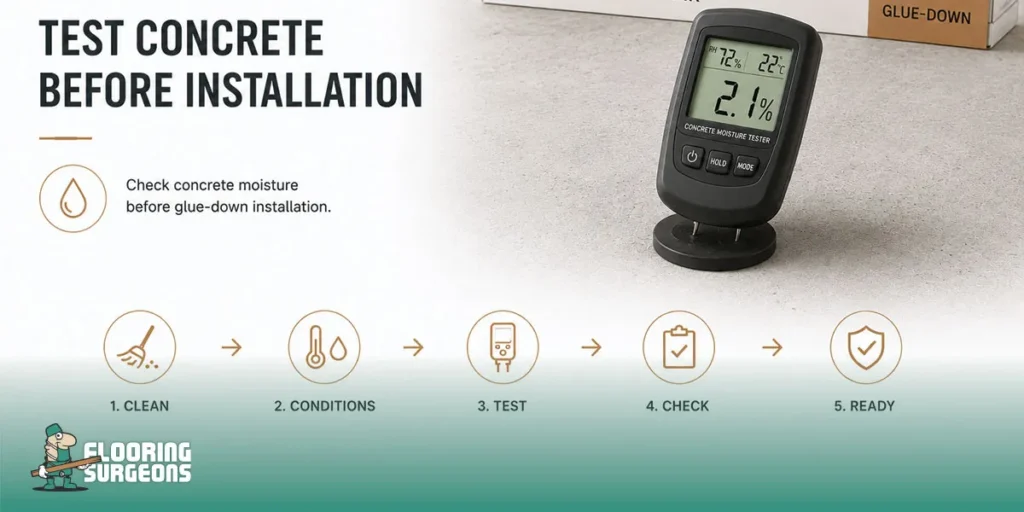
Moisture testing is essential before glue-down vinyl flooring installation begins.
Most manufacturers recommend that concrete subfloors remain below 75% RH unless a compatible damp-proof membrane or moisture suppression system is used.
Some high-performance adhesives may tolerate moisture levels up to 85% RH, depending on the manufacturer’s specifications.
✔ Test moisture levels before applying adhesive
✔ Follow adhesive and flooring manufacturer guidelines
✔ Use a compatible damp-proof membrane where required
✔ Avoid installing over excessively damp concrete
Excess moisture may eventually cause adhesive failure, bubbling, plank movement, or lifting edges after installation.
Glue-down vinyl flooring is generally more moisture-sensitive than floating click flooring systems because the adhesive bond relies heavily on stable subfloor conditions.
Common Moisture Testing Methods
| Test Method | Purpose |
|---|---|
| Hygrometer test | Professional RH testing |
| Moisture meter | Surface moisture testing |
| Calcium chloride test | Advanced moisture testing |
Excess moisture beneath glue-down vinyl flooring may cause:
✔ Adhesive failure
✔ Bubbling beneath the flooring
✔ Plank movement or lifting
✔ Mould growth beneath the subfloor
Proper moisture testing helps prevent long-term bonding and stability issues after installation.
Install Damp-Proof Membrane if Required
Some concrete subfloors may require a damp-proof membrane before installation begins.
✔ Overlap membrane joints correctly
✔ Seal all edges securely
✔ Ensure compatibility with the flooring adhesive
✔ Follow the manufacturer’s installation guidelines
A correctly installed damp-proof membrane helps reduce moisture-related flooring problems after installation.
Apply Primer if Required
Some subfloors require primer before adhesive application to improve surface preparation and adhesive performance.
✔ Improve adhesive bonding strength
✔ Stabilise porous subfloor surfaces
✔ Maintain consistent adhesive spread
✔ Reduce uneven adhesive drying
Highly absorbent subfloors may dry adhesive too quickly, while non-porous surfaces can extend curing times significantly.
Always use primers and adhesives compatible with the specific subfloor type.
Level Uneven Concrete
Uneven concrete surfaces should be corrected before installation using smoothing compound or self-levelling compound.
✔ Correct dips and uneven areas
✔ Apply compound evenly across the surface
✔ Allow levelling compound to dry fully
✔ Maintain ventilation during drying and installation
A smooth and level subfloor helps improve adhesive bonding and flooring appearance.
Wooden Subfloor Preparation
Timber subfloors must remain stable before glue-down vinyl flooring installation begins. Movement beneath the flooring may weaken adhesive bonds over time.
Common Timber Floor Problems
| Problem | Solution |
|---|---|
| Loose boards | Screw boards securely |
| Squeaking | Reinforce unstable areas |
| Uneven boards | Sand or overlay |
| Rot or damp | Replace damaged sections |
Professional installers often use plywood overlays to improve:
✔ Floor stability
✔ Adhesive bonding
✔ Surface smoothness
Plywood joints should remain smooth, level, and securely fixed before installation begins.
Planning the Glue-Down Vinyl Layout
Proper layout planning helps improve installation accuracy, reduce waste, and create a more balanced finished appearance.
Before adhesive application begins:
✔ Measure the room carefully
✔ Calculate perimeter cuts in advance
✔ Establish balanced plank positioning
✔ Avoid narrow edge cuts where possible
✔ Determine the best plank direction for the space
Professional installers often use chalk lines or laser levels to establish accurate reference lines before installation.
Recommended Plank Directions
| Room Type | Recommended Direction |
|---|---|
| Hallways | Lengthwise |
| Open-plan spaces | Along the longest visual line |
| Small rooms | Towards natural light |
| Commercial areas | Along the main traffic flow |
Dry-laying several planks before adhesive application helps visualise the layout and reduce installation mistakes.
Adhesive Selection for Glue-Down Vinyl Installation
Correct adhesive selection is essential for long-term flooring performance. Different adhesives are designed for specific subfloors, environments, traffic levels, and temperature conditions.
Common Glue-Down Vinyl Adhesives
| Adhesive Type | Best Use |
|---|---|
| Pressure-sensitive adhesive | Standard LVT installation |
| Wet-set adhesive | Heavy traffic areas |
| High-temperature adhesive | Conservatories and warm environments |
Always follow the adhesive manufacturer’s recommendations for:
✔ Open time
✔ Dry-back time
✔ Curing time
✔ Adhesive spread rate
Incorrect adhesive selection or application is one of the most common causes of glue-down vinyl flooring failure.
How to Install Glue-Down Vinyl Plank Flooring – Straight Plank Installation
Straight plank installation uses a traditional linear layout and is generally faster than herringbone fitting. Accurate layout planning and adhesive control remain essential throughout the installation process.
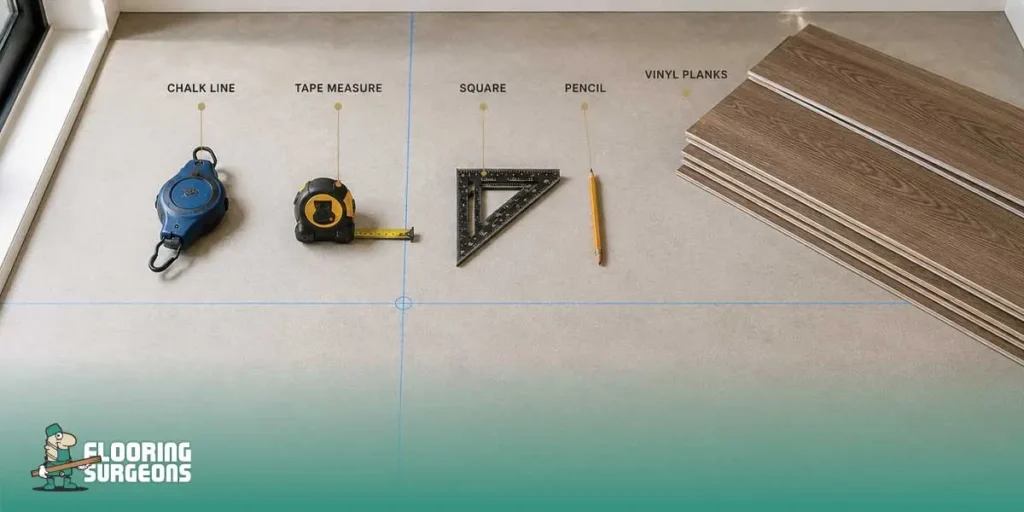
Step 1: Mark Reference Lines
Use chalk lines to establish accurate starting points before spreading adhesive.
✔ Keep rows straight
✔ Balance perimeter cuts
✔ Improve overall floor appearance
Accurate reference lines help maintain a consistent layout across the room.
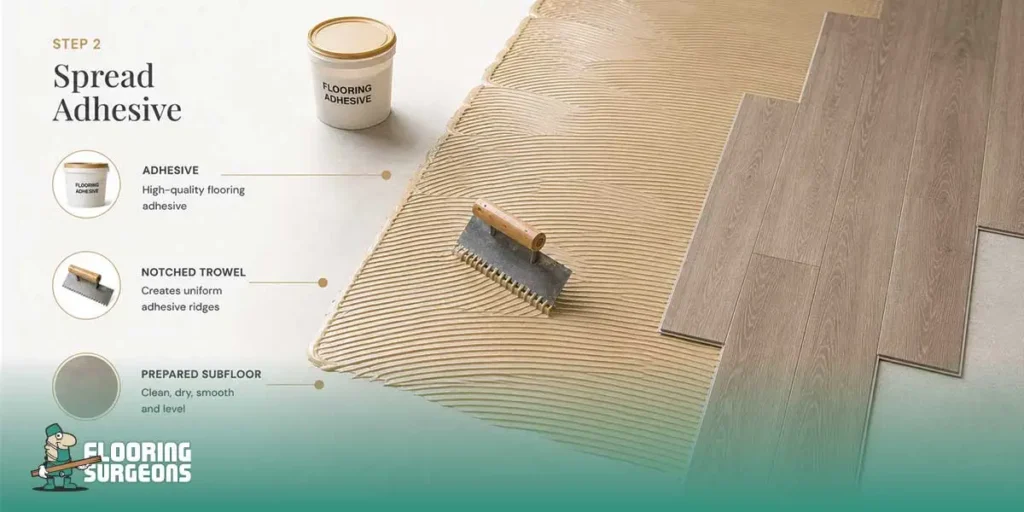
Step 2: Spread Adhesive Correctly
Use the notched trowel recommended by the adhesive manufacturer and work in manageable sections.
✔ Spread adhesive evenly
✔ Work in smaller controlled areas
✔ Avoid excessive adhesive buildup
✔ Prevent adhesive from skinning over
Large adhesive areas may begin drying before planks are installed, especially in warm rooms or areas with strong airflow.
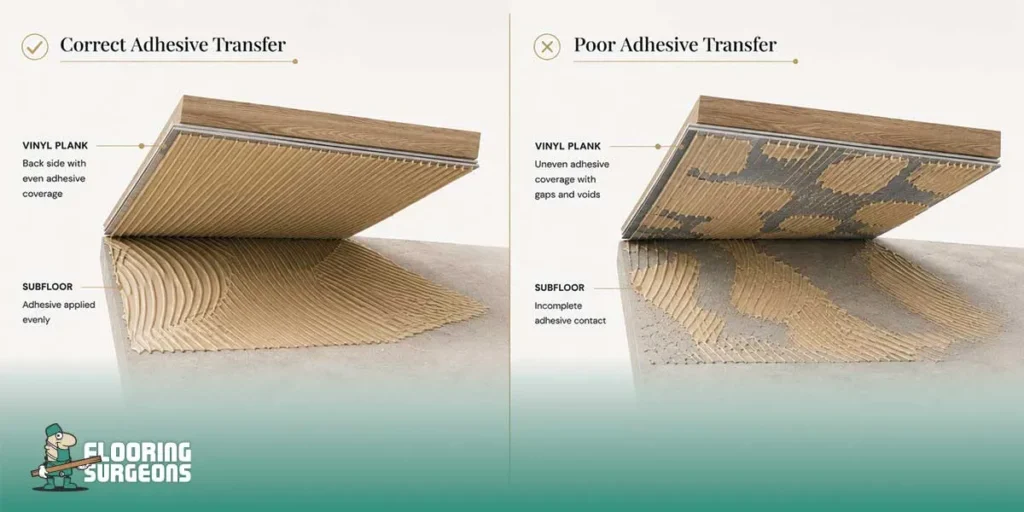
Step 3: Allow Proper Dry-Back Time
Most pressure-sensitive adhesives require dry-back time before installation begins. The adhesive should feel tacky rather than fully wet.
✔ Allow proper adhesive dry-back
✔ Check adhesive transfer regularly
✔ Inspect coverage on the back of the plank
✔ Maintain consistent adhesive spread
Incorrect dry-back timing may lead to poor bonding, plank movement, or uneven adhesive transfer.
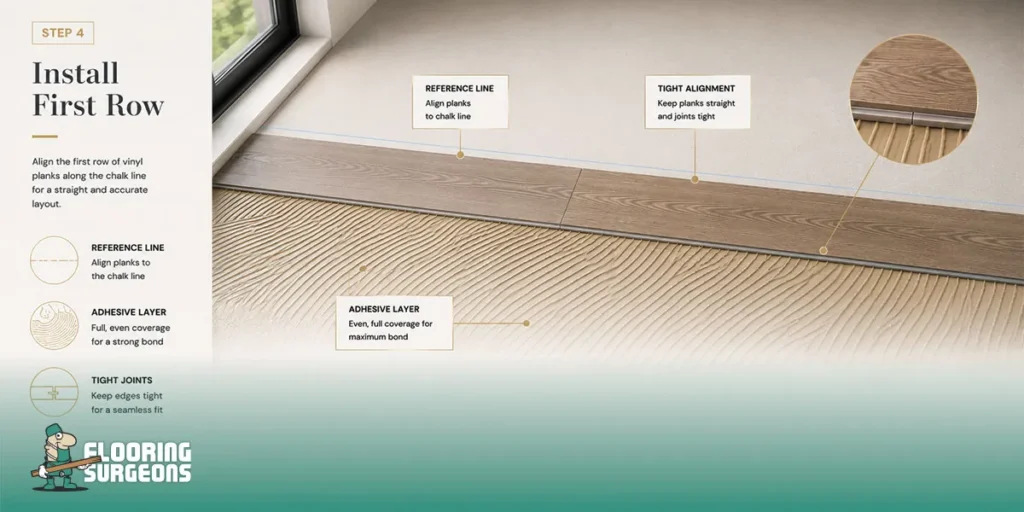
Step 4: Install the First Row
Position the first row carefully along the reference line and press each plank firmly into the adhesive bed.
✔ Align planks accurately
✔ Keep joints tight
✔ Press planks firmly into place
✔ Minimise repositioning after contact
A straight and stable first row improves the overall installation accuracy.
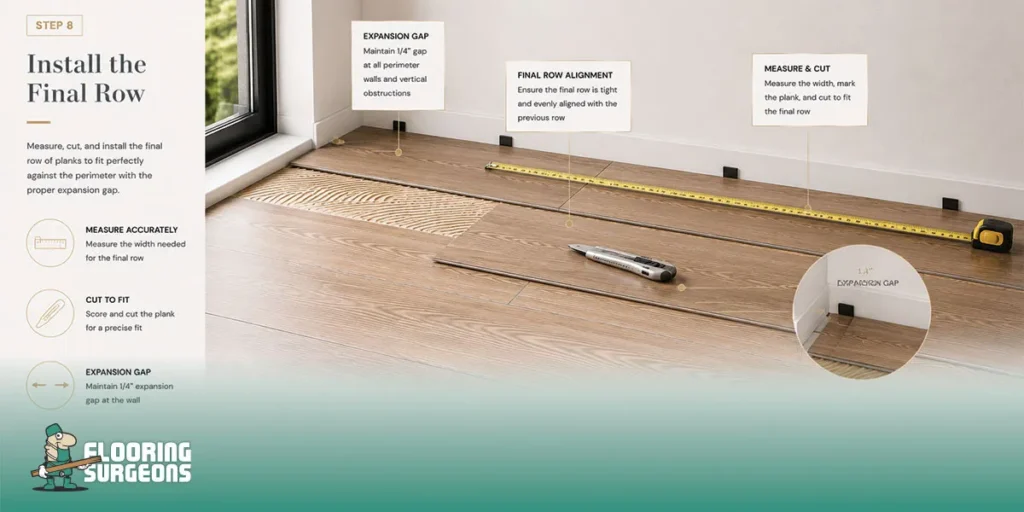
Step 5: Continue Installation Across the Room
Continue installing the flooring row-by-row while checking alignment and plank spacing.
✔ Maintain straight rows
✔ Keep stagger spacing consistent
✔ Avoid visible H-patterns
✔ Mix planks from multiple boxes
Mixing planks helps create more natural colour variation across the floor.
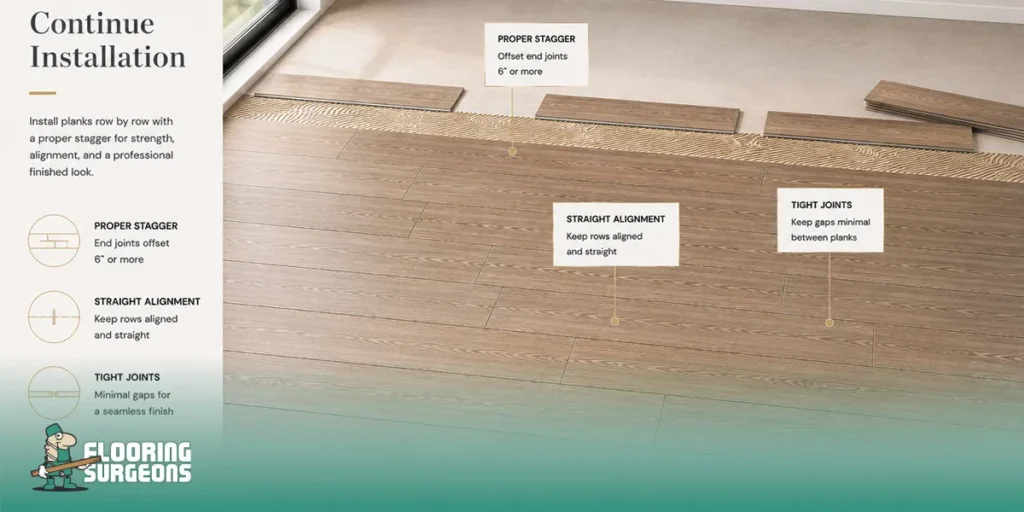
Step 6: Roll the Floor Correctly
Roll the flooring using a 50kg floor roller immediately after installation.
✔ Roll lengthwise across the floor
✔ Roll widthwise across the floor
✔ Remove trapped air beneath planks
✔ Improve adhesive transfer
Some manufacturers recommend repeating the rolling process after a short settling period.
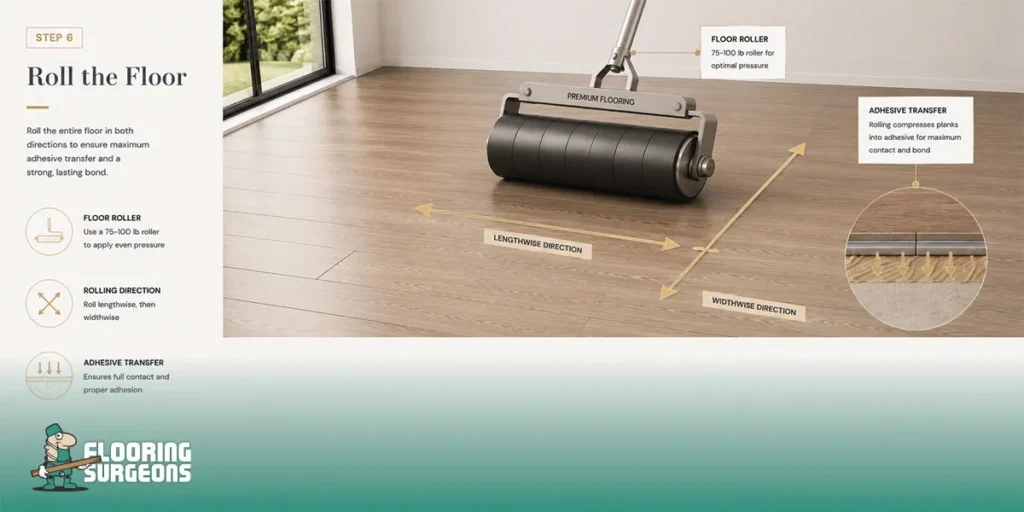
Step 7: Clean Adhesive Residue Immediately
Remove adhesive residue immediately using a manufacturer-approved cleaner.
✔ Clean adhesive before it dries
✔ Use approved cleaning products
✔ Avoid surface staining
✔ Prevent difficult residue removal
Dried adhesive becomes significantly harder to remove later.
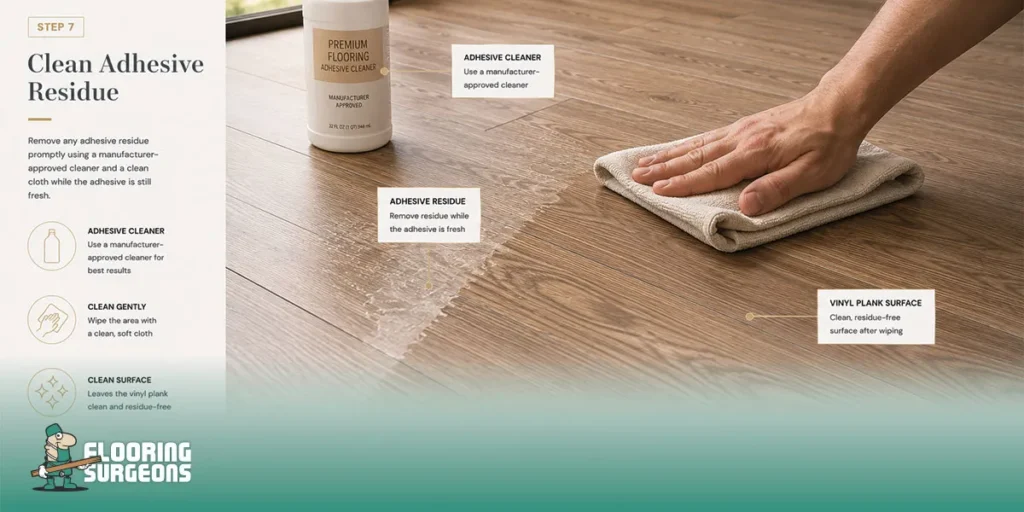
Step 8: Install the Final Row
Measure the remaining gap carefully before cutting the final row.
✔ Measure cuts accurately
✔ Maintain expansion allowances
✔ Keep thethe final row aligned
✔ Check plank fit before installation
Careful measuring helps create a cleaner perimeter finish.
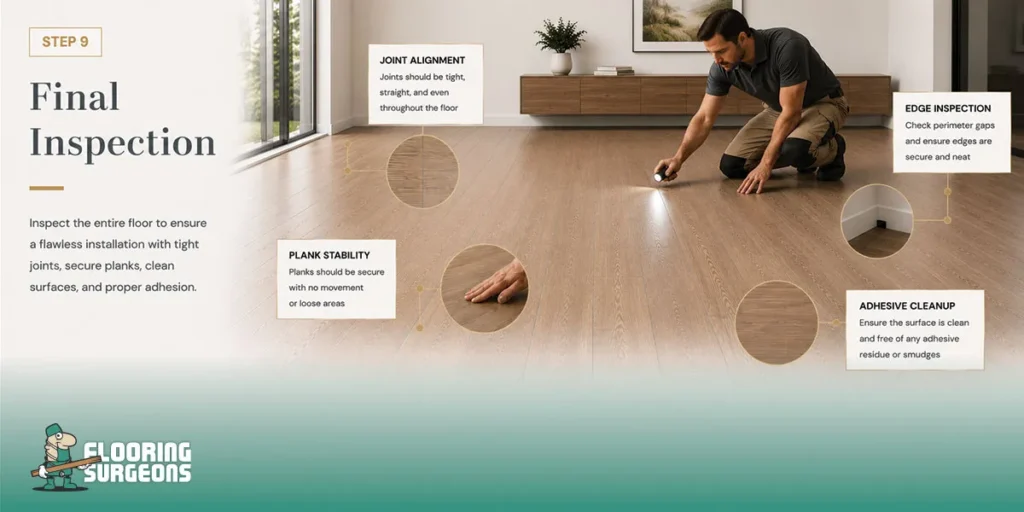
Step 9: Inspect the Straight Plank Installation
Inspect the entire floor before allowing foot traffic onto the surface.
✔ Check for loose edges
✔ Inspect for visible gaps
✔ Look for uneven joints
✔ Remove excess adhesive
✔ Check for plank movement
Correcting issues immediately helps prevent long-term installation problems.
Herringbone Glue-Down Vinyl Installation
Herringbone glue-down vinyl installation creates a premium and highly decorative flooring layout. Because the pattern relies on perfect alignment and spacing, installation accuracy is essential throughout the fitting process.
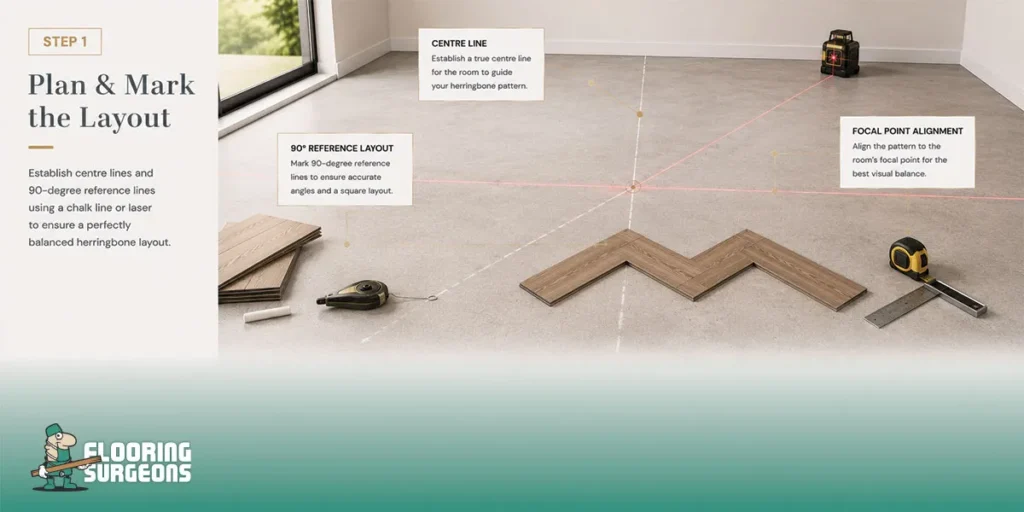
Step 1: Establish Accurate Centre Lines
Use chalk lines or laser levels to create the main layout reference points before installation begins.
✔ Mark accurate centre lines
✔ Create 90-degree reference lines
✔ Align the layout with focal points
✔ Check room symmetry before fitting
Accurate centring helps prevent visible pattern drift later in the installation.
Step 2: Dry Lay the Starter Pattern
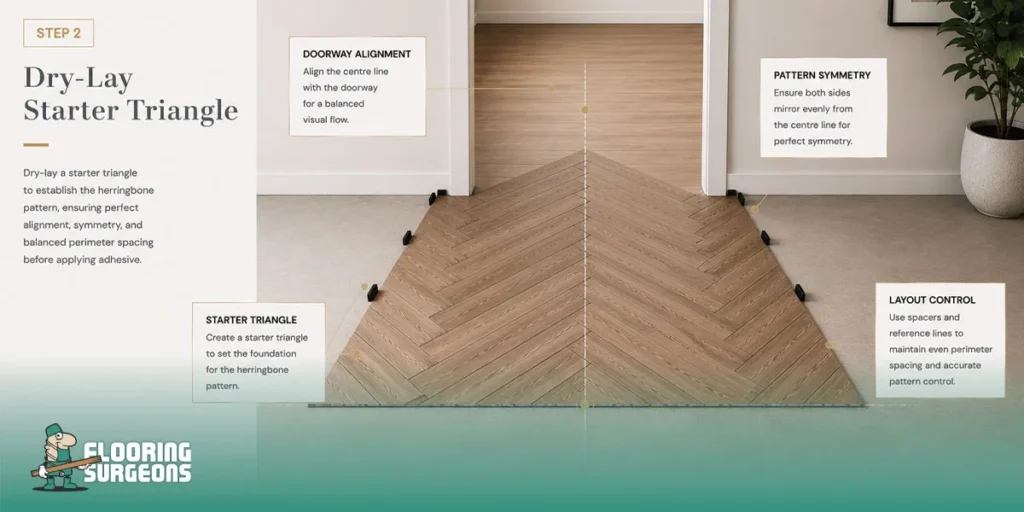
Dry lay the starter triangle before adhesive application begins.
✔ Check pattern symmetry
✔ Balance perimeter cuts
✔ Verify doorway positioning
✔ Confirm layout accuracy
Professional installers often use a double-triangle starter layout to improve pattern control and alignment consistency.
Step 3: Spread Adhesive in Small Sections
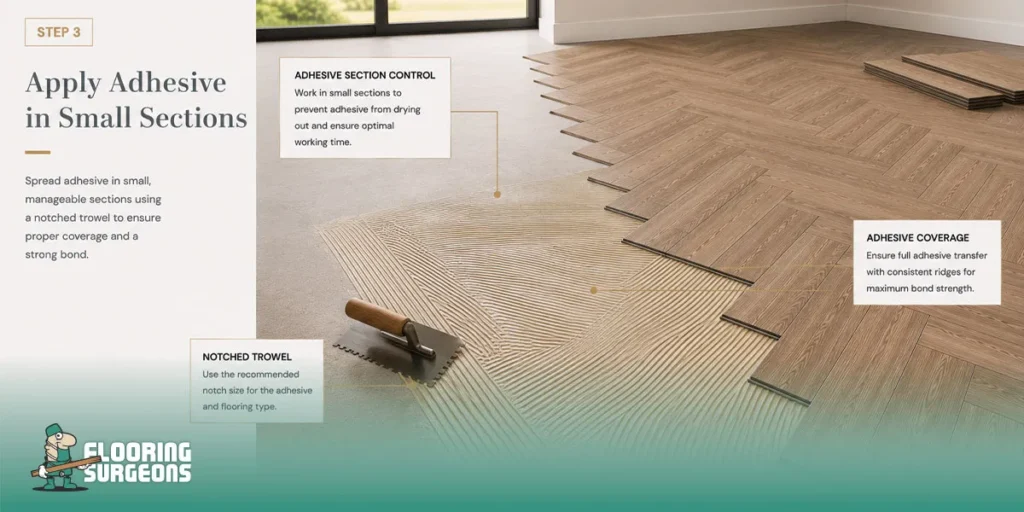
Herringbone installation progresses more slowly than straight plank fitting, so adhesive should be spread in smaller working sections.
✔ Work in controlled adhesive areas
✔ Prevent adhesive skinning
✔ Maintain adhesive consistency
✔ Avoid spreading excessive adhesive
Smaller working sections help maintain proper adhesive performance during slower installations.
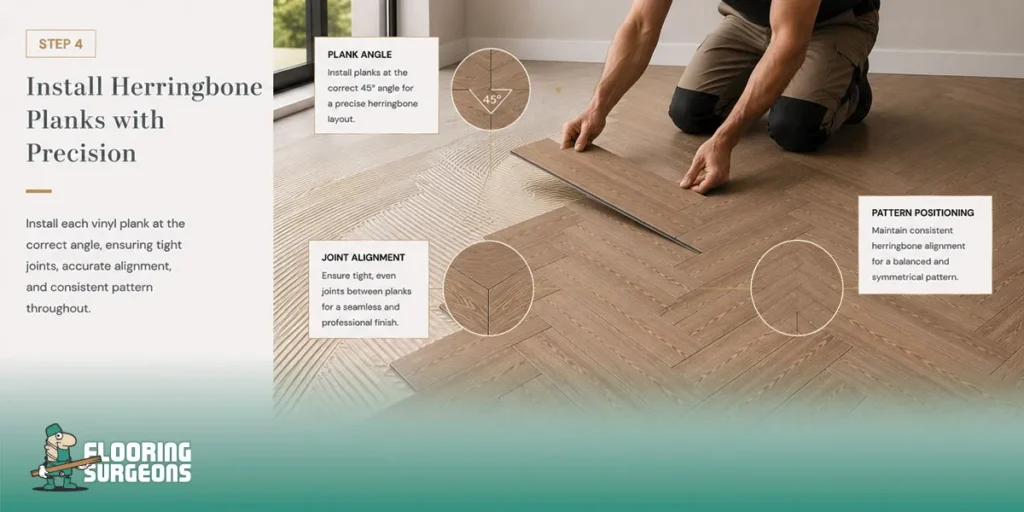
Step 4: Install Herringbone Planks Carefully
Install each plank carefully while maintaining pattern accuracy throughout the floor.
✔ Maintain accurate plank angles
✔ Keep joints tight and consistent
✔ Follow the herringbone pattern carefully
✔ Check alignment regularly during fitting
Small alignment mistakes can become highly visible across the finished installation.
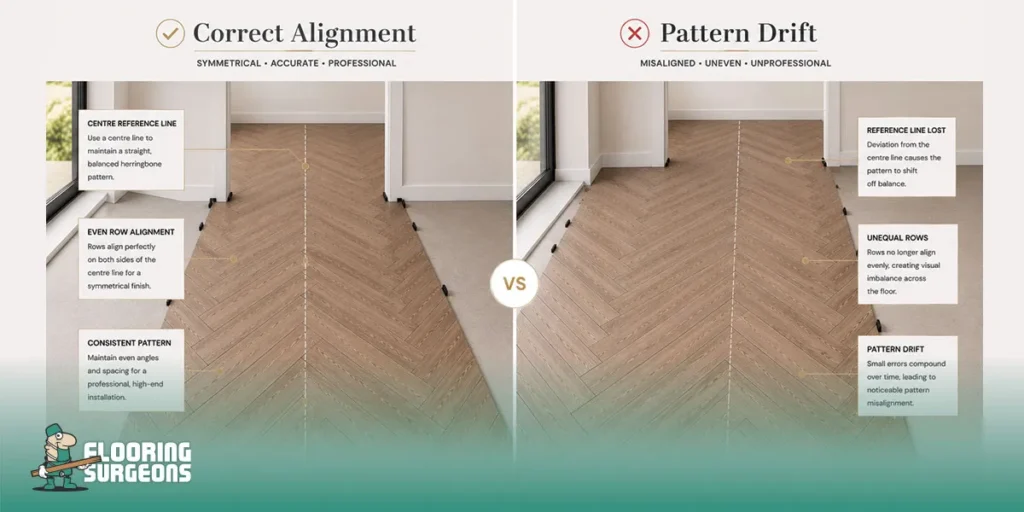
Step 5: Prevent Pattern Drift
Pattern drift occurs when the layout gradually moves out of alignment during installation.
✔ Recheck alignment every few rows
✔ Monitor pattern consistency
✔ Use centre lines as reference guides
✔ Correct small shifts immediately
Frequent alignment checks help maintain a symmetrical herringbone layout across the room.
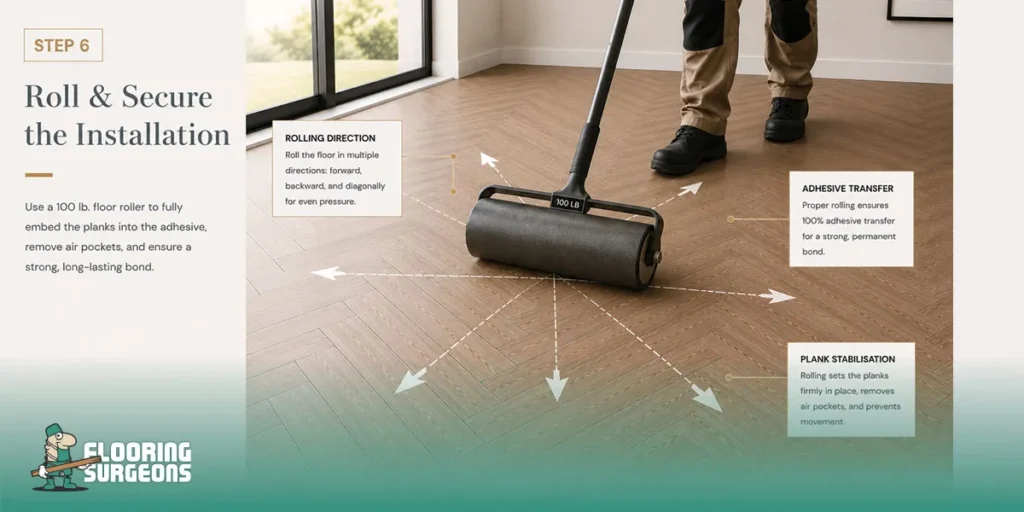
Step 6: Roll the Herringbone Installation
Roll the flooring carefully after installation to improve adhesive transfer and reduce trapped air beneath the planks.
✔ Roll in multiple directions
✔ Apply even pressure across the floor
✔ Improve adhesive bonding
✔ Prevent plank shifting during rolling
Careful rolling helps stabilise the herringbone layout after installation.
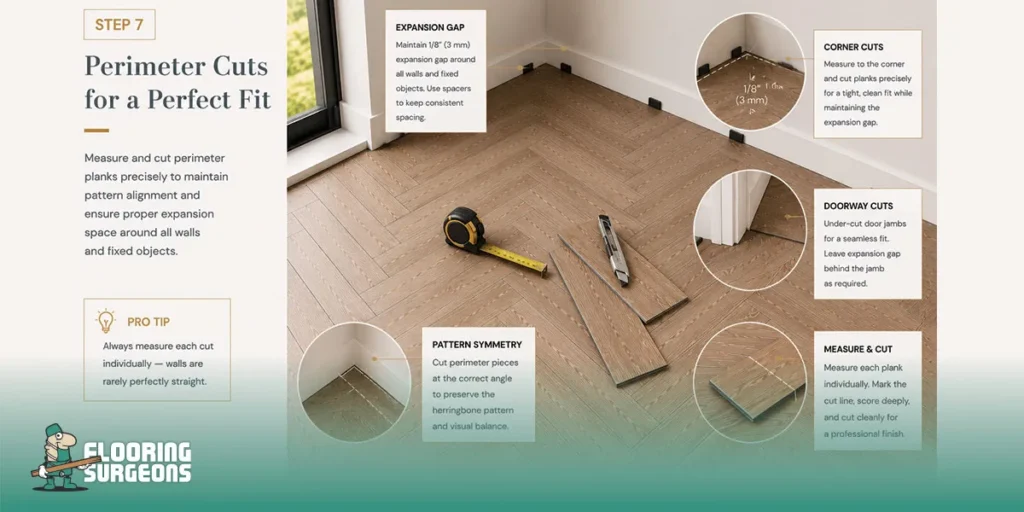
Step 7: Complete Final Perimeter Cuts
Measure all perimeter cuts individually before fitting the final planks.
✔ Measure each cut separately
✔ Maintain layout symmetry
✔ Check perimeter alignment carefully
✔ Allow for expansion spacing where required
Herringbone layouts rarely produce identical perimeter cuts, especially around corners and doorways.
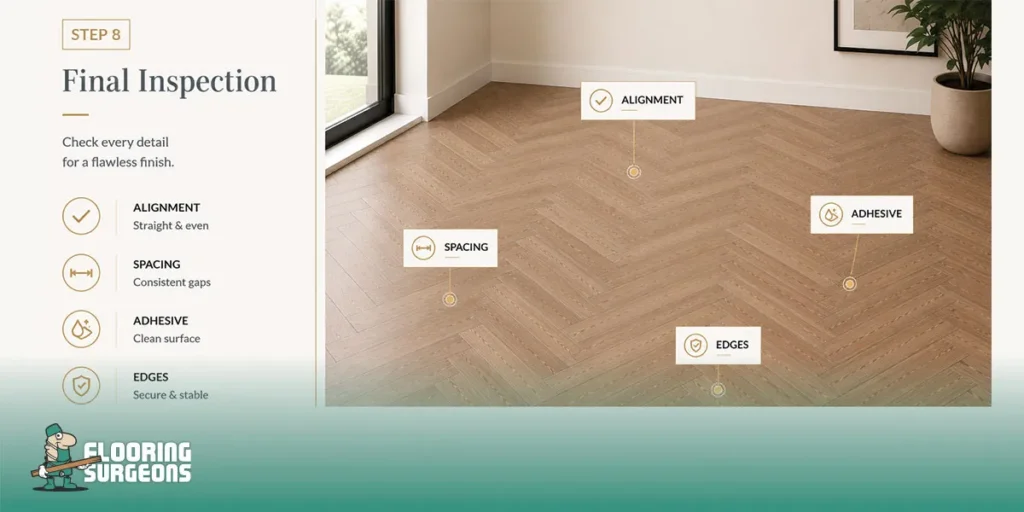
Step 8: Inspect the Herringbone Installation
Inspect the entire floor carefully before the adhesive fully cures.
✔ Check for alignment problems
✔ Inspect for open joints
✔ Remove excess adhesive residue
✔ Check for loose edges
✔ Verify spacing consistency across the pattern
Correcting issues immediately helps preserve the symmetry and overall appearance of the herringbone layout.
Curing Time After Glue-Down Vinyl Installation
Adhesive curing time is critical after installation. Avoid heavy traffic before the adhesive fully cures.
✔ Maintain stable room temperature
✔ Avoid excessive humidity changes
✔ Prevent heavy traffic during curing
✔ Follow adhesive manufacturer guidelines
Stable room conditions help improve long-term adhesive performance and bond strength.
Recommended Waiting Times
| Action | Recommended Waiting Time |
| Light foot traffic | 24 hours |
| Heavy furniture | 48–72 hours |
| Wet cleaning | 72 hours |
Always follow the adhesive manufacturer’s curing recommendations.
Finishing the Glue-Down Vinyl Installation
Correct finishing protects the floor edges and improves the overall appearance of the installation.
Installing Scotia and Skirting
Scotia or skirting boards help conceal perimeter edges and create a cleaner finish.
✔ Cover perimeter expansion gaps
✔ Improve edge appearance
✔ Protect wall edges from damage
✔ Create a more professional finish
Proper finishing trims help complete the overall flooring installation.
Installing Transition Strips
Transition strips help create smooth transitions between adjoining floor areas.
✔ Connect different flooring finishes
✔ Improve doorway transitions
✔ Protect exposed flooring edges
✔ Create a cleaner overall finish
Transition strips improve both floor protection and visual continuity between spaces.
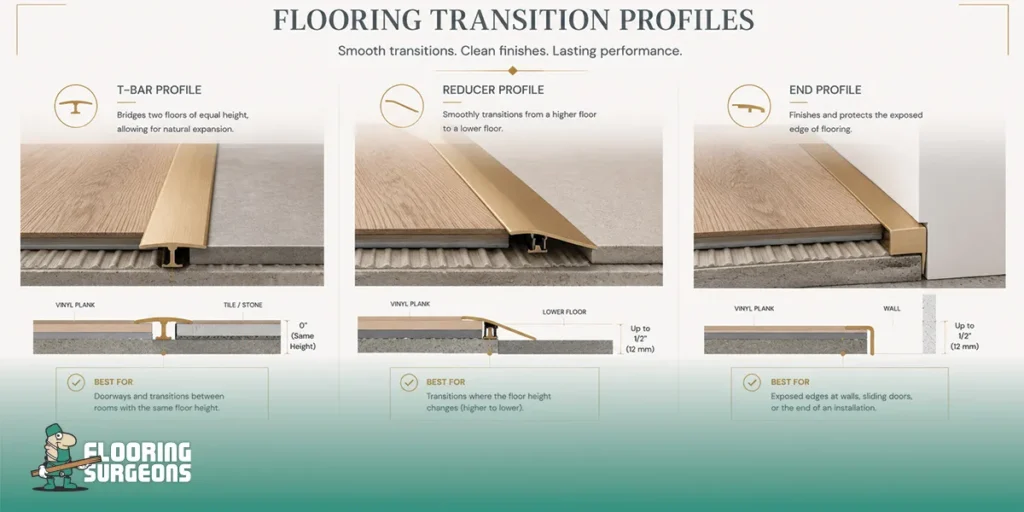
Common Transition Profiles
Different transition profiles are used depending on the flooring layout and height difference between surfaces.
| Profile Type | Purpose |
|---|---|
| T-bar | Connects floors with equal height |
| Reducer | Connects floors with different heights |
| End profile | Finishes exposed floor edges |
Choosing the correct transition profile helps improve floor protection and visual consistency.
Cleaning After Installation
Clean the floor carefully after installation to remove debris and adhesive residue.
✔ Vacuum the floor carefully
✔ Remove installation debris
✔ Clean adhesive residue immediately
✔ Use vinyl-safe floor cleaners
Avoid using excessive moisture or aggressive cleaning products during early cleaning.
Avoid Using
✘ Excessive water
✘ Abrasive cleaning pads
✘ Harsh chemicals
✘ Steam cleaners
Improper cleaning methods may damage the flooring surface or weaken adhesive performance.
Post-Installation Aftercare
Protect the flooring carefully during the first few days after installation while the adhesive continues curing.
✔ Use felt pads beneath furniture legs
✔ Lift heavy appliances instead of dragging
✔ Reduce excessive traffic during curing
✔ Protect plank edges from impact damage
Careful aftercare helps preserve adhesive bonding and prevent early flooring damage.
Proper aftercare is an important part of successful glue down vinyl plank installation, as protecting the floor during adhesive curing helps improve long-term stability and reduce the risk of plank movement or edge lifting. Careful maintenance after glue down vinyl installation also helps preserve the floor finish and overall installation quality.
Common Glue-Down Vinyl Installation Mistakes
Most glue-down flooring failures are caused by preparation or adhesive-related mistakes.
Common Installation Problems
| Mistake | Result |
|---|---|
| Incorrect adhesive | Bond failure |
| No dry-back time | Plank movement |
| Poor subfloor preparation | Uneven finish |
| Excess moisture | Adhesive breakdown |
| Poor rolling | Weak adhesive transfer |
| Over-spread adhesive | Adhesive skinning |
| Poor herringbone alignment | Pattern drift |
Taking extra time during preparation helps improve long-term flooring durability and installation performance.
Glue-Down Vinyl Flooring Installation Cost
The total glue-down vinyl flooring installation cost depends on several installation factors and project requirements.
✔ Room size
✔ Layout complexity
✔ Subfloor condition
✔ Adhesive requirements
✔ Installation method
Straight plank installation is usually faster and more cost-effective, while herringbone layouts require greater fitting precision and additional labour.
The overall glue-down vinyl plank flooring installation cost can also increase if additional subfloor preparation, moisture control treatments or complex pattern layouts are required before installation begins.
Typical UK Labour Costs
| Installation Type | Approximate UK Cost |
|---|---|
| Straight plank glue-down installation | £20–£40 per m² |
| Herringbone glue-down installation | £40–£70 per m² |
| Subfloor levelling | Additional cost |
| Moisture treatment | Additional cost |
Prices may vary depending on installer experience, floor preparation requirements, room complexity, flooring type, and location.
The total glue-down vinyl flooring installation cost may also increase for complex room layouts, decorative patterns or projects requiring extensive subfloor repairs and moisture preparation before fitting begins.
DIY vs Professional Glue-Down Vinyl Installation
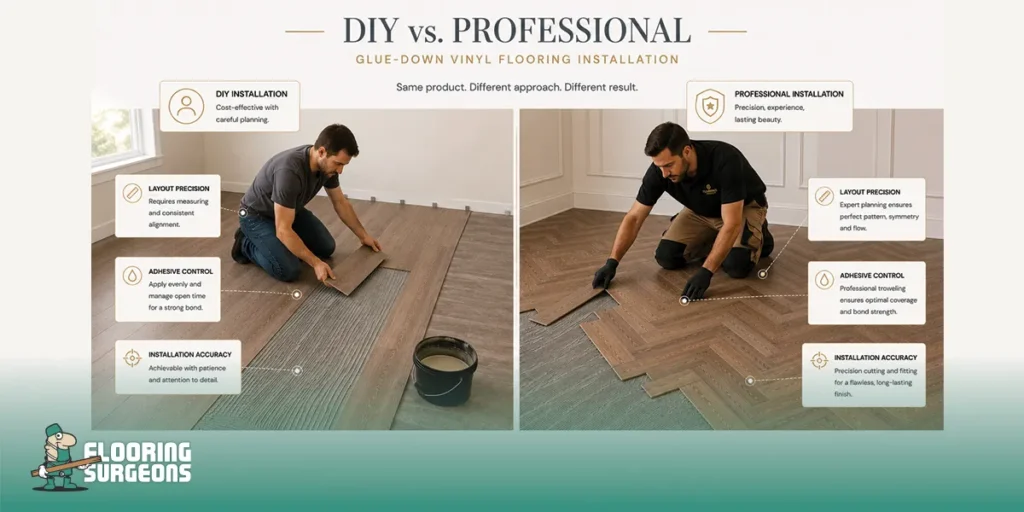
Straight plank glue-down installation may suit experienced DIY users with proper preparation and tools. More complex layouts often require professional installation expertise.
✔ Straight plank layouts are easier to install
✔ Herringbone layouts require advanced accuracy
✔ Adhesive control is critical during fitting
✔ Professional installation improves long-term reliability
Many homeowners prefer professional installation for large areas or decorative layouts to achieve cleaner and more consistent results.
Following professional glue-down vinyl plank flooring installation instructions can help reduce the risk of adhesive failure, uneven plank alignment and long-term flooring movement, especially in larger or more complex installation projects.
Final Thoughts
Glue-down vinyl flooring provides excellent long-term stability, strong subfloor bonding, and a premium finished appearance when installed correctly.
✔ Proper subfloor preparation is essential
✔ Moisture control improves long-term performance
✔ Correct adhesive selection supports stronger bonding
✔ Accurate layout planning improves final appearance
✔ Professional installation helps reduce fitting problems
Straight plank layouts provide a faster and simpler installation method, while herringbone layouts create a more decorative finish that requires greater installation precision.
Following correct installation methods helps achieve a durable, stable, and professional-quality floor for many years. For complex layouts or large-scale projects, professional installers such as Flooring Surgeons can help ensure higher installation accuracy, improved durability, and a cleaner final finish.

Mina Asgari
I’m an SEO Specialist and Content Strategist focused on sustainable business growth. I design data-driven content strategies by deeply analyzing user intent, search behavior, and SEO best practices, ensuring every piece of content serves a clear purpose for both users and search engines.