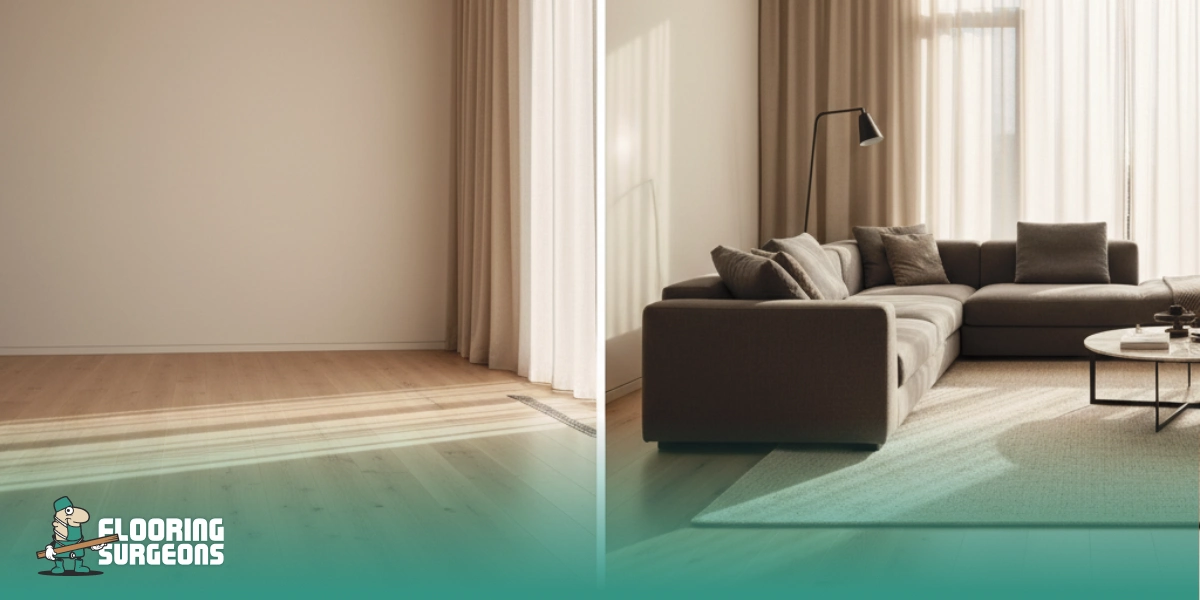
Walking into an empty house usually produces a hollow echoing noise as you take each step. When you are in an empty room, sound reflects off the hard walls and floors. Sound reflection causes sound waves to bounce around when there are few objects to absorb them. After you put furniture in the room, the sound will not echo as much.
But there’s more to consider than just furniture placement. Hard surface flooring itself, as well as what’s underneath, also impacts how sound moves through your home. We’ll cover the acoustics behind sound absorption, the science of why some floors feel “louder” than others, and what you can do to ensure a calm, quiet room before the first sofa is even brought in.
Table of contents
The Science of Sound Absorption and Reflection in Empty Spaces
Sound waves are created when you speak or drop your keys. As these waves travel through the air, they eventually reach a boundary. An empty room is full of flat, hard boundaries. The sound absorption and reflection characteristics are such that most of the energy is reflected back into the room.
Imagine throwing a rubber ball at a concrete wall versus a stack of pillows. Couches, curtains, and carpets are like those pillows; they absorb sound energy. Without anything to absorb the sound, it bounces back and forth between the floor and walls many times. This is what we hear as an “echo” or a hollow sound.
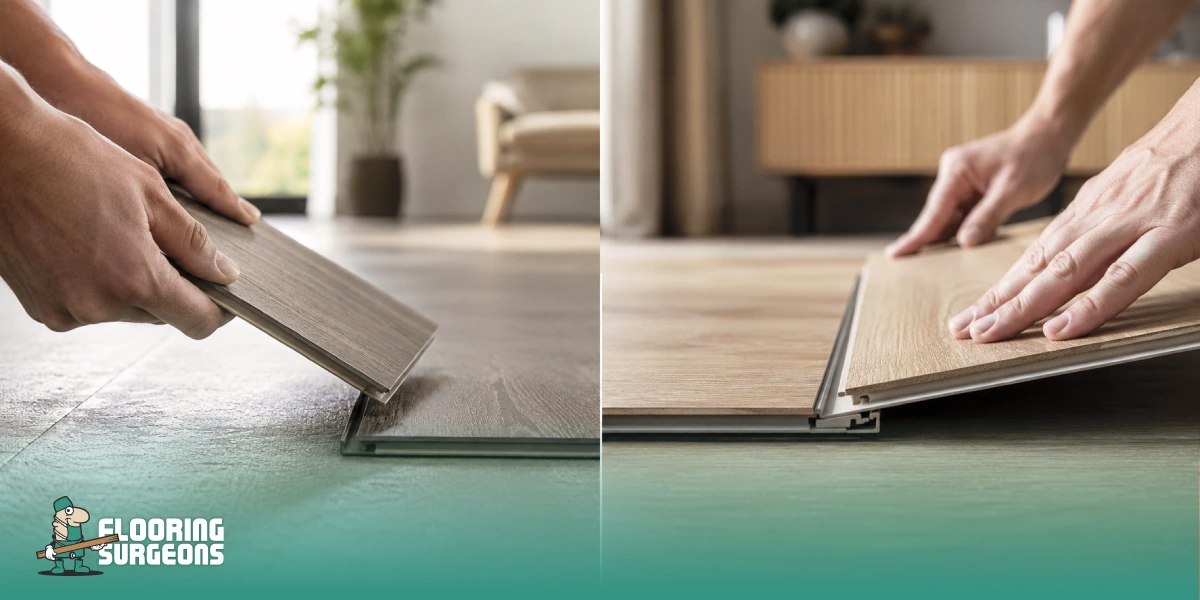
This reflection is affected by the density of your flooring material. Engineered flooring, as you would find in most modern architecture, is highly recommended due to its layered construction. Not only does it provide greater dimensional stability, but it also helps dampen vibrations. Instead of getting that hollow sound, a thicker floor with a solid core helps minimise the “drum effect” between your subfloor and finish.
Impact Noise vs Airborne Noise: Why Your Floor Rings?
The first step in fixing noise problems is to realise that sounds come from different sources. Flooring specialists recognise two categories of sound:
- Airborne Noise: Music, voices, and other sounds that travel through the air.
- Impact Noise: Physical contact with the floor, including footsteps, dragging furniture, and pets’ claws.
Impact noise vs airborne noise will sound amplified in an empty room. Furniture helps to “break up” sound waves. So if there is nothing in the room, impact sounds can reverberate through your entire floor. This is very common in spacious, open-plan living spaces.
One way to avoid this is by considering the thickness of the flooring material. People often choose 12mm Laminate Flooring as the extra thickness makes it feel more solid when walked on and helps cut down on that hollow sound you get from 8mm floors. The thicker and denser the plank is, the less it will resonate and the quieter your house will be before you even add rugs!
Quick Comparison: Why Furniture Matters
To help you visualise the difference, here is how a room’s acoustic profile changes once it’s furnished:
| Feature | Empty Room (Reflective) | Furnished Room (Absorptive) |
| Primary Sound Behavior | High Reflection (Echo) | High Absorption & Diffusion |
| Reverberation Time | Long (Sound lingers) | Short (Sound dies quickly) |
| Noise Type Impact | High Airborne & Impact Noise | Muffled and Contained |
| Best Flooring Fix | Dense flooring + Heavy Underlay | Standard flooring with Rugs |
Why Certain Hard Surface Flooring Types Create More Echo?
Contrary to popular belief, not all hard floors sound alike. The surface material and installation can drastically change the reverberation (how long it takes for sound to dissipate). For instance, a glued-down floor will usually sound quieter than one that is “floated” because there is no void for sound to resonate in.
But you can install the highest-quality hard-surface flooring, and it will still squeak loudly throughout an empty room without proper support underneath. Flooring and subflooring go hand in hand. If you are experiencing clicking/hollow sounds, your floor may not be compatible with your padding. Knowing your specifications is important; click on Different Types of Underlay to learn which best suits your needs.
Managing Acoustics with Acoustic Underlayment and Layout
When dealing with sound control in a large, open-concept space, a two-pronged approach is needed: high-quality materials and strategic room division. The best “invisible” solution for reducing sound is by adding an acoustic underlayment. These purpose-made membranes absorb vibrations before they reach the structural subfloor, eliminating echoes.
Now that we have the tech aspects covered, we move on to the “Furnished” side of the equation. Things like rugs, bookshelves, and even textured wall art serve as natural diffusers. In high-traffic areas where you need durability and absorption, opt for a high-spec laminate flooring in the living room, paired with heavy curtains to absorb that “cavernous” sound. Think of creating as many “obstacles” for the sound waves to travel through, starting from the underlayment up to your furnishings.
The Secret to a Peaceful Home Atmosphere
Bottom line, why floors sound different in unfurnished rooms vs furnished rooms is physics and materials. Furniture can finish the sound of a room’s acoustics, but an acoustically quiet home starts well before furniture shopping. It starts with choosing the right density, thickness, and installation to ensure your floor feels sturdy and tranquil.
Flooring Surgeons have experience installing flooring in renovations that look amazing, but have not-so-great sound quality. We understand how frustrating this can be when undertaking a large, empty renovation or when wanting to improve what you already have. That’s why we’re here to make sure your floors look and sound high-quality.

Ana.Soltanpoor
I’m an SEO Specialist with a strong background in content management and organic search. I build data-driven content strategies by aligning user intent, search behavior, and SEO best practices to ensure every piece of content delivers clarity, relevance, and measurable organic performance.