


- Width 90mm
- Thickness 15mm
- Length 510mm
4.3
Natural Oak 90mm Solid Chevron
- Scratch resistant
- Splash resistant
Price
£54.99per m²

*Mainland England, floors and accessories.

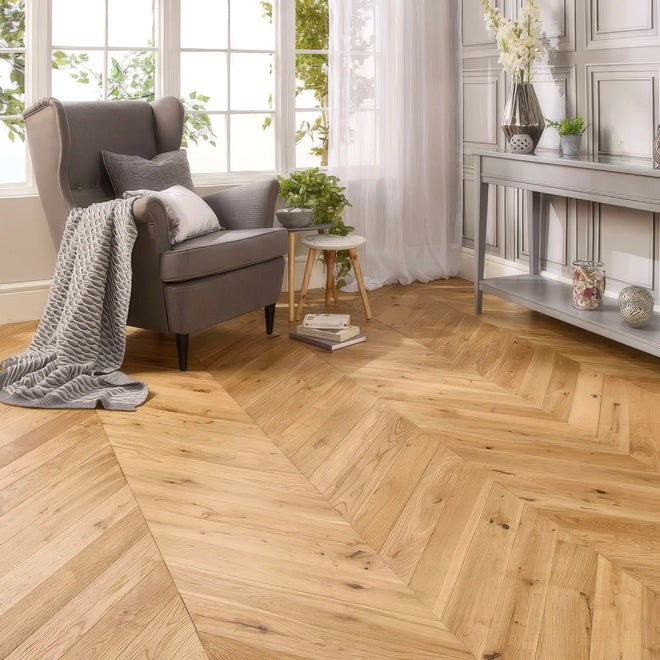
Discover solid wood flooring crafted from real timber, with the natural grain, character and individual variation that make every floor distinctive. Explore solid oak flooring in classic plank, herringbone, chevron and parquet styles, with a choice of tones and finishes for both traditional and contemporary interiors. Compare board size, thickness, finish, grade, price and pack coverage to find the right floor for your space. Each product page includes current stock, room suitability and installation requirements to help you make an informed choice. Order up to three free solid wood flooring samples from eligible products to appreciate the colour, grain and finish at home, use our Flooring Calculator to estimate your quantity, or speak to our flooring team for expert advice before ordering.
17 products found
Sort By
Sort products by price, relevancy and more.
Solid wood flooring is made from one piece of timber throughout the board. Engineered wood has a real-wood surface supported by multiple structural layers. Both provide a genuine wood floor, but engineered flooring is generally more dimensionally stable when temperature and humidity change. Solid wood offers traditional construction and greater long-term refinishing potential.
The solid wood flooring we supply is not suitable for use with underfloor heating. If your room has underfloor heating, we recommend choosing a compatible engineered wood flooring product instead and checking the individual manufacturer’s temperature and installation requirements.
Yes. Solid wood flooring can be fully bonded to a suitable concrete or screed subfloor, commonly using a flexible MS/SMP polymer wood-floor adhesive designed to accommodate the natural movement of solid timber. Please note, the subfloor must be sound, flat, clean and sufficiently dry, with moisture levels tested before installation. Where excess residual moisture is present, a compatible liquid DPM or moisture-control system may be required as part of the preparation before bonding.
Yes. Solid wood flooring can be used in kitchens where the product and site conditions are suitable. However, solid timber naturally expands and contracts as moisture and humidity change, making it less forgiving of frequent spillages and fluctuating conditions than engineered wood. Spills should be cleaned promptly and excessive moisture avoided.
Not usually in the same way as a floating laminate or click floor. Solid wood flooring is generally fixed to the subfloor using an appropriate adhesive or mechanical fixing system. The correct method depends on the board and subfloor construction, so do not add underlay unless the specified installation system requires it.
As a general UK guideline, allow at least 5-7 days for solid wood flooring to acclimatise in the room where it will be installed, under normal living conditions.Keep the packs flat, unopened and away from direct heat or moisture, with the room already dry, heated and close to its normal temperature and humidity.
Acclimatisation time can vary by manufacturer and site conditions, so always follow the product-specific guidance.
Solid wood boards are commonly around 15–20mm thick, although specifications vary by product and installation system. Our solid wood flooring ranges from approximately 15 – 18mm, making it suitable for fully supported subfloors where the individual product and fixing method are appropriate.
Thickness affects finished floor height, thresholds, installation method and future refinishing potential, but thicker does not automatically mean better quality. Always consider the board construction, tongue-and-groove depth and intended installation method alongside the overall thickness.
Neither is better overall; they offer different benefits.
Oiled flooring has a more natural, tactile finish and is easier to maintain or repair locally, but it normally needs periodic re-oiling.
Lacquered flooring has a sealed surface, needs less regular maintenance and is easy to clean, but scratches or worn areas can be harder to repair invisibly.
Choose oiled for a more natural look and easier local maintenance, or lacquered for a more sealed, lower-maintenance finish.
Yes. One of the main long-term advantages of solid wood flooring is that it can usually be sanded and refinished multiple times.
The actual number is not unlimited and depends on the board thickness, tongue-and-groove position, previous sanding and overall condition of the floor. Excessive sanding can eventually compromise the board.
Measure the total floor area, then add an allowance for cuts, board selection and wastage.
As a practical guide:
Natural timber grading can also influence usable board selection. Use our Flooring Calculator as a starting estimate and have your fitter confirm complicated layouts before ordering.
Wood grade describes the appearance and natural character of the timber; not its overall quality or strength.
Typical grading ranges from:
Filled knots, small splits and natural markings can be normal within characterful grades. Grading terminology varies between manufacturers, so compare the actual product specification, imagery and sample rather than choosing purely by the grade name.
Start with where the floor will be used, then consider wood tone, board layout and thickness. The table helps you quickly identify the most relevant collection, then check the finish, dimensions, grade, pack coverage and fitting requirements on the product page.
| Category | Best suited to | Key point |
|---|---|---|
| Oak solid wood flooring | Natural, versatile real-wood interiors | Check grade, tone, plank dimensions and finish |
| Light solid wood flooring | Bright rooms and softer colour schemes | Sample in the room to judge undertone and natural variation |
| Dark solid wood flooring | Richer, more dramatic interiors | Check how the tone works with light levels and furniture |
| Straight plank solid wood flooring | Classic layouts and flexible room schemes | Board width changes the scale and rhythm of the finished floor |
| Herringbone solid wood flooring | Pattern-led rooms and traditional detailing | Plan the layout, subfloor and installation approach before purchasing |
| 18mm solid wood flooring | Projects requiring a substantial solid timber board | Confirm installed height, fixing method and product specification |
Suitability depends on the room conditions and the individual product specification. For commercial properties, choose only products whose specification and warranty approve the expected traffic and intended use. Use this quick guide to identify what to check before choosing.
| Room or project | What to check | Recommended action |
|---|---|---|
| Living rooms, bedrooms and hallways | Traffic level, finish and care requirements | Choose a suitable product and request a sample for the room |
| Kitchens and conservatories | Moisture, temperature changes and manufacturer approval | Use only a product whose room guidance matches the conditions |
| Underfloor heating | Product compatibility, temperature limits and installation method | Follow the manufacturer guidance or ask the expert team |
If you already know you want oak, browse solid oak flooring and request a sample to check the undertone in the intended space. For a more textured finish, consider brushed and oiled boards; choose unfinished boards when you want the surface treatment completed after installation.
Need help deciding between solid and layered construction? Ask the Flooring Surgeons team to review your room, subfloor and installation plans before you buy.
Shop solid wood flooring online and compare board size, thickness, grade, finish, pack coverage, price and current stock before ordering. Use our Flooring Calculator to estimate the quantity required, and speak to our flooring team if you need help with room suitability, subfloor preparation or installation requirements.
Flooring Surgeons delivers solid wood flooring across mainland England, Wales and selected areas of Scotland. Qualifying orders over £500 receive free delivery to mainland England, with delivery dates chosen in your basket and any postcode-specific charges confirmed at checkout. See ourdelivery information for full details.
Pay securely by debit or credit card through Shopify Payments, PayPal or Klarna. Eligible customers may also be able to spread the cost using PayPal Pay in 3 or Klarna flexible payment options, subject to eligibility and provider terms.
Professional solid wood flooring installation is available for selected projects within approximately a 15-mile radius of Birmingham, covering much of the West Midlands, subject to availability.
Our fitting team can assess subfloor preparation, moisture conditions, acclimatisation and the correct fixing method before installation, all important considerations with solid timber flooring.
Learn more about ourprofessional flooring fitting service or contact us before ordering to discuss your project.
Solid wood flooring is made from real timber throughout each board, giving every floor natural variation in grain, tone and character. Specifications vary by product, so compare the details that will affect both appearance and installation.
Before buying, check:
For a more textured, natural finish, explore ourbrushed and oiled solid wood flooring.
Solid timber is less forgiving of changes in moisture and humidity than engineered wood, so correct preparation, acclimatisation and installation are particularly important.
Our solid wood flooring prices are shown per m², with flooring supplied in complete packs. As a guide, our current solid wood collection typically ranges from around £45 – £60 per m², depending on timber, grade, board dimensions, finish and design.
Use our Flooring Calculator to estimate how much you need, allowing extra for cuts and wastage. Straight-plank installations generally require a smaller waste allowance, while herringbone, chevron and complex room layouts typically require around 10–15% extra.
When comparing solid wood flooring prices, consider the complete project cost as well as the price per m², including pack coverage, subfloor preparation, fixing materials, fitting and ongoing care.
Current prices, offers, stock availability and pack coverage are shown on each product page.
Solid wood is best judged in the room where it will live. Order up to three complimentary solid wood flooring samples from eligible products and take time to see how the timber works with your light, furniture, joinery and surrounding finishes.
Look at each sample throughout the day. Natural timber can appear warmer, softer or more pronounced as the light changes, while the grain, texture and finish reveal much more in person than they ever can on a screen.
Your sample should be treated as a reference to the character of the floor, not an exact replica of every board. Subtle variation in tone, grain and markings is part of what makes a genuine solid wood floor individual.
Before you order


